
[Paper Review] threaTrace: Detecting and Tracing Host-based Threats in Node Level Through Provenance Graph Learning
threaTrace is a real-time, node-level host intrusion detection system that uses a GraphSAGE-based multi-model framework to learn benign entity roles in data provenance graphs, enabling high-accuracy detection and localization of stealthy, persistent threats like APTs and malware implants without prior attack pattern knowledge. It outperforms state-of-the-art systems on three public datasets while maintaining low system overhead.
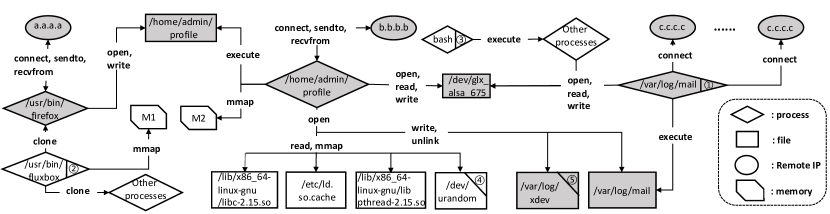
Host-based threats such as Program Attack, Malware Implantation, and Advanced Persistent Threats (APT), are commonly adopted by modern attackers. Recent studies propose leveraging the rich contextual information in data provenance to detect threats in a host. Data provenance is a directed acyclic graph constructed from system audit data. Nodes in a provenance graph represent system entities (e.g., $processes$ and $files$) and edges represent system calls in the direction of information flow. However, previous studies, which extract features of the whole provenance graph, are not sensitive to the small number of threat-related entities and thus result in low performance when hunting stealthy threats. We present threaTrace, an anomaly-based detector that detects host-based threats at system entity level without prior knowledge of attack patterns. We tailor GraphSAGE, an inductive graph neural network, to learn every benign entity's role in a provenance graph. threaTrace is a real-time system, which is scalable of monitoring a long-term running host and capable of detecting host-based intrusion in their early phase. We evaluate threaTrace on three public datasets. The results show that threaTrace outperforms three state-of-the-art host intrusion detection systems.
Motivation & Objective
- To address the challenge of detecting stealthy, persistent host-based threats such as APTs and malware implants that evade traditional graph-level anomaly detection.
- To enable node-level detection and precise tracing of anomalous entities in data provenance graphs without requiring prior knowledge of attack patterns.
- To overcome data imbalance and improve detection performance in real-world systems with diverse benign behaviors.
- To design a scalable, real-time system with acceptable computational and memory overhead for long-term deployment on production hosts.
- To provide a complete, open-source detection and tracing framework for practical deployment in enterprise and government environments.
Proposed method
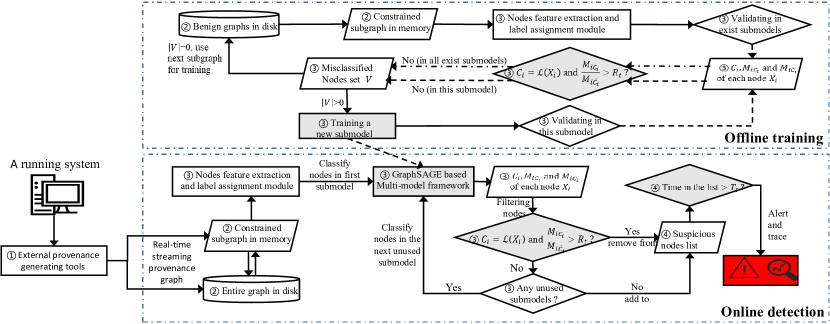
- Tailors GraphSAGE, an inductive graph neural network, to learn structural and contextual roles of individual benign nodes in provenance graphs based on neighborhood information.
- Employs a multi-model framework that trains separate submodels for different types of benign nodes (e.g., processes, files) to address data imbalance and improve detection sensitivity.
- Uses a probability-based scoring mechanism to identify nodes deviating from learned benign roles, flagging them as potential threats.
- Processes provenance graphs incrementally in real time, enabling early detection of intrusion activities during long-running host sessions.
- Supports incremental model updates using new benign provenance data without full retraining, ensuring adaptability to evolving system workloads.
- Integrates a whitelist mechanism to reduce false positives, allowing administrators to manually validate and suppress benign false alarms.
Experimental results
Research questions
- RQ1Can a node-level anomaly detection approach in provenance graphs outperform existing graph-level or path-level detection methods for stealthy threats?
- RQ2How can a graph neural network be adapted to detect subtle, low-probability anomalies in large-scale provenance graphs without prior attack signatures?
- RQ3Can a multi-model framework effectively handle data imbalance and improve detection performance across diverse benign system behaviors?
- RQ4To what extent can the system maintain real-time performance and low resource overhead in long-term monitoring of production hosts?
- RQ5Can the system accurately trace and localize anomalous nodes, enabling actionable insights for incident response?
Key findings
- threaTrace outperforms three state-of-the-art APT detection systems on three public datasets, demonstrating superior detection accuracy for stealthy, low-profile threats.
- The system achieves high processing speed and acceptable system resource overhead, enabling real-time deployment on long-running hosts.
- The multi-model framework significantly improves detection performance by learning distinct roles of different benign node types, especially in imbalanced data scenarios.
- threaTrace successfully detects and traces anomalous nodes, including those involved in APT campaigns and malware implantation, by identifying deviations from learned benign behavior patterns.
- The integration of a whitelist mechanism reduces false positives, particularly in graphs with high node counts, and supports incremental model updates for long-term adaptability.
- Evaluation shows that threaTrace can detect threats in their early phase, even when they involve only a small number of anomalous nodes within a large provenance graph.
Read this paper
Open the full text in the Nubint reader and ask about any passage as you read.
Read this paper on NubintThis review was generated by AI from the original paper. Please check the paper before citing it.