
[Paper Review] TIFA: Accurate and Interpretable Text-to-Image Faithfulness Evaluation with Question Answering
TIFA introduces a reference-free, interpretable metric for evaluating text-to-image faithfulness by generating question-answer pairs from text inputs and assessing whether visual question-answering (VQA) models can correctly answer them using generated images. It achieves higher correlation with human judgments (Spearman’s ρ = 0.60) than CLIPScore (0.33) and captioning-based metrics (0.34), revealing persistent failures in counting, spatial reasoning, and multi-object composition despite progress in color and material generation.
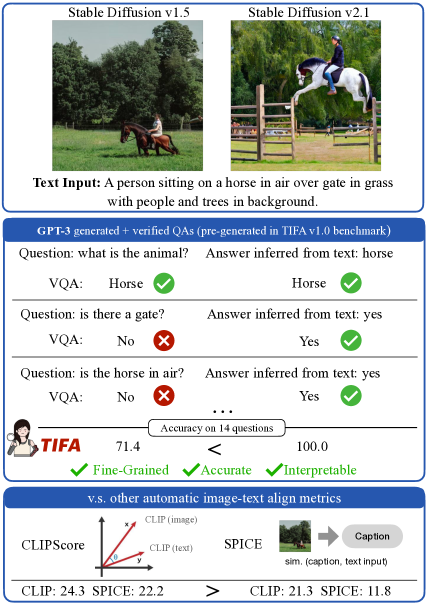
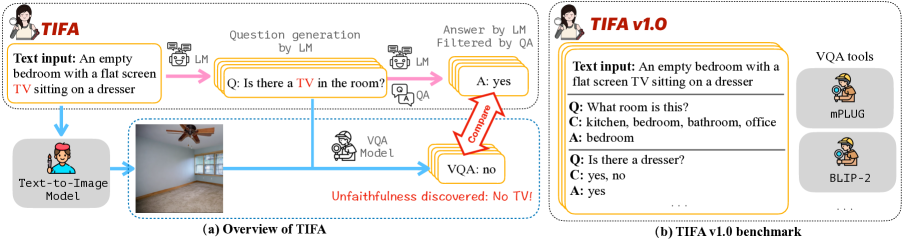
Despite thousands of researchers, engineers, and artists actively working on improving text-to-image generation models, systems often fail to produce images that accurately align with the text inputs. We introduce TIFA (Text-to-Image Faithfulness evaluation with question Answering), an automatic evaluation metric that measures the faithfulness of a generated image to its text input via visual question answering (VQA). Specifically, given a text input, we automatically generate several question-answer pairs using a language model. We calculate image faithfulness by checking whether existing VQA models can answer these questions using the generated image. TIFA is a reference-free metric that allows for fine-grained and interpretable evaluations of generated images. TIFA also has better correlations with human judgments than existing metrics. Based on this approach, we introduce TIFA v1.0, a benchmark consisting of 4K diverse text inputs and 25K questions across 12 categories (object, counting, etc.). We present a comprehensive evaluation of existing text-to-image models using TIFA v1.0 and highlight the limitations and challenges of current models. For instance, we find that current text-to-image models, despite doing well on color and material, still struggle in counting, spatial relations, and composing multiple objects. We hope our benchmark will help carefully measure the research progress in text-to-image synthesis and provide valuable insights for further research.
Motivation & Objective
- To address the lack of accurate, interpretable, and fine-grained automatic evaluation metrics for text-to-image generation faithfulness.
- To overcome limitations of existing metrics like CLIPScore and captioning-based approaches, which fail to capture compositional reasoning, counting, and attribute binding.
- To develop a benchmark that enables systematic evaluation of model failures across diverse attributes such as objects, spatial relations, and materials.
- To provide a modular, extensible framework that integrates evolving language and vision models for future scalability.
Proposed method
- Use a large language model (GPT-3) to automatically generate diverse question-answer pairs from text inputs, decomposing complex prompts into fine-grained probes.
- Filter generated QA pairs using a question-answering model (UnifiedQA) to ensure question-answer coherence and quality.
- Evaluate image faithfulness by running a VQA model (e.g., mPLUG-large) on the generated image to answer the questions, measuring correctness as the faithfulness score.
- Select mPLUG as the default VQA model due to its high accuracy (85.2%) and reasonable inference speed (0.25s per question).
- Separate image generation errors from VQA model errors using human-verified VQA annotations, confirming that most failures stem from image generation, not VQA.
- Design TIFA v1.0 as a benchmark with 4,000 diverse text inputs and 25,000 questions across 12 categories, including object, counting, spatial relations, and materials.
Experimental results
Research questions
- RQ1How does TIFA’s faithfulness score correlate with human judgments compared to existing metrics like CLIPScore and captioning-based approaches?
- RQ2In which visual attributes—such as counting, spatial relations, or multi-object composition—do current text-to-image models most frequently fail?
- RQ3To what extent are errors in TIFA evaluations due to image generation versus VQA model limitations?
- RQ4How does the choice of VQA model affect the reliability and performance of TIFA scores?
- RQ5Can TIFA detect subtle failures in attribute binding and compositional reasoning that CLIPScore and captioning metrics miss?
Key findings
- TIFA achieves a Spearman’s correlation of 0.60 with human judgments, significantly outperforming CLIPScore (0.33) and captioning-based metrics (0.34).
- Stable Diffusion v2.1 scored higher on TIFA than v1.5, contradicting CLIPScore and SPICE results, indicating TIFA detects model differences more accurately.
- Current models struggle most with counting (e.g., incorrect object counts), spatial relations (e.g., incorrect relative positions), and multi-object composition.
- Less than 25% of TIFA errors were attributed to VQA models, confirming that the majority of failures stem from image generation, not VQA limitations.
- mPLUG-large was selected as the default VQA model due to its high accuracy (85.2%) and acceptable inference speed (0.25s per question), balancing performance and efficiency.
- The TIFA v1.0 benchmark contains 4,000 diverse text inputs and 25,000 questions across 12 categories, enabling fine-grained analysis of model behavior.
Read this paper
Open the full text in the Nubint reader and ask about any passage as you read.
Read this paper on NubintThis review was generated by AI from the original paper. Please check the paper before citing it.