
[Paper Review] Time Series Alignment with Global Invariances
This paper proposes DTW-GI, a novel similarity measure that jointly optimizes temporal alignment via Dynamic Time Warping (DTW) and feature space transformations to handle both temporal and feature-level invariances in multivariate time series. It introduces a differentiable loss and barycenter computation under the new geometry, achieving state-of-the-art performance on cover song identification and human motion prediction by enabling joint optimization over time warping and rigid transformations in the feature space.
Multivariate time series are ubiquitous objects in signal processing. Measuring a distance or similarity between two such objects is of prime interest in a variety of applications, including machine learning, but can be very difficult as soon as the temporal dynamics and the representation of the time series, {\em i.e.} the nature of the observed quantities, differ from one another. In this work, we propose a novel distance accounting both feature space and temporal variabilities by learning a latent global transformation of the feature space together with a temporal alignment, cast as a joint optimization problem. The versatility of our framework allows for several variants depending on the invariance class at stake. Among other contributions, we define a differentiable loss for time series and present two algorithms for the computation of time series barycenters under this new geometry. We illustrate the interest of our approach on both simulated and real world data and show the robustness of our approach compared to state-of-the-art methods.
Motivation & Objective
- To address the challenge of comparing multivariate time series that differ in temporal dynamics and feature space representations due to global invariances such as time warping and sensor permutations.
- To develop a unified similarity measure that jointly optimizes temporal alignment and feature space transformation, improving robustness to distribution shifts in time series data.
- To enable the computation of barycenters for heterogeneous time series under the new geometric framework, supporting downstream applications like clustering and forecasting.
- To demonstrate the method's versatility by incorporating prior knowledge about transformation classes, such as key transpositions in music, through constrained optimization.
Proposed method
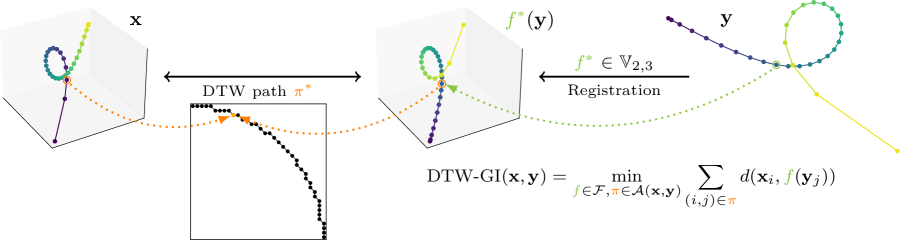
- The method formulates time series alignment as a joint optimization problem over temporal alignment (via DTW or softDTW) and a global transformation in the feature space, such as rotations in the Stiefel manifold.
- It introduces a differentiable loss function that enables end-to-end optimization of both alignment and transformation parameters using gradient-based methods.
- The framework supports various invariance classes, including orthogonal transformations (e.g., rotations, permutations), and allows for constrained optimization via prior knowledge on the transformation family.
- It proposes two algorithms for computing time series barycenters under the DTW-GI geometry, enabling clustering and representation learning for heterogeneous time series.
- The approach is flexible enough to handle discrete transformation sets (e.g., 12 semitone transpositions in music) by exhaustively evaluating all candidates and selecting the optimal one.
- It extends existing methods like CTW and GromovDTW by learning the transformation map explicitly, enabling reuse in downstream tasks and better integration with deep learning pipelines.
Experimental results
Research questions
- RQ1Can a unified framework jointly optimize temporal alignment and feature space transformation to improve time series similarity measurement under global invariances?
- RQ2How does the proposed joint optimization of time warping and feature transformation compare to state-of-the-art methods in handling real-world time series with heterogeneous representations?
- RQ3To what extent can prior knowledge about transformation classes (e.g., key transpositions in music) be integrated into the alignment process to improve performance?
- RQ4Can the proposed geometry support the computation of meaningful barycenters for heterogeneous time series, enabling clustering and representation learning?
- RQ5How does the differentiable formulation of DTW-GI enable integration into deep learning models for tasks such as representation learning or imitation learning?
Key findings
- DTW-GI achieves an MR1 of 29.0 ± 1.0 on the cover song identification task when using feature space optimization on the Stiefel manifold, outperforming baselines that do not jointly optimize alignment and transformation.
- By incorporating prior knowledge of 12 possible key transpositions, DTW-GI achieves significant performance gains over baselines that compute transposition on averaged features, demonstrating the benefit of joint optimization.
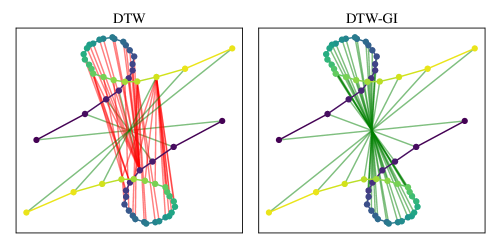
- The method outperforms CTW and other state-of-the-art approaches on both simulated data and real-world datasets, showing robustness to rotations and temporal shifts in feature space.
- The proposed barycenter computation under the DTW-GI geometry is, to the best of the authors' knowledge, the first formulation for heterogeneous time series, enabling new applications in clustering and representation learning.
- SoftDTW-GI enables differentiable alignment and transformation, suggesting its potential use as a loss or feature extractor in deep learning models, as demonstrated by its compatibility with triplet loss training in future work.
Read this paper
Open the full text in the Nubint reader and ask about any passage as you read.
Read this paper on NubintThis review was generated by AI from the original paper. Please check the paper before citing it.