
[Paper Review] To Trust or to Think: Cognitive Forcing Functions Can Reduce Overreliance on AI in AI-assisted Decision-making
Cognitive forcing functions (CFF) reduce overreliance on AI in AI-assisted decisions compared with simple explainable AI approaches, though they impose higher cognitive effort and benefit higher Need for Cognition individuals more.
People supported by AI-powered decision support tools frequently overrely on the AI: they accept an AI's suggestion even when that suggestion is wrong. Adding explanations to the AI decisions does not appear to reduce the overreliance and some studies suggest that it might even increase it. Informed by the dual-process theory of cognition, we posit that people rarely engage analytically with each individual AI recommendation and explanation, and instead develop general heuristics about whether and when to follow the AI suggestions. Building on prior research on medical decision-making, we designed three cognitive forcing interventions to compel people to engage more thoughtfully with the AI-generated explanations. We conducted an experiment (N=199), in which we compared our three cognitive forcing designs to two simple explainable AI approaches and to a no-AI baseline. The results demonstrate that cognitive forcing significantly reduced overreliance compared to the simple explainable AI approaches. However, there was a trade-off: people assigned the least favorable subjective ratings to the designs that reduced the overreliance the most. To audit our work for intervention-generated inequalities, we investigated whether our interventions benefited equally people with different levels of Need for Cognition (i.e., motivation to engage in effortful mental activities). Our results show that, on average, cognitive forcing interventions benefited participants higher in Need for Cognition more. Our research suggests that human cognitive motivation moderates the effectiveness of explainable AI solutions.
Motivation & Objective
- Motivate using dual-process theory to address AI overreliance in decision-making.
- Investigate whether cognitive forcing interventions can reduce reliance on AI explanations.
- Compare three cognitive forcing designs to simple explainable AI approaches and a no-AI baseline.
- Audit intervention effects for inequalities related to Need for Cognition (NFC).
- Identify trade-offs between effectiveness and user acceptability of forcing functions.
Proposed method
- Design and conduct an online experiment (N=199) comparing 3 cognitive forcing designs to 2 SXAI conditions and a no-AI baseline.
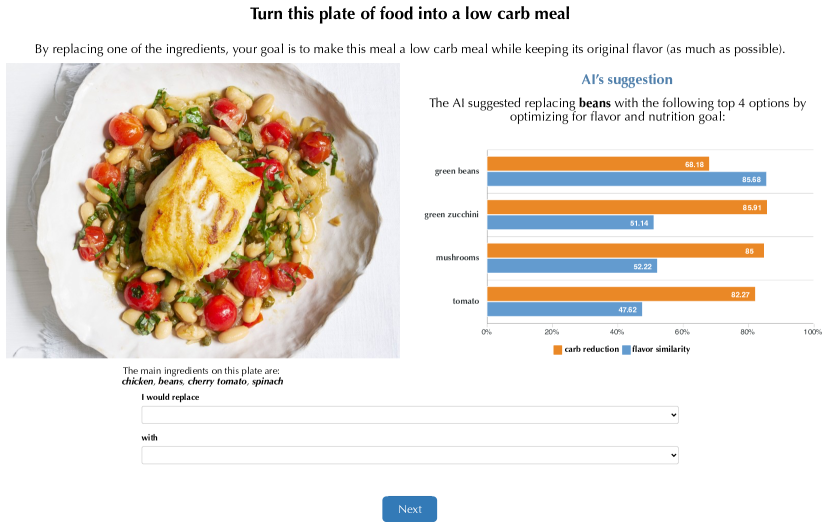
- Use a nutrition-based task where participants replace a high-carb ingredient with a low-carb substitute, guided by AI explanations.
- Implement a simulated AI with 75% recognition accuracy and four top replacements with feature-based explanations (carb reduction and flavor similarity).
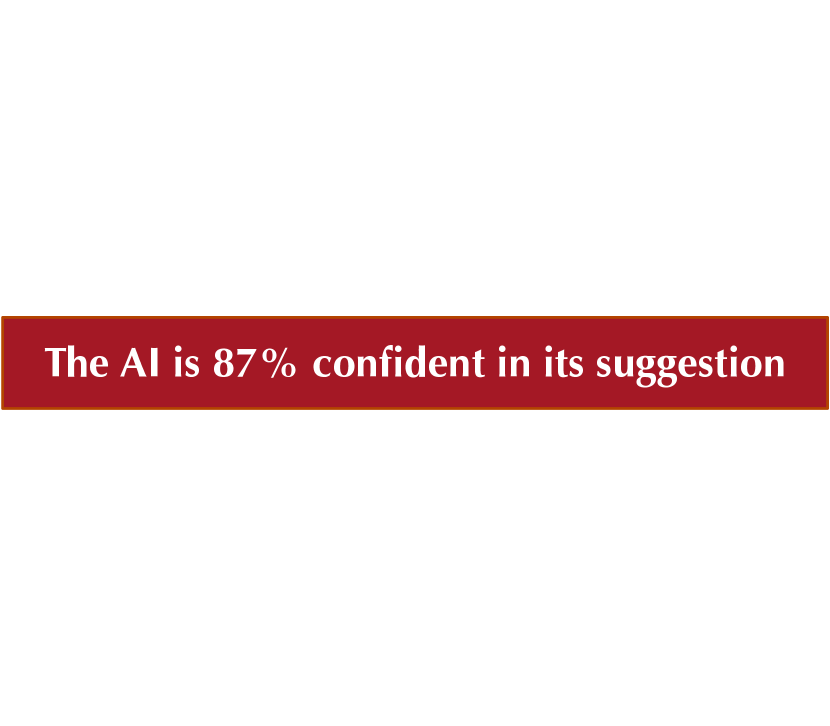
- Introduce six conditions: No AI, SXAI (Explanation, Uncertainty), and CFF (On demand, Update, Wait).
- Measure objective outcomes (overall performance, carb source detection, carb reduction, flavor similarity, overreliance, human error) and subjective measures (preference, trust, mental demand, system complexity).
- Analyze with mixed-effects models, Holm-Bonferroni post-hoc tests, and Pearson correlations for NFC moderation.
Experimental results
Research questions
- RQ1Does cognitive forcing reduce overreliance on the AI compared with SXAI approaches when AI predictions are incorrect?
- RQ2Do cognitive forcing interventions improve overall task performance and alignment with optimal nutrient substitutions?
- RQ3What trade-offs exist between intervention effectiveness and user acceptability?
- RQ4Do NFC levels moderate the benefits of cognitive forcing functions, potentially creating inequality in outcomes?
Key findings
- CFFs significantly reduced overreliance and improved objective performance on incorrect AI predictions compared with SXAI.
- Across all instances, SXAI and CFF improved performance over the no-AI baseline.
- When AI predictions were incorrect, CFFs yielded higher carb source detection, carb reduction, and flavor similarity, and more correct decisions than SXAI.
- There was a trade-off: users reported lower acceptability for CFFs, which demanded more cognitive effort.
- Auditing for intervention-generated inequalities showed higher NFC individuals benefited more from CFFs on average.
- Overall, human factors like cognitive motivation influence the effectiveness of explainable AI strategies.
Read this paper
Open the full text in the Nubint reader and ask about any passage as you read.
Read this paper on NubintThis review was generated by AI from the original paper. Please check the paper before citing it.