
[Paper Review] Topology-aware Federated Learning in Edge Computing: A Comprehensive Survey
This survey proposes topology-aware federated learning (FL) frameworks tailored for heterogeneous, dynamic edge computing networks, optimizing communication efficiency, privacy, and fault tolerance by leveraging star, tree, decentralized, and hybrid topologies. It demonstrates that topology-aware design significantly improves convergence speed, reduces communication overhead, and enhances model fairness and resilience in real-world edge deployments.
The ultra-low latency requirements of 5G/6G applications and privacy constraints call for distributed machine learning systems to be deployed at the edge. With its simple yet effective approach, federated learning (FL) is a natural solution for massive user-owned devices in edge computing with distributed and private training data. FL methods based on FedAvg typically follow a naive star topology, ignoring the heterogeneity and hierarchy of the volatile edge computing architectures and topologies in reality. Several other network topologies exist and can address the limitations and bottlenecks of the star topology. This motivates us to survey network topology-related FL solutions. In this paper, we conduct a comprehensive survey of the existing FL works focusing on network topologies. After a brief overview of FL and edge computing networks, we discuss various edge network topologies as well as their advantages and disadvantages. Lastly, we discuss the remaining challenges and future works for applying FL to topology-specific edge networks.
Motivation & Objective
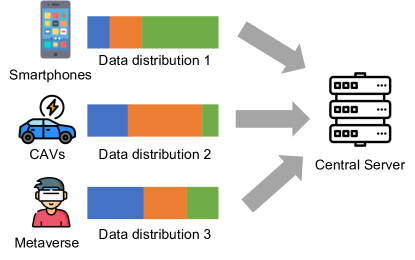
- Address the limitations of vanilla FedAvg in real-world edge networks, which ignore network heterogeneity and dynamic topologies.
- Investigate how different network topologies—star, tree, decentralized, hybrid—impact communication efficiency, model convergence, and system robustness in edge-based FL.
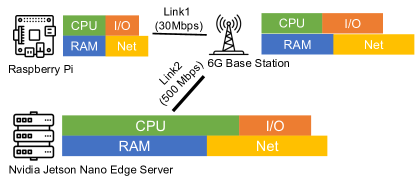
- Identify and address key challenges in edge FL, including device heterogeneity, unstable links, privacy leakage, and unfair model updates due to noisy devices.
- Propose topology-aware solutions to improve energy efficiency, model fairness, and availability in decentralized and hierarchical edge FL architectures.
- Provide a comprehensive taxonomy and analysis of existing FL frameworks and algorithms based on their underlying network topologies.
Proposed method
- Categorize edge network topologies into star, tree, decentralized (gossip/mesh), ring, clique, grid, and hybrid structures, analyzing their structural and performance trade-offs.
- Introduce topology control mechanisms that dynamically adapt communication patterns based on device availability, bandwidth, and energy constraints to reduce communication cost and improve reliability.
- Propose opportunistic routing and model aggregation strategies that incorporate cross-cluster model updates to mitigate bias from noisy or dominant edge devices.
- Integrate privacy-preserving techniques such as model mingling across changing neighbor sets to reduce vulnerability to differential privacy attacks.
- Design availability-aware overlay networks on top of physical clusters to enable fault tolerance and load balancing through replication and redundancy.
- Evaluate topology-specific FL performance using metrics like convergence speed, communication rounds, energy consumption, and model fairness under realistic edge conditions.
Experimental results
Research questions
- RQ1How do different network topologies (e.g., star, tree, mesh) affect communication efficiency and convergence in federated learning over edge networks?
- RQ2What topology control strategies can mitigate the impact of device heterogeneity, unstable links, and intermittent connectivity in edge FL systems?
- RQ3How can topology-aware designs improve model fairness and reduce bias caused by dominant or noisy edge devices in cluster-based FL architectures?
- RQ4In what ways can dynamic topology adaptation enhance privacy preservation in federated learning by reducing model exposure and differential privacy risks?
- RQ5What role do overlay topologies and replication techniques play in ensuring high availability and fault tolerance during model aggregation at edge servers?
Key findings
- Topology-aware FL designs reduce communication rounds and improve convergence speed compared to standard FedAvg, especially in high-latency or bandwidth-constrained edge environments.
- Hybrid and decentralized topologies (e.g., mesh, gossip-based) outperform star topologies in dynamic and unreliable networks due to better fault tolerance and load distribution.
- Opportunistic routing that incorporates cross-cluster model updates significantly improves local model fairness, particularly in clusters with dominant or noisy devices.
- Model mingling through dynamic neighbor selection in topology-aware networks reduces the risk of differential privacy attacks by increasing the diversity of model exposure patterns.
- Overlay network topologies enable high availability of model aggregation tasks by allowing replication and failover across edge servers, even when individual cluster heads are down.
- Energy-aware topology control reduces power consumption in edge devices by minimizing redundant transmissions and optimizing data routing paths.
Read this paper
Open the full text in the Nubint reader and ask about any passage as you read.
Read this paper on NubintThis review was generated by AI from the original paper. Please check the paper before citing it.