
[Paper Review] Towards a Psychological Generalist AI: A Survey of Current Applications of Large Language Models and Future Prospects
The paper surveys how large language models are being applied in psychology, discusses model validation, and outlines future prospects and challenges for generalist AI in mental health.
The complexity of psychological principles underscore a significant societal challenge, given the vast social implications of psychological problems. Bridging the gap between understanding these principles and their actual clinical and real-world applications demands rigorous exploration and adept implementation. In recent times, the swift advancement of highly adaptive and reusable artificial intelligence (AI) models has emerged as a promising way to unlock unprecedented capabilities in the realm of psychology. This paper emphasizes the importance of performance validation for these large-scale AI models, emphasizing the need to offer a comprehensive assessment of their verification from diverse perspectives. Moreover, we review the cutting-edge advancements and practical implementations of these expansive models in psychology, highlighting pivotal work spanning areas such as social media analytics, clinical nursing insights, vigilant community monitoring, and the nuanced exploration of psychological theories. Based on our review, we project an acceleration in the progress of psychological fields, driven by these large-scale AI models. These future generalist AI models harbor the potential to substantially curtail labor costs and alleviate social stress. However, this forward momentum will not be without its set of challenges, especially when considering the paradigm changes and upgrades required for medical instrumentation and related applications.
Motivation & Objective
- Evaluate how LLMs are currently used in psychology across digital media, clinical care, and community settings.
- Highlight validation frameworks and evaluation tasks for LLMs in psychological contexts.
- Discuss multimodal generalist AI, ethical monitoring, and real-world deployment challenges in psychology.
- Outline prospective applications and implications for psychotherapy, diagnosis, and mental health support.
Proposed method
- Review existing literature across domains like social media analytics, clinical nursing, and community monitoring.
- Summarize task-specific evaluation approaches in psychology (e.g., emotion recognition, depression and suicidality detection).
- Discuss evaluation platforms and datasets (e.g., CLEVA, CHBias) for assessing LLM capabilities in psychology.
- Synthesize progress in LLMs (GPT series) across digital platforms, clinical settings, and theory development.

Experimental results
Research questions
- RQ1What are the current applications of large language models in psychology across different settings?
- RQ2How are LLMs validated and evaluated for psychological tasks and characteristics?
- RQ3What future roles could generalist AI play in psychotherapy, mental health monitoring, and research?
- RQ4What ethical, technical, and practical challenges accompany deploying LLMs in psychological contexts?
Key findings
- LLMs are applied to sentiment analysis, suicide risk detection, cognitive distortions, and emotion recognition in social media and clinical data.
- Task performance varies with dataset and task complexity, with fine-tuning improving some outcomes but not all cognitive distortion tasks.
- Evaluation frameworks (e.g., CLEVA, CHBias) and task-specific metrics are essential for understanding LLM capabilities in psychology.
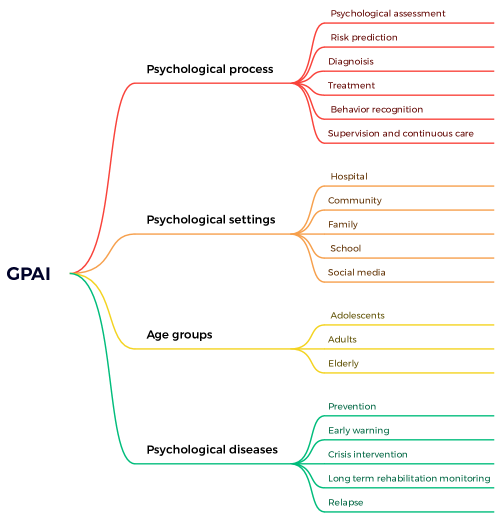
- Multimodal and interactive capabilities enable GPAI to monitor, assist clinicians, and support individuals with negative emotions.
- There are significant ethical, bias, and governance considerations for deploying LLMs in mental health settings.
Read this paper
Open the full text in the Nubint reader and ask about any passage as you read.
Read this paper on NubintThis review was generated by AI from the original paper. Please check the paper before citing it.