
[Paper Review] Towards a unitary formulation of quantum field theory in curved spacetime: the case of de Sitter spacetime
This paper proposes a unitary formulation of quantum field theory in curved spacetime using $Χ\mathcal{P}\mathcal{T}$ symmetry, introducing a direct-sum Fock space structure to ensure S-matrix unitarity in de Sitter spacetime. By treating time as a quantum parameter and defining forward/backward evolving states via dual Schrödinger equations, the framework constructs a $Χ\mathcal{P}\mathcal{T}$-invariant quantum theory that enables a consistent S-matrix analogous to Minkowski spacetime, resolving key issues in QFTCS.
Before we ask what the quantum gravity theory is, it is a legitimate quest to formulate a robust quantum field theory in curved spacetime (QFTCS). Several conceptual problems, especially unitarity loss (pure states evolving into mixed states), have raised concerns over several decades. In this paper, acknowledging the fact that {time} is a parameter in quantum theory, which is different from its status in the context of General Relativity (GR), we start with a "quantum first approach" and propose a new formulation for QFTCS based on the discrete spacetime transformations which offer a way to achieve unitarity. We rewrite the QFT in Minkowski spacetime with a direct-sum Fock space structure based on the discrete spacetime transformations and geometric superselection rules. Applying this framework to QFTCS, in the context of de Sitter (dS) spacetime, we elucidate how this approach to quantization complies with unitarity and the observer complementarity principle. We then comment on understanding the scattering of states in de Sitter spacetime. Furthermore, we discuss briefly the implications of our QFTCS approach to future research in quantum gravity.
Motivation & Objective
- To address the long-standing problem of non-unitary S-matrix formulations in quantum field theory in curved spacetime (QFTCS), particularly in de Sitter spacetime.
- To resolve conceptual inconsistencies arising from treating time as a classical parameter in a quantum framework, especially in the context of General Relativity.
- To propose a new quantization scheme based on $\mathcal{C}\mathcal{P}\mathcal{T}$ symmetry that ensures unitarity and consistency with particle/antiparticle duality.
- To establish a framework compatible with observer complementarity and extendable to other spacetime geometries like closed FLRW coordinates.
- To lay foundational groundwork for a unitary quantum theory of gravity by first achieving robust QFTCS in de Sitter spacetime.
Proposed method
- Introduces a dual Schrödinger equation framework: one for states evolving forward in time ($i\partial_t|\psi_I\rangle = \hat{H}|\psi_I\rangle$) and another for backward-evolving states ($-i\partial_t|\psi_{II}\rangle = \hat{H}|\psi_{II}\rangle$), corresponding to particles and antiparticles.
- Constructs a direct-sum Hilbert space $\mathcal{H} = \mathcal{H}_I \oplus \mathcal{H}_{II}$, where states are combined as $|\psi\rangle = \frac{1}{\sqrt{2}}(|\psi_I\rangle \oplus |\psi_{II}\rangle)$, ensuring $\mathcal{C}\mathcal{P}\mathcal{T}$ invariance.
- Defines operators in block-diagonal form $\hat{\mathcal{O}} = \hat{\mathcal{O}}_I \oplus \hat{\mathcal{O}}_{II}$, enabling consistent evolution under $\mathcal{C}\mathcal{P}\mathcal{T}$ transformations.
- Imposes $\mathcal{C}\mathcal{P}\mathcal{T}$ symmetry on the Fock space, ensuring that in- and out-states are related by $\mathcal{C}\mathcal{P}\mathcal{T}$, analogous to standard QFT in Minkowski spacetime.
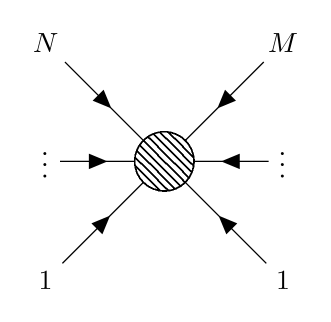
- Applies the framework to de Sitter spacetime in flat FLRW coordinates, deriving a consistent S-matrix that preserves unitarity and scattering amplitude invariance.
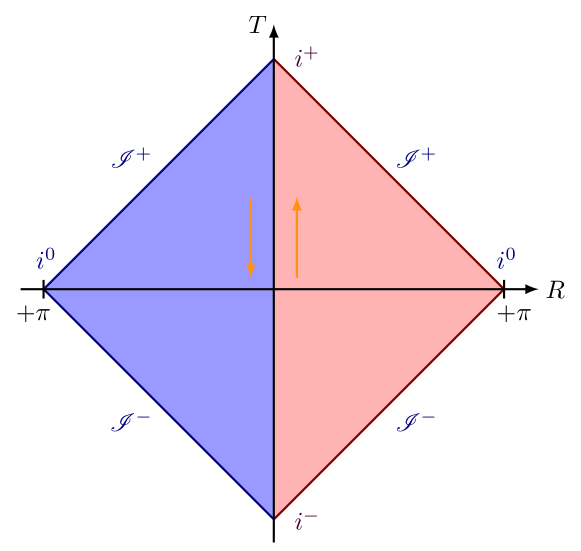
- Demonstrates compatibility with the observer complementarity principle by ensuring that different observers' descriptions are related via $\mathcal{C}\mathcal{P}\mathcal{T}$-invariant transformations.
Experimental results
Research questions
- RQ1How can a unitary S-matrix be consistently defined in quantum field theory on de Sitter spacetime, given the absence of global timelike Killing vectors?
- RQ2What role does $\mathcal{C}\mathcal{P}\mathcal{T}$ symmetry play in ensuring unitarity and particle-antiparticle duality in curved spacetime?
- RQ3Can a direct-sum Fock space structure resolve the foundational issues in QFTCS arising from the classical treatment of spacetime geometry?
- RQ4How does the proposed framework maintain consistency with the observer complementarity principle in de Sitter spacetime?
- RQ5To what extent can this $\mathcal{C}\mathcal{P}\mathcal{T}$-symmetric formulation be generalized to other curved spacetimes, such as closed FLRW coordinates?
Key findings
- The paper successfully constructs a $\mathcal{C}\mathcal{P}\mathcal{T}$-invariant direct-sum Fock space that ensures unitarity of the S-matrix in de Sitter spacetime, analogous to standard QFT in Minkowski spacetime.
- The dual Schrödinger equations—forward and backward in time—allow for a consistent description of particles and antiparticles as states evolving in opposite time directions.
- The direct-sum Hilbert space structure ensures that the total state vector $|\psi\rangle = \frac{1}{\sqrt{2}}(|\psi_I\rangle \oplus |\psi_{II}\rangle)$ is explicitly $\mathcal{C}\mathcal{P}\mathcal{T}$-invariant, preserving scattering amplitude symmetries.
- The framework is compatible with the observer complementarity principle, as different observers' descriptions are related by $\mathcal{C}\mathcal{P}\mathcal{T}$ transformations.
- The approach avoids the need for a fixed classical spacetime background by treating time as a quantum parameter, thereby resolving foundational tensions between QFT and GR.
- The method is extendable to de Sitter spacetime in closed FLRW coordinates, suggesting broader applicability beyond flat FLRW foliations.
Read this paper
Open the full text in the Nubint reader and ask about any passage as you read.
Read this paper on NubintThis review was generated by AI from the original paper. Please check the paper before citing it.