
[Paper Review] Towards AI Accountability Infrastructure: Gaps and Opportunities in AI Audit Tooling
The paper inventories AI audit tools, interviews practitioners, and argues that current tooling focuses on evaluation but insufficient for accountability, calling for broader infrastructure for AI accountability.
Audits are critical mechanisms for identifying the risks and limitations of deployed artificial intelligence (AI) systems. However, the effective execution of AI audits remains incredibly difficult, and practitioners often need to make use of various tools to support their efforts. Drawing on interviews with 35 AI audit practitioners and a landscape analysis of 435 tools, we compare the current ecosystem of AI audit tooling to practitioner needs. While many tools are designed to help set standards and evaluate AI systems, they often fall short in supporting accountability. We outline challenges practitioners faced in their efforts to use AI audit tools and highlight areas for future tool development beyond evaluation -- from harms discovery to advocacy. We conclude that the available resources do not currently support the full scope of AI audit practitioners' needs and recommend that the field move beyond tools for just evaluation and towards more comprehensive infrastructure for AI accountability.
Motivation & Objective
- Map the current ecosystem of AI audit tools across the audit process stages.
- Understand which AI audit tools are actually used in practice and how they are applied.
- Identify gaps between available tooling and practitioners' accountability needs.
- Provide recommendations for researchers, policymakers, and practitioners to develop infrastructure beyond evaluation.
Proposed method
- Collated a dataset of 390 AI audit tools.
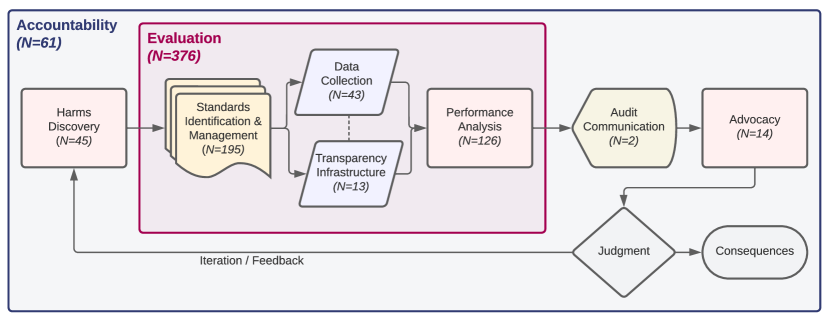
- Developed a taxonomy organizing tools into seven stages of the audit process.
- Conducted 27 semi-structured interviews with 35 audit practitioners across 24 organizations.
- Applied qualitative coding (descriptive and values coding) to interview transcripts.
- Performed landscape analysis augmented by sources like Crunchbase, GitHub, and Google Scholar API.
- Provided an interactive dataset at tools.auditing-ai.com and accompanying analysis at github.com/ryansteed/oat-analysis.
Experimental results
Research questions
- RQ1RQ1: What AI audit tooling is available to support AI audit work?
- RQ2RQ2: Which AI audit tools are actually used and how?
- RQ3RQ3: What do AI audit practitioners actually need?
Key findings
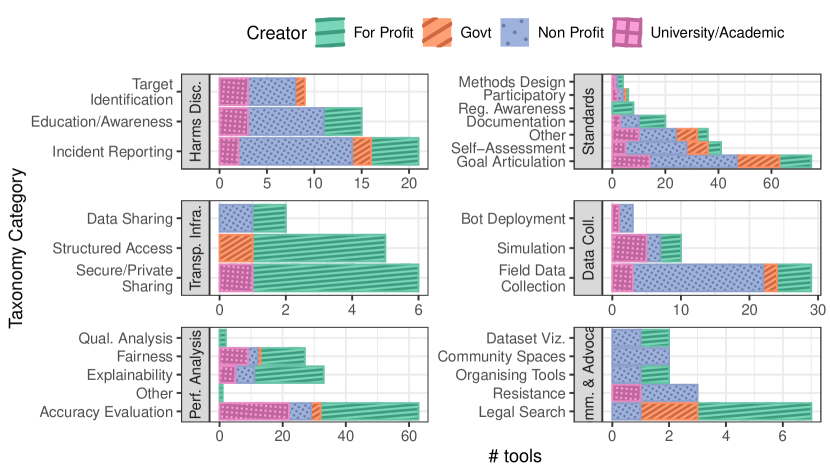
- There are many tools to support evaluation and standards management, but fewer tools for stages essential to accountability such as harms discovery, data collection, transparency infrastructure, advocacy, and audit communication.
- Practitioners frequently adapt or build their own tools to fit workflows, revealing gaps between available tooling and real-world needs.
- Access to high-quality, uncompromised data, consistent holistic standards, audit integrity, and cross-disciplinary collaboration are persistent challenges.
- Most tools identified are publicly available or open-source, yet practical impact of tooling is limited without infrastructure supporting accountability.
- The study advocates moving beyond evaluation toward comprehensive AI accountability infrastructure that supports harms discovery, stakeholder inclusion, and advocacy.
Read this paper
Open the full text in the Nubint reader and ask about any passage as you read.
Read this paper on NubintThis review was generated by AI from the original paper. Please check the paper before citing it.