
[Paper Review] Towards Anatomy Education with Generative AI-based Virtual Assistants in Immersive Virtual Reality Environments
This study presents a VR anatomy education environment with a generative AI–embodied virtual assistant (avatar vs screen) and evaluates user performance, usability, and presence in a pilot with 16 participants across two cognitive complexity levels.
Virtual reality (VR) and interactive 3D visualization systems have enhanced educational experiences and environments, particularly in complicated subjects such as anatomy education. VR-based systems surpass the potential limitations of traditional training approaches in facilitating interactive engagement among students. However, research on embodied virtual assistants that leverage generative artificial intelligence (AI) and verbal communication in the anatomy education context is underrepresented. In this work, we introduce a VR environment with a generative AI-embodied virtual assistant to support participants in responding to varying cognitive complexity anatomy questions and enable verbal communication. We assessed the technical efficacy and usability of the proposed environment in a pilot user study with 16 participants. We conducted a within-subject design for virtual assistant configuration (avatar- and screen-based), with two levels of cognitive complexity (knowledge- and analysis-based). The results reveal a significant difference in the scores obtained from knowledge- and analysis-based questions in relation to avatar configuration. Moreover, results provide insights into usability, cognitive task load, and the sense of presence in the proposed virtual assistant configurations. Our environment and results of the pilot study offer potential benefits and future research directions beyond medical education, using generative AI and embodied virtual agents as customized virtual conversational assistants.
Motivation & Objective
- Advance anatomy education by integrating generative AI with embodied VR to support verbal interaction and adaptive questioning.
- Evaluate technical efficacy and usability of avatar- and screen-based AI assistants in VR across different cognitive complexities.
- Assess user experience metrics (usability, task load, presence) and performance in a within-subject design.
- Identify benefits, limitations, and future research directions for AI-enabled VR anatomy education.
Proposed method
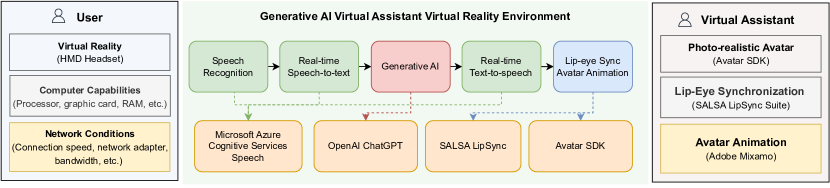
- Developed a Unity-based immersive VR anatomy environment with a ChatGPT-3.5–driven embodied virtual assistant.
- Compared two interaction configurations (avatar with lip-synced speech vs text-only screen) in a 2x2 within-subject design.
- Implemented two cognitive levels (knowledge-based and analysis-based Bloom’s taxonomy) for the questions.
- Collected objective performance data (task completion time, number of interactions, score) and subjective measures (SUS, NASA TLX, IPQ).
- Analyzed data with two-way ANOVA to assess configuration, cognitive level, and interaction effects.
Experimental results
Research questions
- RQ1RQ1 How do avatar- and screen-based virtual assistant configurations influence user performance in anatomy education?
- RQ2RQ2 How do subjective measures (usability, task load, presence) relate to virtual assistant configurations?
- RQ3RQ3 What are the advantages, limitations, and potential research directions of using generative AI for anatomy education?
Key findings
- Avatar configuration yielded higher scores overall and greater variation between knowledge-based and analysis-based questions (significant difference for cognition level within avatar, F(1,15)=4.62, p=0.046, ηp2=0.07).
- Knowledge-based questions were answered faster and with fewer interactions in the avatar configuration compared to analysis-based questions, indicating cognitive complexity effects.
- Usability was high for both configurations (avatar SUS 75.16, screen SUS 76.72) with no significant difference between configurations.
- Task load showed no significant differences across configurations, with mental demand being the highest-rated dimension in both.
- Presence scores were similar across configurations, with no significant differences in IPQ results.
- Qualitative feedback indicated mixed preferences for avatar versus screen, with some requests to improve voice synchronization and question phrasing strategy.

Read this paper
Open the full text in the Nubint reader and ask about any passage as you read.
Read this paper on NubintThis review was generated by AI from the original paper. Please check the paper before citing it.