
[Paper Review] Towards Automation of Human Stage of Decay Identification: An Artificial Intelligence Approach
This study proposes automating human decomposition stage (SOD) identification using deep learning models—specifically Inception V3 and Xception—trained on a large dataset of 1.5 million forensic decomposition images. The Xception model achieved macro F1 scores of up to .881 for head and torso SOD classification under Megyesi’s four-stage system, with interrater reliability comparable to human experts, demonstrating AI’s feasibility for scalable, objective SOD assessment in forensic contexts.
Determining the stage of decomposition (SOD) is crucial for estimating the postmortem interval and identifying human remains. Currently, labor-intensive manual scoring methods are used for this purpose, but they are subjective and do not scale for the emerging large-scale archival collections of human decomposition photos. This study explores the feasibility of automating two common human decomposition scoring methods proposed by Megyesi and Gelderman using artificial intelligence (AI). We evaluated two popular deep learning models, Inception V3 and Xception, by training them on a large dataset of human decomposition images to classify the SOD for different anatomical regions, including the head, torso, and limbs. Additionally, an interrater study was conducted to assess the reliability of the AI models compared to human forensic examiners for SOD identification. The Xception model achieved the best classification performance, with macro-averaged F1 scores of .878, .881, and .702 for the head, torso, and limbs when predicting Megyesi's SODs, and .872, .875, and .76 for the head, torso, and limbs when predicting Gelderman's SODs. The interrater study results supported AI's ability to determine the SOD at a reliability level comparable to a human expert. This work demonstrates the potential of AI models trained on a large dataset of human decomposition images to automate SOD identification.
Motivation & Objective
- To address the subjectivity and scalability limitations of manual SOD scoring in forensic pathology.
- To evaluate whether deep learning models can automate SOD classification using visual data from decomposing human remains.
- To compare AI performance against human forensic examiners in interrater reliability for SOD identification.
- To explore the feasibility of replacing labor-intensive manual scoring with AI for large-scale archival image analysis.
- To establish a proof-of-concept for AI integration into forensic practice for PMI estimation and remains identification.
Proposed method
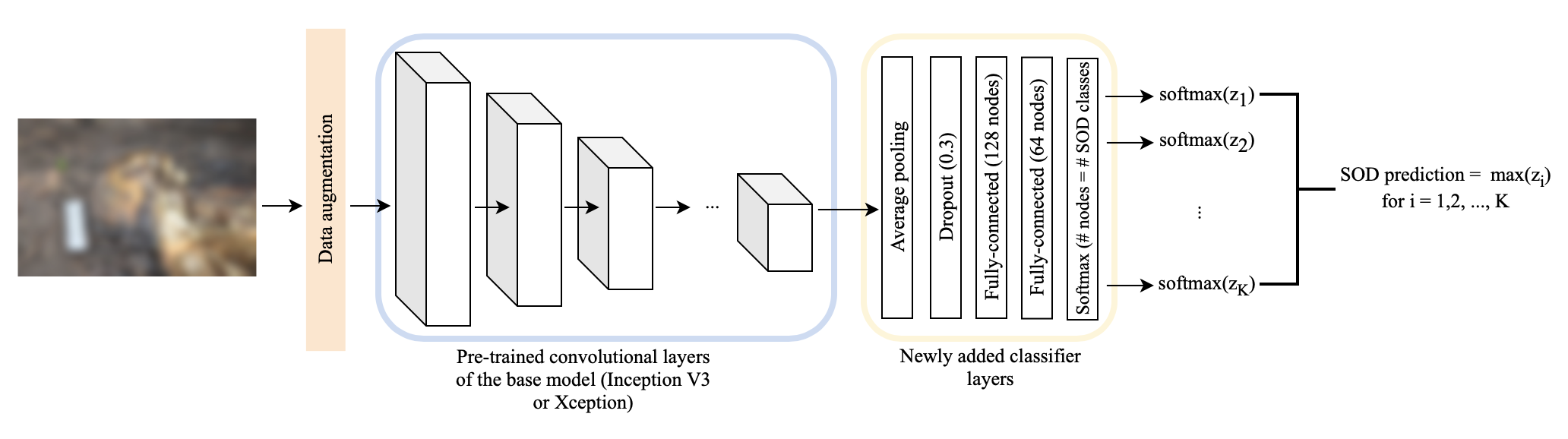
- Trained convolutional neural networks (CNNs), specifically Inception V3 and Xception, on a large-scale dataset of 1.5 million human decomposition images.
- Applied two established SOD scoring methods: Megyesi et al. (four stages) and Gelderman et al. (six stages), with region-specific classification for head, torso, and limbs.
- Used transfer learning with ImageNet-pretrained models fine-tuned on the decomposition image dataset for improved generalization.
- Employed macro-averaged F1 score as the primary evaluation metric for multi-class classification performance across anatomical regions.
- Conducted an interrater reliability study comparing AI predictions against human forensic examiner scores using Cohen’s kappa and intra-class correlation.
- Addressed class imbalance through model evaluation and acknowledged the need for future data augmentation via label propagation techniques.

Experimental results
Research questions
- RQ1Can deep learning models achieve reliable SOD classification performance comparable to human forensic experts on human decomposition images?
- RQ2How does model performance vary across different anatomical regions (head, torso, limbs) when predicting SOD using Megyesi and Gelderman scoring systems?
- RQ3Does the complexity of the SOD classification task (four vs. six stages) affect model performance and reliability?
- RQ4To what extent can AI replicate the interrater reliability of human experts in SOD identification?
- RQ5What are the limitations of current AI models in terms of environmental specificity and data bias in forensic image analysis?
Key findings
- The Xception model achieved the highest classification performance, with macro-averaged F1 scores of .878 (head), .881 (torso), and .702 (limbs) for Megyesi’s SOD system.
- For Gelderman’s six-stage system, the Xception model achieved F1 scores of .872 (head), .875 (torso), and .760 (limbs), demonstrating robustness despite increased class complexity.
- Interrater reliability analysis showed substantial agreement (kappa > 0.6) between human raters and AI for the Megyesi system, and moderate agreement (kappa ~0.5) for the Gelderman system.
- AI performance matched human expert reliability in SOD identification, indicating that AI can serve as a consistent and scalable alternative to manual scoring.
- The study identified limitations including potential labeling bias from single-expert annotation and environmental specificity, as models were trained on outdoor, humid subtropical conditions.
- Future improvements are expected through larger, more diverse, and balanced datasets created via domain-aware label propagation to reduce annotation burden and bias.
Read this paper
Open the full text in the Nubint reader and ask about any passage as you read.
Read this paper on NubintThis review was generated by AI from the original paper. Please check the paper before citing it.