
[Paper Review] Towards Generalist Foundation Model for Radiology by Leveraging Web-scale 2D&3D Medical Data
RadFM introduces MedMD and RadMD to train a visually conditioned radiology foundation model, evaluated on RadBench, and outperforms public baselines across multiple radiology tasks.
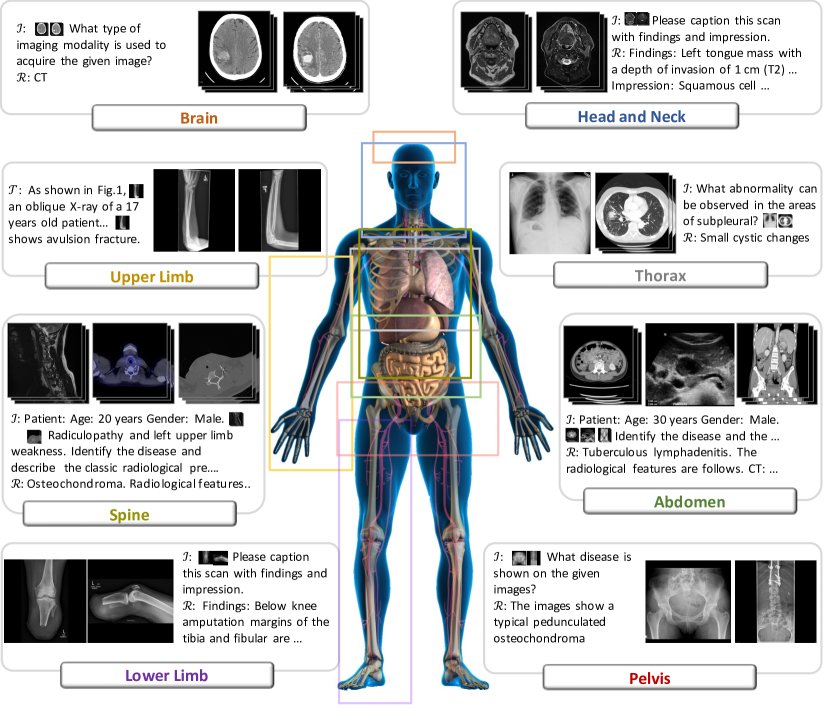
In this study, we aim to initiate the development of Radiology Foundation Model, termed as RadFM. We consider the construction of foundational models from three perspectives, namely, dataset construction, model design, and thorough evaluation. Our contribution can be concluded as follows: (i), we construct a large-scale Medical Multi-modal Dataset, MedMD, which consists of 16M 2D and 3D medical scans with high-quality text descriptions or reports across various data formats, modalities, and tasks, covering over 5000 distinct diseases. To the best of our knowledge, this is the first large-scale, high-quality, medical visual-language dataset, with both 2D and 3D scans; (ii), we propose an architecture that enables visually conditioned generative pre-training, i.e., allowing for integration of text input with 2D or 3D medical scans, and generate responses for diverse radiologic tasks. The model was initially pre-trained on MedMD and subsequently fine-tuned on the domain-specific dataset, which is a radiologic cleaned version of MedMD, containing 3M radiologic visual-language pairs, termed as RadMD; (iii), we propose a new evaluation benchmark, RadBench, that comprises five tasks, including modality recognition, disease diagnosis, visual question answering, report generation and rationale diagnosis, aiming to comprehensively assess the capability of foundation models in handling practical clinical problems. We conduct both automatic and human evaluation on RadBench, in both cases, RadFM outperforms existing multi-modal foundation models, that are publicaly accessible, including Openflamingo, MedFlamingo, MedVInT and GPT-4V. Additionally, we also adapt RadFM for different public benchmarks, surpassing existing SOTAs on diverse datasets. All codes, data, and model checkpoint will all be made publicly available to promote further research and development in the field.
Motivation & Objective
- Address the lack of large-scale multimodal medical data for foundation models in radiology.
- Construct a large-scale, high-quality radiology-focused multimodal dataset (MedMD) and a clean finetuning subset (RadMD).
- Develop a unified, visually conditioned generative model (RadFM) capable of handling 2D and 3D medical images and text.
- Establish a comprehensive evaluation benchmark (RadBench) to assess modality recognition, disease diagnosis, VQA, report generation, and rationale diagnosis.
- Demonstrate RadFM’s performance gains over existing public multi-modal foundation models and adaptivity to other benchmarks.
Proposed method
- Construct MedMD with 16M 2D/3D radiology scans and high-quality text captions or reports across 17 systems and 5000+ diseases.
- Create RadMD by filtering MedMD to a 3M radiology-focused visual-language dataset for domain-specific fine-tuning.
- Propose RadFM, a visually conditioned autoregressive model using a 3D ViT visual encoder, a Perceiver aggregation module, and an LLM for text generation.
- Enable multi-image input by padding 2D images to 4 slices and using learnable 3D position embeddings for 3D patches.
- Use a Perceiver-based fusion to aggregate visual embeddings with interleaved text prompts; train with a negative log-likelihood objective.
- Apply per-token weighting to emphasize medical terms and relevant prompts, differing for interleaved versus visual-instruction datasets.
- Utilize task-specific prompting for modality recognition, disease diagnosis, VQA, report generation, and rationale diagnosis to shape outputs.

Experimental results
Research questions
- RQ1Can a single generalist model effectively handle diverse radiology tasks (modality recognition, disease diagnosis, VQA, report generation, rationale diagnosis) using 2D/3D inputs and natural language output?
- RQ2Does training on a large-scale MedMD dataset followed by radiology-focused fine-tuning (RadMD) yield superior performance over existing public multi-modal radiology models?
- RQ3How does RadFM perform on a comprehensive radiology-specific benchmark (RadBench) and on public benchmarks beyond RadBench?
- RQ4What architectural choices (3D ViT encoder, Perceiver fusion, LLM decoder) contribute to unifying 2D/3D radiology data and diverse tasks?
- RQ5What is the impact of data quality and prompting strategies on model performance across radiology tasks?
Key findings
- RadFM outperforms publicly available multi-modal foundation models (OpenFlamingo, MedFlamingo, MedVInT, GPT-4V) on RadBench across automatic and human evaluations.
- RadFM demonstrates strong generalization when adapted to public benchmarks outside RadBench.
- RadFM is the first foundation model to unify 2D and 3D radiology images within a single architecture.
- The model supports multiple images as input and generates natural language outputs for varied radiology tasks.
- The training pipeline combines a broad MedMD pre-training dataset with a radiology-focused RadMD fine-tuning set to achieve strong domain alignment.
Read this paper
Open the full text in the Nubint reader and ask about any passage as you read.
Read this paper on NubintThis review was generated by AI from the original paper. Please check the paper before citing it.