
[Paper Review] Towards Language Models That Can See: Computer Vision Through the LENS of Natural Language
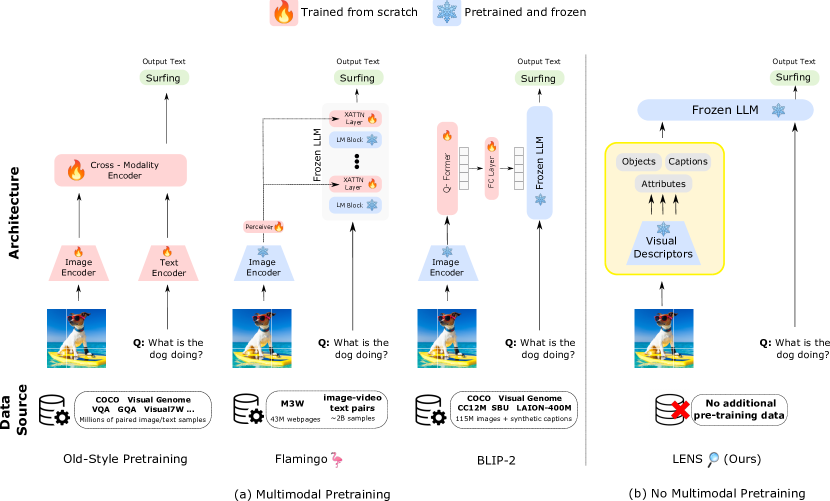
LENS enables off-the-shelf frozen LLMs to perform vision and vision-language tasks by reasoning over rich textual descriptions from separate vision modules, without multimodal pretraining. It achieves competitive zero-shot performance compared with multimodal pretrained systems.
We propose LENS, a modular approach for tackling computer vision problems by leveraging the power of large language models (LLMs). Our system uses a language model to reason over outputs from a set of independent and highly descriptive vision modules that provide exhaustive information about an image. We evaluate the approach on pure computer vision settings such as zero- and few-shot object recognition, as well as on vision and language problems. LENS can be applied to any off-the-shelf LLM and we find that the LLMs with LENS perform highly competitively with much bigger and much more sophisticated systems, without any multimodal training whatsoever. We open-source our code at https://github.com/ContextualAI/lens and provide an interactive demo.
Motivation & Objective
- Motivate and enable visual reasoning with frozen LLMs without multimodal pretraining.
- Propose a modular architecture (LENS) that couples vision modules with a frozen LLM as the reasoning engine.
- Show that LENS achieves competitive zero-shot performance on object recognition and vision-language tasks across diverse datasets.
Proposed method
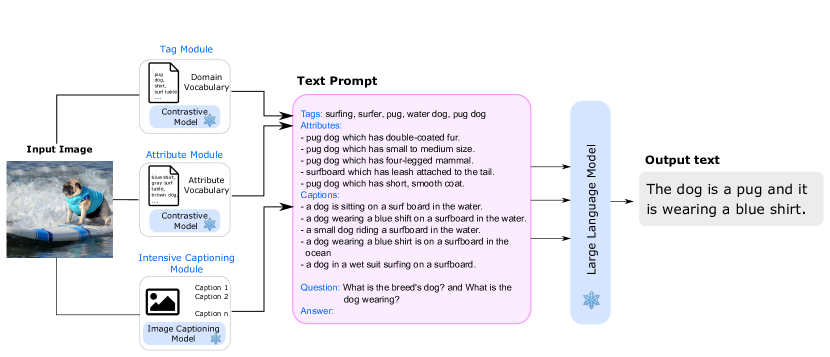
- Define visual vocabularies (tags and attributes) to describe images.
- Use three vision modules (Tag, Attributes, Intensive Captioning) to produce textual descriptions from images.
- Feed concatenated textual descriptions into a frozen LLM to perform object recognition and V&L tasks.
- Design task-specific prompts that combine vision module outputs with the user query and a short final answer cue.
- Evaluate on zero-shot and few-shot object recognition and zero-shot VQA/OK-VQA/hateful memes benchmarks, comparing to multimodal baselines.
Experimental results
Research questions
- RQ1Can a frozen LLM, guided by textual descriptions from independent vision modules, perform competitive vision and vision-language tasks without multimodal pretraining?
- RQ2What is the contribution of different vision modules (tags, attributes, captions) to zero-shot object recognition and V&L reasoning performance?
- RQ3How does LENS compare to jointly pretrained multimodal models on standard vision benchmarks and VQA-style tasks?
- RQ4What prompts and prompt components best leverage textual visual information for LLM-based reasoning?
Key findings
- LENS achieves competitive zero-shot object recognition performance against end-to-end pretrained models like Kosmos and Flamingo.
- In vision-and-language tasks, LENS with Flan-T5 XXL attains superior or competitive results on VQA 2.0 and related benchmarks compared to several multimodal baselines.
- The combination of tag and attribute information provides complementary gains for object recognition beyond using a single vision module.
- Intensive captioning improves VQA results, with diminishing returns beyond a certain number of captions, and OCR-based prompts help hateful memes tasks when combined with tags and attributes.
- LENSOO (best variants) demonstrate strong zero-shot performance while avoiding multimodal pretraining, highlighting the effectiveness of modular, reasoning-based use of LLMs.
Read this paper
Open the full text in the Nubint reader and ask about any passage as you read.
Read this paper on NubintThis review was generated by AI from the original paper. Please check the paper before citing it.