
[Paper Review] Towards practical reinforcement learning for tokamak magnetic control
This paper proposes improved reinforcement learning (RL) algorithms for real-time magnetic control in tokamak fusion reactors, enhancing control accuracy and reducing learning time. By refining the agent architecture and training procedure based on prior work, the method achieves up to 65% better plasma shape accuracy, reduced steady-state current bias, and 3x faster training on the TCV tokamak, validating its practicality for fusion energy research.
Reinforcement learning (RL) has shown promising results for real-time control systems, including the domain of plasma magnetic control. However, there are still significant drawbacks compared to traditional feedback control approaches for magnetic confinement. In this work, we address key drawbacks of the RL method; achieving higher control accuracy for desired plasma properties, reducing the steady-state error, and decreasing the required time to learn new tasks. We build on top of \cite{degrave2022magnetic}, and present algorithmic improvements to the agent architecture and training procedure. We present simulation results that show up to 65\% improvement in shape accuracy, achieve substantial reduction in the long-term bias of the plasma current, and additionally reduce the training time required to learn new tasks by a factor of 3 or more. We present new experiments using the upgraded RL-based controllers on the TCV tokamak, which validate the simulation results achieved, and point the way towards routinely achieving accurate discharges using the RL approach.
Motivation & Objective
- Address key limitations of prior RL-based tokamak control, including poor shape accuracy, high steady-state error, and long training times.
- Improve the scalability and practicality of RL for real-time plasma control in fusion energy research.
- Enable rapid adaptation to new plasma scenarios through faster policy learning and enhanced robustness.
- Validate the effectiveness of the improved RL framework on the TCV tokamak, bridging simulation and real-world deployment.
- Demonstrate that RL can achieve performance comparable or superior to traditional feedback control methods in complex plasma configurations.
Proposed method
- Enhance the agent architecture to better capture long-term dependencies and improve policy generalization in plasma control tasks.
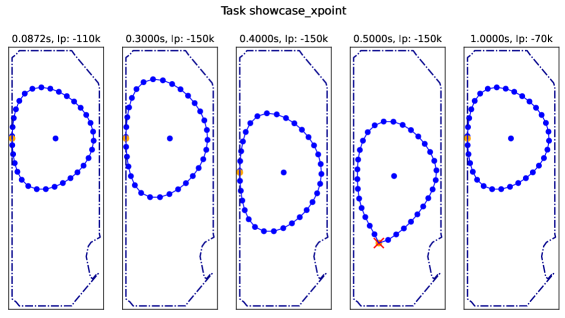
- Implement episode chunking during training to accelerate learning by enabling parallelized exploration across multiple plasma shape configurations.
- Introduce curriculum learning with structured task progression, starting from simpler plasma shapes and gradually increasing complexity.
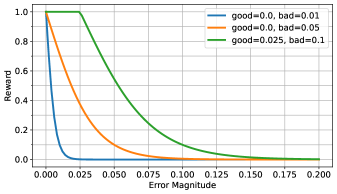
- Optimize the reward function to reduce sparse feedback issues and improve signal-to-noise ratio during training.
- Leverage transfer learning techniques to fine-tune policies across similar plasma scenarios, reducing sample complexity.
- Integrate the trained RL policy into the real-time control system of the TCV tokamak, using magnetic measurements as input and coil current commands as output.
Experimental results
Research questions
- RQ1Can improved RL algorithms achieve higher plasma shape accuracy compared to prior RL methods in tokamak control?
- RQ2To what extent can the new training procedure reduce steady-state error in plasma current and location?
- RQ3How much faster can the enhanced RL framework learn new plasma control tasks compared to baseline approaches?
- RQ4Does the improved RL policy generalize across diverse plasma configurations, including highly elongated and snowflake-like shapes?
- RQ5Can the RL-based controller achieve stable, accurate control in real-world experiments on the TCV tokamak?
Key findings
- The improved RL method achieves up to 65% higher plasma shape accuracy compared to the baseline method in simulation.
- The long-term bias in plasma current is substantially reduced, indicating better steady-state control performance.
- Training time to learn new control tasks is reduced by a factor of three or more through optimized training procedures.
- The RL controller successfully stabilizes complex plasma configurations, including snowflake and droplet-like shapes, in real-world TCV experiments.
- The simulation results are validated on the actual TCV tokamak, demonstrating the practical feasibility of the RL-based control system.
- The method shows strong generalization across diverse plasma scenarios, supporting rapid deployment for new experimental campaigns.
Read this paper
Open the full text in the Nubint reader and ask about any passage as you read.
Read this paper on NubintThis review was generated by AI from the original paper. Please check the paper before citing it.