
[Paper Review] Towards Understanding of Deepfake Videos in the Wild
This paper introduces RWDF-23, the largest and most diverse real-world deepfake dataset to date, comprising 2,000 videos collected from Reddit, YouTube, TikTok, and Bilibili across 21 countries and four languages. It analyzes deepfake creators, manipulation strategies, purposes, and viewer sentiment using NLP and metadata, revealing significant biases in viewer reactions based on victim ethnicity and gender, and identifying trends in user engagement over time.
Deepfakes have become a growing concern in recent years, prompting researchers to develop benchmark datasets and detection algorithms to tackle the issue. However, existing datasets suffer from significant drawbacks that hamper their effectiveness. Notably, these datasets fail to encompass the latest deepfake videos produced by state-of-the-art methods that are being shared across various platforms. This limitation impedes the ability to keep pace with the rapid evolution of generative AI techniques employed in real-world deepfake production. Our contributions in this IRB-approved study are to bridge this knowledge gap from current real-world deepfakes by providing in-depth analysis. We first present the largest and most diverse and recent deepfake dataset (RWDF-23) collected from the wild to date, consisting of 2,000 deepfake videos collected from 4 platforms targeting 4 different languages span created from 21 countries: Reddit, YouTube, TikTok, and Bilibili. By expanding the dataset's scope beyond the previous research, we capture a broader range of real-world deepfake content, reflecting the ever-evolving landscape of online platforms. Also, we conduct a comprehensive analysis encompassing various aspects of deepfakes, including creators, manipulation strategies, purposes, and real-world content production methods. This allows us to gain valuable insights into the nuances and characteristics of deepfakes in different contexts. Lastly, in addition to the video content, we also collect viewer comments and interactions, enabling us to explore the engagements of internet users with deepfake content. By considering this rich contextual information, we aim to provide a holistic understanding of the {evolving} deepfake phenomenon and its impact on online platforms.
Motivation & Objective
- To address the lack of up-to-date, diverse, and real-world deepfake datasets that reflect current generative AI techniques.
- To investigate the characteristics, creators, and purposes of non-pornographic deepfake videos in the wild.
- To analyze viewer engagement and sentiment toward deepfakes, particularly regarding victim ethnicity, gender, and video categories.
- To identify patterns in deepfake dissemination and audience perception across platforms and over time.
- To support the development of more robust detection and mitigation strategies through empirical, IRB-approved data collection and analysis.
Proposed method
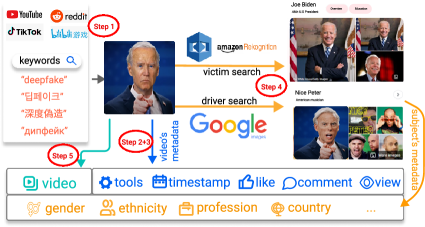
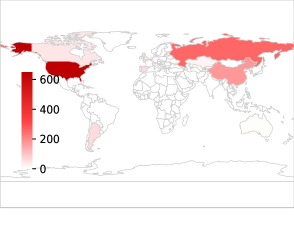
- Systematically collected 2,000 deepfake videos from Reddit, YouTube, TikTok, and Bilibili across 21 countries and four languages, ensuring broad linguistic and cultural diversity.
- Gathered comprehensive metadata including uploader identity, victim demographics (gender, ethnicity, profession), video timestamps, and platform-specific attributes.
- Collected viewer interactions such as views, likes, comments, and comment timestamps to analyze engagement dynamics over time.
- Applied NLP techniques to analyze sentiment in user comments, using a sentiment scoring model to assess audience perception of realism and bias.
- Classified videos into categories based on creator-provided labels (e.g., educational, science & technology) to compare sentiment across content types.
- Conducted statistical analysis using the Mann-Whitney U test (α = 0.01) to evaluate significant differences in sentiment scores across victim demographics.
Experimental results
Research questions
- RQ1What are the characteristics of recently generated deepfake videos shared online across different platforms and countries?
- RQ2Who are the deepfake video uploaders, and what are their intentions behind creation and sharing?
- RQ3How do users’ responses and reactions to deepfake videos change over time, and what factors influence sentiment?
Key findings
- Videos featuring Caucasian victims received the most neutral comments, while those with Southeast Asian victims received relatively more positive sentiment, suggesting potential regional or ethnic bias in audience perception.
- Female victims consistently received significantly more positive comments than male victims, with a p-value < 0.001, likely due to their frequent portrayal in entertainment content like singing or dancing.
- Educational content labeled by creators received more positive audience sentiment, indicating a potential exploitation vector for spreading deepfakes under the guise of awareness.
- Science and Technology videos, intended to inform about deepfakes, received more negative comments such as 'This tech is so dangerous,' reflecting fear and concern.
- Viewer interest in deepfakes surged in early 2023, peaking at an average of 6,000 comments per video, likely driven by advances in generative models like MidJourney.
- Interest declined after mid-2021 but rebounded in early 2023, indicating cyclical trends in public engagement tied to technological advancements and high-profile events.
Read this paper
Open the full text in the Nubint reader and ask about any passage as you read.
Read this paper on NubintThis review was generated by AI from the original paper. Please check the paper before citing it.