
[論文レビュー] Towards Zero-trust Security for the Metaverse
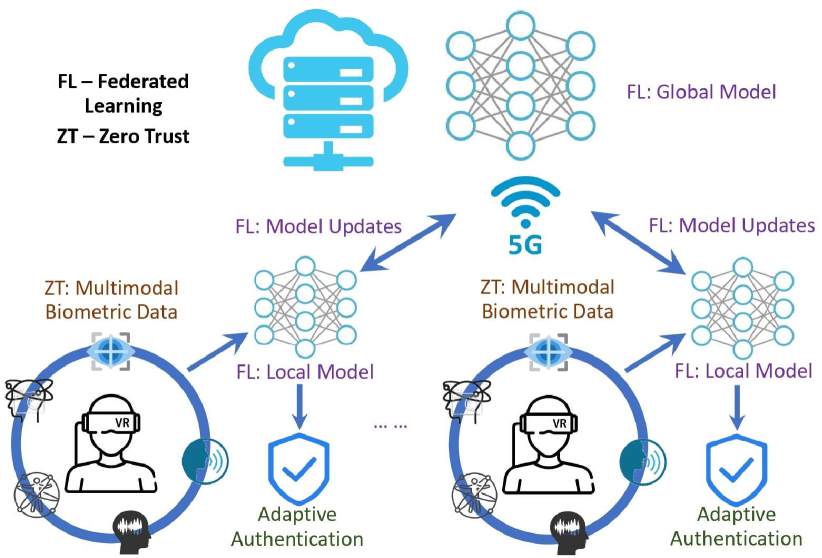
MetaGuardを提案する。社会VRにおける継続的でマルチモーダルな生体認証をプライバシー保護型、連合学習ベースのフレームワークとして実現し、メタバースでのゼロトラストセキュリティを可能にする。
By focusing on immersive interaction among users, the burgeoning Metaverse can be viewed as a natural extension of existing social media. Similar to traditional online social networks, there are numerous security and privacy issues in the Metaverse (e.g., attacks on user authentication and impersonation). In this paper, we develop a holistic research agenda for zero-trust user authentication in social virtual reality (VR), an early prototype of the Metaverse. Our proposed research includes four concrete steps: investigating biometrics-based authentication that is suitable for continuously authenticating VR users, leveraging federated learning (FL) for protecting user privacy in biometric data, improving the accuracy of continuous VR authentication with multimodal data, and boosting the usability of zero-trust security with adaptive VR authentication. Our preliminary study demonstrates that conventional FL algorithms are not well suited for biometrics-based authentication of VR users, leading to an accuracy of less than 10%. We discuss the root cause of this problem, the associated open challenges, and several future directions for realizing our research vision.
研究の動機と目的
- メタバースのゼロトラストセキュリティと社会VRにおける継続的なユーザー認証を動機づける。
- マルチモーダル生体情報を用いたプライバシー保護型のFLベース認証フレームワークを提案する。
- 正のラベルのみを用いる局所データでのFLの課題を特定し、今後の改善案を概説する。
- 使いやすさとセキュリティのバランスを取るための適応的、マルチモーダル、およびパーソナライズされた認証を探求する。
提案手法
- VRユーザー向けのFLベースでプライバシー保護型の継続認証フレームワークとしてMetaGuardを定義する。
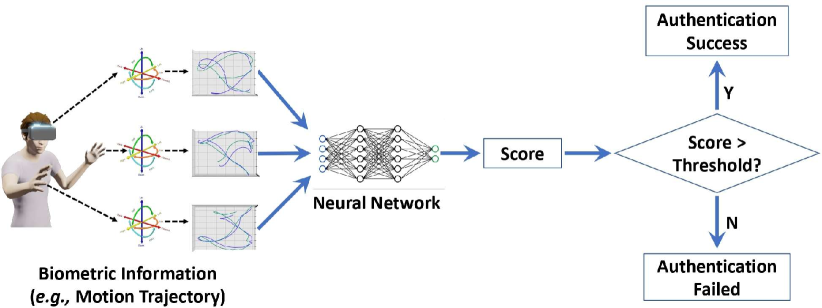
- 認証のためのマルチモーダル生体データ(例:頭部/体動、視線、声)を調査する。
- VR認証における正のラベルのみデータを用いた標準FL(FedAvg)の限界をデモンストレーションする。
- 精度向上のための個別化されたマルチモーダルデータ融合と時系列ベースのモデル(例:VRNN/LSTM)を提案する。
- 信頼性・使いやすさ・資源使用のバランスを取る適応型認証について論じる。
実験結果
リサーチクエスチョン
- RQ1生体認証の生データを共有せずに、連合学習はVRでのプライバシー保護型継続認証を可能にするか?
- RQ2現実的なVR利用下で、どの生体モダリティと融合戦略がメタバースでの堅牢なゼロトラスト認証をもたらすか?
- RQ3ユーザー数が増えるにつれてFLベースのVR認証のスケーラビリティ課題は何か、そして個別化はどのように役立つか?
- RQ4適応型認証は信頼性とプライバシーを維持しつつ資源使用をどのように削減できるか?
主な発見
- 正のラベルのみデータを使うFedAvgなどの従来のFLはVR認証で性能が低い(6.34%の精度)。
- プライバシーを保護しないモデル(Siamese、FCN、ResNet)は使用データセットで87–90%の精度を達成し、プライバシーの代償を浮き彫りにする。
- FedAvg + FCNの精度はユーザー数が増えると劇的に低下する(例: 2ユーザー時は>90%、25ユーザー時は<10%)。
- 六モダリティすべてを使用するとFedAvg+FCNの精度は非常に低くなる(6.34%)、一方でモダリティ数を減らすと性能が向上する(例:三モダリティで19.32%)。
- ユーザー間で最適モダリティの組み合わせに大きなばらつきがあり、パーソナライズされたモダリティ選択の必要性を強調している。
より良い研究を、今すぐ始めましょう
論文設計から論文執筆まで、研究時間を劇的に削減しましょう。
クレジットカード登録不要
このレビューはAIが作成し、人間の編集者が確認しました。