
[Paper Review] Train in Germany, Test in The USA: Making 3D Object Detectors Generalize
This paper identifies car size distribution differences as the primary cause of performance drop when deploying 3D object detectors trained on one dataset (e.g., KITTI in Germany) to another (e.g., Waymo in the USA). It proposes a simple statistical normalization method using average car dimensions from external data sources to correct bounding box predictions, resulting in a 41.4-point average precision improvement on the 3D detection task across datasets.
In the domain of autonomous driving, deep learning has substantially improved the 3D object detection accuracy for LiDAR and stereo camera data alike. While deep networks are great at generalization, they are also notorious to over-fit to all kinds of spurious artifacts, such as brightness, car sizes and models, that may appear consistently throughout the data. In fact, most datasets for autonomous driving are collected within a narrow subset of cities within one country, typically under similar weather conditions. In this paper we consider the task of adapting 3D object detectors from one dataset to another. We observe that naively, this appears to be a very challenging task, resulting in drastic drops in accuracy levels. We provide extensive experiments to investigate the true adaptation challenges and arrive at a surprising conclusion: the primary adaptation hurdle to overcome are differences in car sizes across geographic areas. A simple correction based on the average car size yields a strong correction of the adaptation gap. Our proposed method is simple and easily incorporated into most 3D object detection frameworks. It provides a first baseline for 3D object detection adaptation across countries, and gives hope that the underlying problem may be more within grasp than one may have hoped to believe. Our code is available at https://github.com/cxy1997/3D_adapt_auto_driving.
Motivation & Objective
- To investigate the root causes of performance degradation when deploying 3D object detectors trained on one autonomous driving dataset to another.
- To identify which domain shift factors—such as sensor differences, weather, or vehicle size—most significantly impact detector generalization.
- To develop a practical, lightweight method to mitigate domain shift in 3D object detection without retraining.
- To validate that car size statistics are the dominant factor in cross-dataset performance drops.
Proposed method
- Train 3D object detectors (PIXOR and PointRCNN) on one dataset and evaluate them on multiple other datasets to measure domain shift.
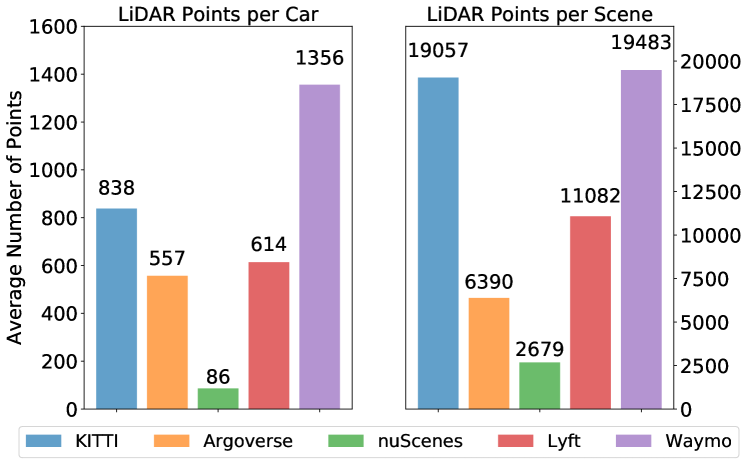
- Analyze differences in car size, shape, and sensor configurations across datasets to isolate the main cause of performance drop.
- Propose a statistical normalization technique that rescales predicted 3D bounding boxes using mean car dimensions from external data (e.g., car sales statistics).
- Apply the normalization to both input LiDAR features and output detection predictions to align detector outputs with target domain statistics.
- Use aggregate car size data (height, width, length) from national vehicle registries or sales reports to calibrate the normalization.
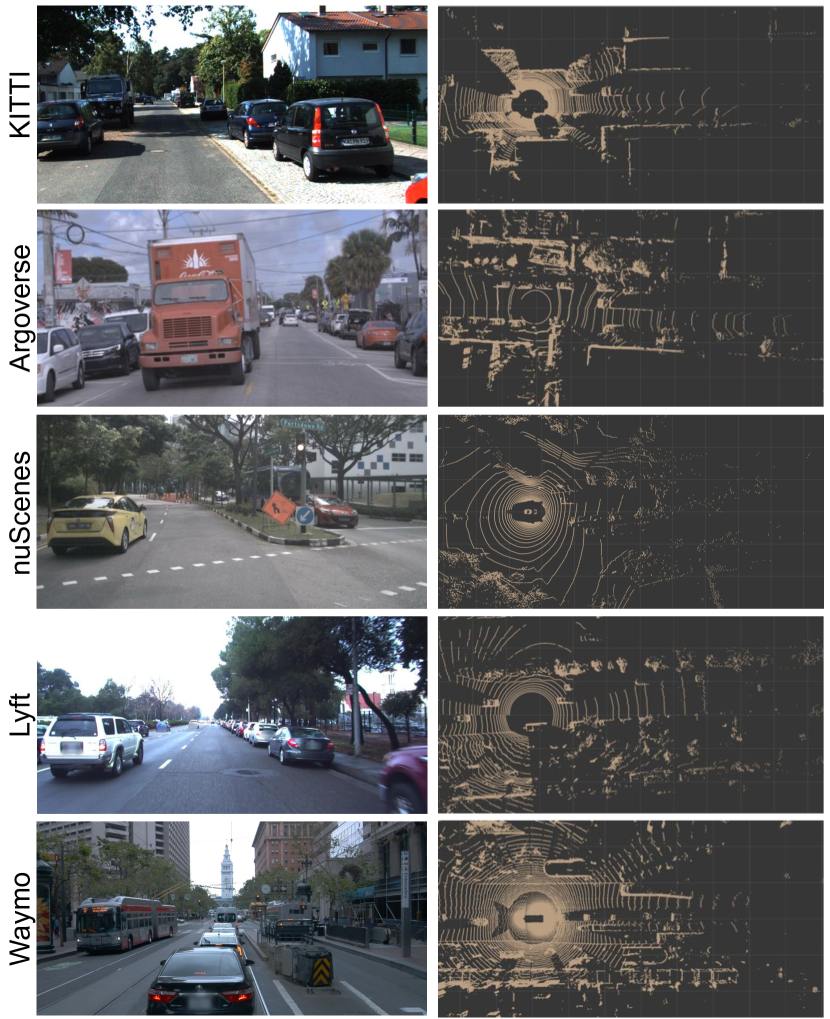
- Evaluate the method across five major datasets: KITTI, Argoverse, nuScenes, Lyft, and Waymo, under multiple distance and difficulty thresholds.
Experimental results
Research questions
- RQ1What are the primary domain shift factors causing 3D object detectors to fail when transferred from one geographic region to another?
- RQ2How do differences in car size and shape across datasets compare to other factors like sensor configuration or weather in their impact on detector performance?
- RQ3Can a simple, data-driven normalization based on average car dimensions significantly improve cross-dataset 3D detection performance?
- RQ4Is the performance gain from size normalization robust across diverse datasets with varying sensor setups and environmental conditions?
Key findings
- The primary cause of performance degradation in cross-dataset 3D object detection is statistical differences in car sizes between training and test domains.
- A detector trained on KITTI (German cars, average length ~4.4m) performs 36% worse on Waymo (USA, average length ~5.15m) when no adaptation is applied.
- Applying statistical normalization using average car size from external data sources improves 3D detection average precision by 41.4 points on the 3D easy set across datasets.
- The method is effective even when using car sales data instead of dataset-specific statistics, showing robustness and practicality.
- The approach reduces false positive rates and improves bounding box size estimation, as shown in qualitative results on KITTI.
- Performance gains are most significant in longer-range detection (50m–70m), where size misalignment is most detrimental.
Read this paper
Open the full text in the Nubint reader and ask about any passage as you read.
Read this paper on NubintThis review was generated by AI from the original paper. Please check the paper before citing it.