
[Paper Review] Training neural operators to preserve invariant measures of chaotic attractors
This paper proposes training neural operators to preserve the invariant measures of chaotic attractors—key statistical properties of long-term dynamics—using two novel loss functions: an optimal transport-based loss requiring expert knowledge of invariant statistics, and a contrastive feature loss that preserves these statistics without prior domain knowledge. The method significantly improves long-term statistical fidelity over standard RMSE training, even under high noise and chaotic sensitivity.
Chaotic systems make long-horizon forecasts difficult because small perturbations in initial conditions cause trajectories to diverge at an exponential rate. In this setting, neural operators trained to minimize squared error losses, while capable of accurate short-term forecasts, often fail to reproduce statistical or structural properties of the dynamics over longer time horizons and can yield degenerate results. In this paper, we propose an alternative framework designed to preserve invariant measures of chaotic attractors that characterize the time-invariant statistical properties of the dynamics. Specifically, in the multi-environment setting (where each sample trajectory is governed by slightly different dynamics), we consider two novel approaches to training with noisy data. First, we propose a loss based on the optimal transport distance between the observed dynamics and the neural operator outputs. This approach requires expert knowledge of the underlying physics to determine what statistical features should be included in the optimal transport loss. Second, we show that a contrastive learning framework, which does not require any specialized prior knowledge, can preserve statistical properties of the dynamics nearly as well as the optimal transport approach. On a variety of chaotic systems, our method is shown empirically to preserve invariant measures of chaotic attractors.
Motivation & Objective
- To address the failure of standard RMSE-based training in preserving long-term statistical properties of chaotic dynamical systems.
- To develop a training framework that maintains invariant measures of chaotic attractors despite exponential sensitivity to initial conditions and measurement noise.
- To propose a contrastive learning approach that preserves statistical properties without requiring expert knowledge of invariant measures.
- To combine short-horizon RMSE loss with long-horizon statistical preservation losses for improved generalization in multi-environment settings.
- To empirically validate the method on chaotic PDEs such as the Kuramoto–Sivashinsky equation under varying noise levels.
Proposed method
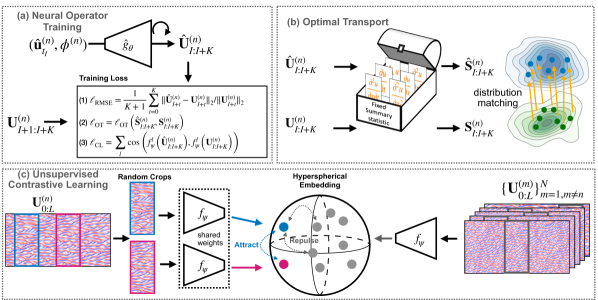
- Introduces a Sinkhorn divergence-based optimal transport loss to match the distribution of summary statistics between model outputs and data, ensuring preservation of invariant measures.
- Proposes a contrastive feature loss that learns invariant representations without requiring prior knowledge of the underlying invariant measures.
- Combines the statistical preservation losses with a standard short-horizon RMSE loss to retain short-term predictive accuracy.
- Uses a hyperparameter $λ$ to balance the trade-off between RMSE and feature loss, with $λ=0.8$ selected via grid search to minimize feature loss while keeping RMSE within 110% of baseline.
- Employs a multi-environment training setup where each trajectory evolves under slightly different parameters, enhancing generalization across diverse system configurations.
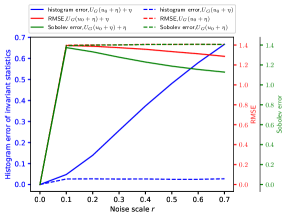
- Validates the method on the Kuramoto–Sivashinsky PDE with random initial conditions and varying noise levels ($r = 0.1, 0.2, 0.3$), using fourth-order Runge-Kutta time integration.
Experimental results
Research questions
- RQ1Can neural operators trained with optimal transport-based losses preserve the invariant measures of chaotic attractors in the presence of noise and chaotic sensitivity?
- RQ2Can a contrastive learning framework preserve long-term statistical properties of chaotic systems without requiring expert knowledge of invariant measures?
- RQ3How does combining RMSE and statistical preservation losses affect the trade-off between short-term prediction accuracy and long-term statistical fidelity?
- RQ4How do different noise levels impact the performance of standard RMSE training versus the proposed statistical preservation methods?
- RQ5Does the multi-environment training setup improve generalization across diverse dynamical realizations in chaotic systems?
Key findings
- The contrastive feature loss preserves invariant measures nearly as well as the expert-informed optimal transport loss, despite not requiring prior knowledge of the system's statistical structure.
- At a noise level of $r=0.3$, the RMSE-baseline model exhibits significant degradation, including fewer negative values in predicted dynamics and poor high-frequency signal capture, as shown in energy spectra.
- With $λ=0.8$, the combined loss model achieves the lowest feature loss while maintaining RMSE within 110% of the RMSE-only baseline, indicating a favorable trade-off between prediction accuracy and statistical fidelity.
- Visualizations show that both proposed methods produce statistically consistent dynamics with the true system, especially under higher noise, whereas RMSE-only models diverge in statistical behavior.
- The optimal transport and contrastive losses effectively reduce unseen statistical error (measured via invariant statistics) as $λ$ increases, peaking at $λ=0.8$ before diminishing returns set in.
- The method successfully preserves time-invariant statistical properties across multiple chaotic systems, demonstrating robustness under high noise and chaotic sensitivity.
Read this paper
Open the full text in the Nubint reader and ask about any passage as you read.
Read this paper on NubintThis review was generated by AI from the original paper. Please check the paper before citing it.