
[Paper Review] Transformer-Based Language Model Surprisal Predicts Human Reading Times Best with About Two Billion Training Tokens
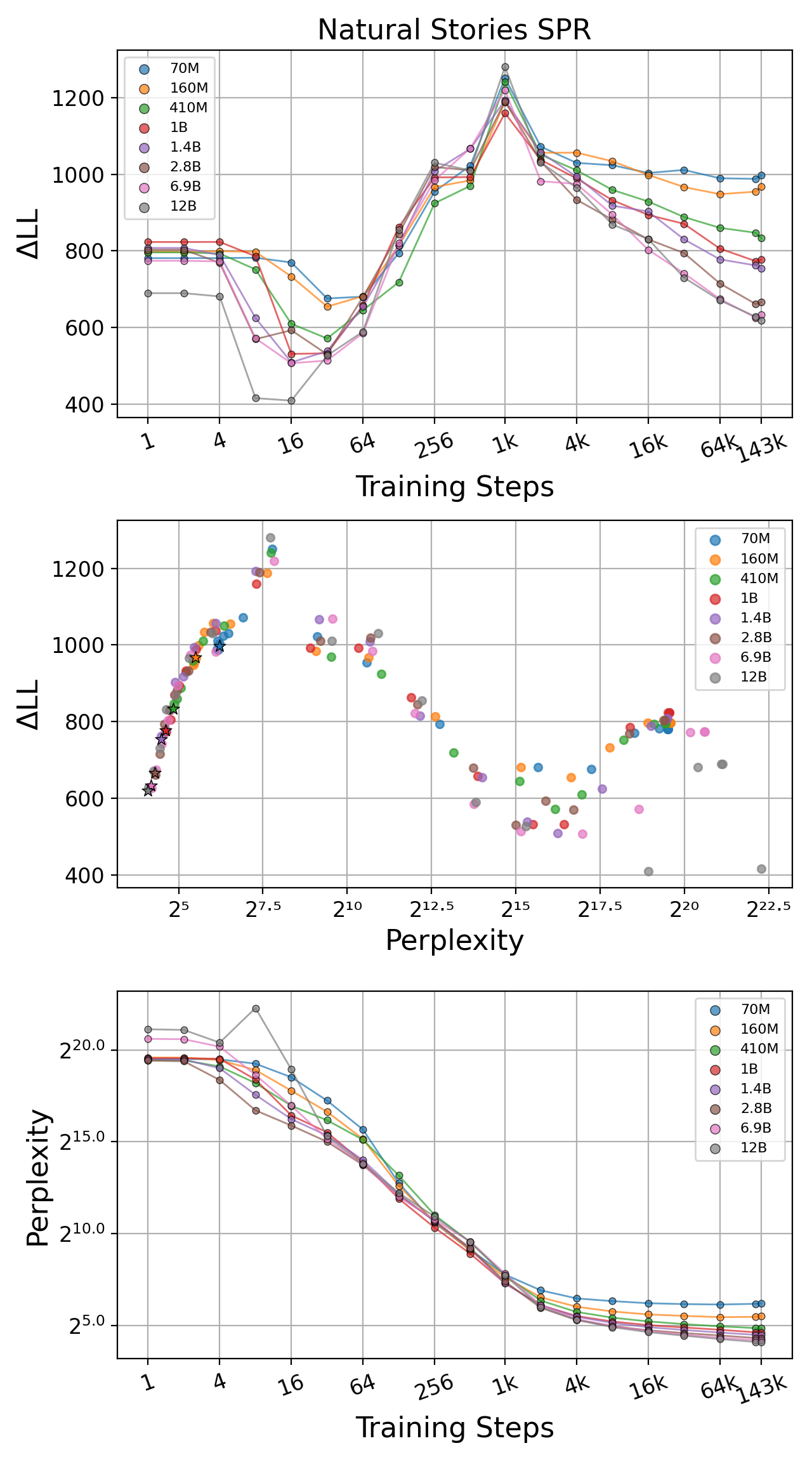
This study investigates how training data size and model capacity in Transformer-based language models affect surprisal's ability to predict human reading times. It finds that surprisal estimates from models trained on approximately two billion tokens yield the best fit to human reading data, after which performance degrades due to over-optimization. A 'tipping point' in smaller models reveals that sufficient capacity is needed to capture human-like prediction behavior.
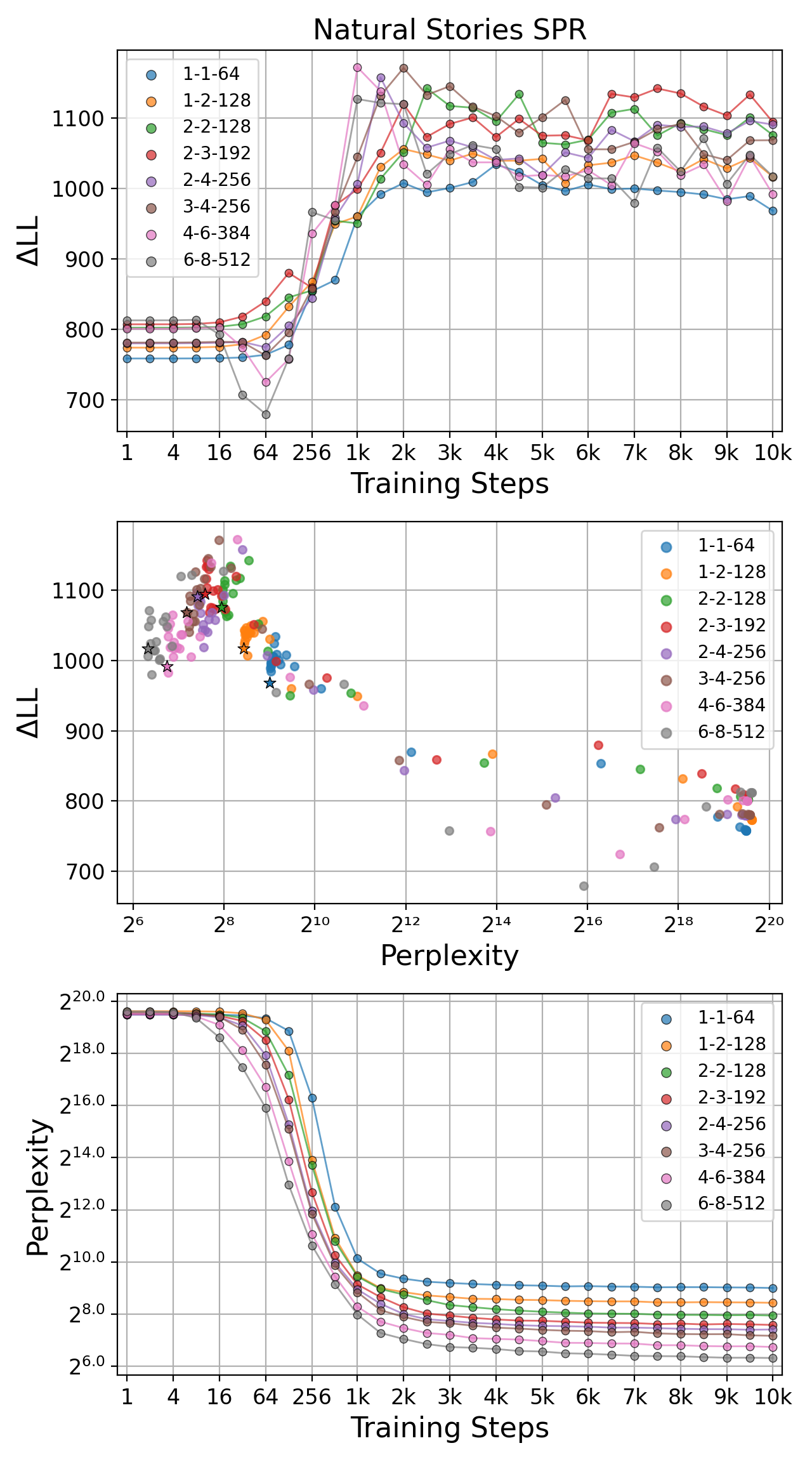
Recent psycholinguistic studies have drawn conflicting conclusions about the relationship between the quality of a language model and the ability of its surprisal estimates to predict human reading times, which has been speculated to be due to the large gap in both the amount of training data and model capacity across studies. The current work aims to consolidate these findings by evaluating surprisal estimates from Transformer-based language model variants that vary systematically in the amount of training data and model capacity on their ability to predict human reading times. The results show that surprisal estimates from most variants with contemporary model capacities provide the best fit after seeing about two billion training tokens, after which they begin to diverge from humanlike expectations. Additionally, newly-trained smaller model variants reveal a 'tipping point' at convergence, after which the decrease in language model perplexity begins to result in poorer fits to human reading times. These results suggest that the massive amount of training data is mainly responsible for the poorer fit achieved by surprisal from larger pre-trained language models, and that a certain degree of model capacity is necessary for Transformer-based language models to capture humanlike expectations.
Motivation & Objective
- To resolve conflicting findings on the relationship between language model quality and surprisal's predictive power for human reading times.
- To investigate how varying amounts of training data and model capacity influence the fit of surprisal estimates to human reading times.
- To identify whether there is a threshold in data or capacity where surprisal performance begins to diverge from human processing patterns.
- To examine whether smaller models exhibit a 'tipping point' where improved perplexity leads to worse predictive fit.
Proposed method
- Trained multiple Pythia-based Transformer language model variants with systematic variation in model capacity and training data size.
- Calculated surprisal estimates from each model variant at different training stages using autoregressive next-word prediction.
- Evaluated surprisal predictions against two behavioral datasets: self-paced reading times (Natural Stories Corpus) and go-past eye-gaze durations (Dundee Corpus).
- Used log-transformed reading time data in hierarchical linear regression models to assess how well surprisal explained variance in reading times.
- Tracked the relationship between model perplexity and model fit (ΔLL) across training progression to identify performance turning points.
- Compared results across model sizes and training stages to isolate the effects of data quantity and model capacity.
Experimental results
Research questions
- RQ1At what point in training does surprisal from a Transformer-based language model best predict human reading times?
- RQ2How does model capacity moderate the relationship between language model perplexity and predictive fit to reading times?
- RQ3Does a 'tipping point' exist in smaller models where decreasing perplexity leads to poorer fit with human reading times?
- RQ4Why do large pre-trained models show a negative relationship between perplexity and predictive power, while smaller models show a positive one initially?
- RQ5To what extent does the amount of training data drive the divergence between model surprisal and human processing difficulty?
Key findings
- Surprisal estimates from most contemporary Transformer-based language models provide the best fit to human reading times after approximately two billion training tokens.
- After two billion tokens, further training leads to a decline in predictive fit, indicating that over-optimization causes surprisal to diverge from human expectations.
- Smaller model variants (e.g., 2-3-192) exhibit a 'tipping point' at convergence, where continued reduction in perplexity results in poorer fit to reading times.
- The 2-3-192 model variant represents a critical threshold: below this capacity, models cannot learn humanlike expectations effectively; above it, they begin to overfit to statistical regularities.
- A strictly monotonic negative relationship between perplexity and model fit emerges only in larger models after extensive training, confirming prior findings of inverse correlation.
- Model capacity does not significantly alter the relationship between perplexity and fit; all variants follow a continuous curve, suggesting shared inductive bias in how models learn to predict beyond human-level expectations.
Read this paper
Open the full text in the Nubint reader and ask about any passage as you read.
Read this paper on NubintThis review was generated by AI from the original paper. Please check the paper before citing it.