
[Paper Review] Transformers as Support Vector Machines
This paper establishes a formal equivalence between the optimization dynamics of self-attention in transformers and a hard-margin support vector machine (SVM) problem, showing that gradient descent on 1-layer transformers with vanishing regularization converges in direction to an SVM solution that minimizes the nuclear norm of the parameter matrix $\mathbf{W} = \mathbf{K}\mathbf{Q}^\top$. The key contribution is a theoretical framework linking attention mechanisms to SVMs, revealing that over-parameterization ensures global convergence and benign optimization landscapes.
Since its inception in "Attention Is All You Need", transformer architecture has led to revolutionary advancements in NLP. The attention layer within the transformer admits a sequence of input tokens $X$ and makes them interact through pairwise similarities computed as softmax$(XQK^ op X^ op)$, where $(K,Q)$ are the trainable key-query parameters. In this work, we establish a formal equivalence between the optimization geometry of self-attention and a hard-margin SVM problem that separates optimal input tokens from non-optimal tokens using linear constraints on the outer-products of token pairs. This formalism allows us to characterize the implicit bias of 1-layer transformers optimized with gradient descent: (1) Optimizing the attention layer with vanishing regularization, parameterized by $(K,Q)$, converges in direction to an SVM solution minimizing the nuclear norm of the combined parameter $W=KQ^ op$. Instead, directly parameterizing by $W$ minimizes a Frobenius norm objective. We characterize this convergence, highlighting that it can occur toward locally-optimal directions rather than global ones. (2) Complementing this, we prove the local/global directional convergence of gradient descent under suitable geometric conditions. Importantly, we show that over-parameterization catalyzes global convergence by ensuring the feasibility of the SVM problem and by guaranteeing a benign optimization landscape devoid of stationary points. (3) While our theory applies primarily to linear prediction heads, we propose a more general SVM equivalence that predicts the implicit bias with nonlinear heads. Our findings are applicable to arbitrary datasets and their validity is verified via experiments. We also introduce several open problems and research directions. We believe these findings inspire the interpretation of transformers as a hierarchy of SVMs that separates and selects optimal tokens.
Motivation & Objective
- To understand the implicit bias of 1-layer transformers trained with gradient descent by connecting their optimization geometry to SVMs.
- To characterize how the attention mechanism selects optimal tokens through linear constraints on token pair outer products.
- To explain why over-parameterization leads to global convergence in attention optimization by ensuring feasibility and eliminating spurious stationary points.
- To extend the SVM equivalence beyond linear heads to nonlinear prediction heads and multi-token compositions.
- To validate the theory through numerical experiments on cross-attention and self-attention mechanisms across various data settings.
Proposed method
- Formalize the self-attention mechanism as a hard-margin SVM problem (Att-SVM) that separates optimal from non-optimal input tokens using constraints on pairwise token outer products.
- Show that parameterizing the attention layer via $({\mathbf{K}}, {\mathbf{Q}})$ leads to gradient descent converging in direction to an SVM solution minimizing the nuclear norm of $\mathbf{W} = \mathbf{K}\mathbf{Q}^\top$.
- Prove that direct parameterization by $\mathbf{W}$ leads to an SVM objective minimizing the Frobenius norm, with convergence guaranteed under geometric conditions.
- Demonstrate that over-parameterization ensures the feasibility of the SVM problem and eliminates non-global stationary points, enabling global convergence.
- Introduce a generalized SVM equivalence for nonlinear heads and multi-token attention, validated via numerical experiments on varying dimensions and token selection thresholds.
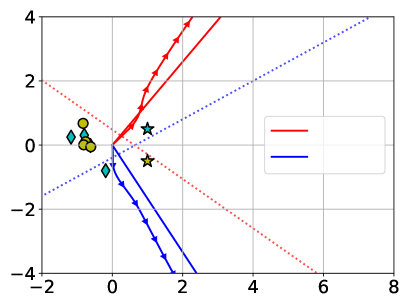
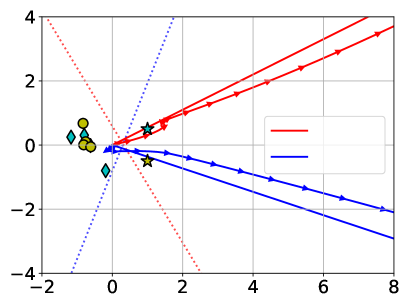
- Use empirical analysis to verify directional convergence of gradient descent to SVM solutions, measuring correlation between learned $\mathbf{W}$ and optimal $\mathbf{W}^{\text{mm}}$.
Experimental results
Research questions
- RQ1How does the optimization geometry of self-attention in transformers relate to a hard-margin SVM problem?
- RQ2What is the implicit bias of gradient descent on 1-layer transformers with $({\mathbf{K}}, {\mathbf{Q}})$ parameterization, and how does it differ from direct $\mathbf{W}$ parameterization?
- RQ3Under what conditions does gradient descent converge globally in the attention optimization landscape?
- RQ4How does over-parameterization influence the convergence behavior and landscape of attention models?
- RQ5Can the SVM equivalence be extended to nonlinear prediction heads and multi-token compositions in attention?
Key findings
- Gradient descent on $({\mathbf{K}}, {\mathbf{Q}})$-parameterized attention converges in direction to an SVM solution minimizing the nuclear norm of $\mathbf{W} = \mathbf{K}\mathbf{Q}^\top$.
- For $\mathbf{W}$-parameterized attention, gradient descent converges globally or locally depending on geometric conditions, with over-parameterization ensuring global convergence by eliminating non-global stationary points.
- Over-parameterization ensures the feasibility of the SVM problem and guarantees a benign optimization landscape devoid of spurious stationary points.
- Numerical experiments confirm that the learned attention weights $\mathbf{W}$ achieve a correlation of over 0.99 with the optimal SVM solution $\mathbf{W}^{\text{mm}}$ when $d \geq 8$ or $\Gamma \leq 10^{-9}$.
- The number of selected tokens by attention remains within the limit $\tau$ when using the generalized SVM equivalence, validating Lemma 6.
- Performance remains consistent across varying sequence length $T$, but requires $m \gtrsim n$ for accurate convergence to the SVM solution, confirming theoretical bounds on rank and dimensionality.
Read this paper
Open the full text in the Nubint reader and ask about any passage as you read.
Read this paper on NubintThis review was generated by AI from the original paper. Please check the paper before citing it.