
[Paper Review] TreeMAN: Tree-enhanced Multimodal Attention Network for ICD Coding
TreeMAN proposes a tree-enhanced multimodal attention network that fuses textual clinical notes with structured medical data from EHRs by learning decision tree-based features to improve ICD coding accuracy. By using attention mechanisms to integrate these tree-based features with text representations, TreeMAN achieves state-of-the-art performance on two MIMIC datasets, outperforming prior methods in multi-label ICD coding tasks.
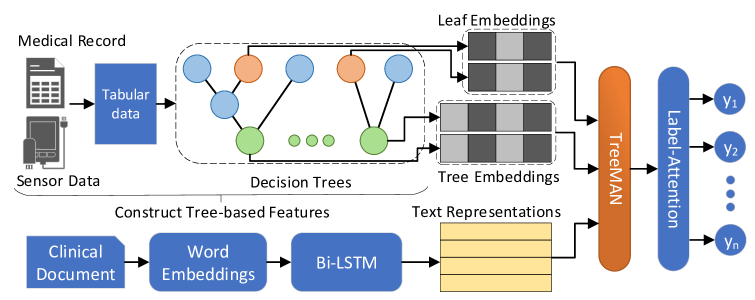
ICD coding is designed to assign the disease codes to electronic health records (EHRs) upon discharge, which is crucial for billing and clinical statistics. In an attempt to improve the effectiveness and efficiency of manual coding, many methods have been proposed to automatically predict ICD codes from clinical notes. However, most previous works ignore the decisive information contained in structured medical data in EHRs, which is hard to be captured from the noisy clinical notes. In this paper, we propose a Tree-enhanced Multimodal Attention Network (TreeMAN) to fuse tabular features and textual features into multimodal representations by enhancing the text representations with tree-based features via the attention mechanism. Tree-based features are constructed according to decision trees learned from structured multimodal medical data, which capture the decisive information about ICD coding. We can apply the same multi-label classifier from previous text models to the multimodal representations to predict ICD codes. Experiments on two MIMIC datasets show that our method outperforms prior state-of-the-art ICD coding approaches. The code is available at https://github.com/liu-zichen/TreeMAN.
Motivation & Objective
- To address the limitation of existing ICD coding models that ignore structured medical data in EHRs, which contain decisive diagnostic information.
- To improve the robustness and accuracy of automated ICD coding by integrating tabular and textual features through a unified multimodal representation framework.
- To develop a method that automatically learns informative, decision tree-derived features from structured EHR data without relying on manual feature engineering or medical knowledge.
- To enable attention-based fusion of text and tree-based features to highlight relevant multimodal signals for multi-label ICD code prediction.
- To demonstrate the effectiveness of multimodal representation learning using both clinical notes and structured EHR data on real-world ICD coding benchmarks.
Proposed method
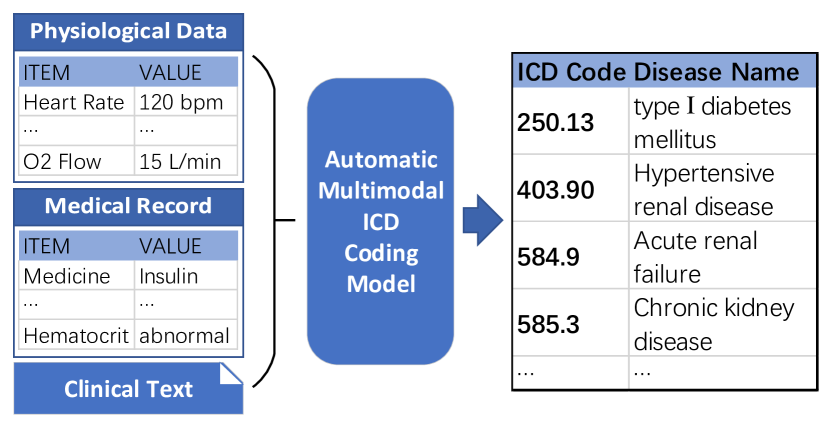
- TreeMAN constructs tree-based features by training decision trees on structured multimodal EHR data, such as lab results, prescriptions, and vital signs, to extract decisive diagnostic patterns.
- The decision tree outputs are embedded into vector representations using learned embedding layers to form tree-based feature vectors.
- Text representations are extracted from clinical notes using deep neural networks (e.g., BiLSTM or transformer-based encoders) to capture semantic context.
- An attention mechanism dynamically attends to relevant tree-based features for each text representation, enabling adaptive fusion of multimodal signals.
- The fused multimodal representations are fed into a standard multi-label classifier to predict multiple ICD codes simultaneously.
- The entire model is end-to-end trainable, with joint optimization of text encoding, tree feature embedding, attention weights, and multi-label classification.
Experimental results
Research questions
- RQ1Can tree-based features derived from structured EHR data improve the performance of automated ICD coding models?
- RQ2How effectively can attention mechanisms fuse textual clinical notes with structured medical data for multi-label ICD code prediction?
- RQ3Does the integration of decision tree-derived features lead to better representation learning compared to models relying solely on text?
- RQ4How does TreeMAN perform relative to state-of-the-art methods on benchmark ICD coding datasets?
- RQ5To what extent do tree-based features help in capturing subtle distinctions (e.g., between insulin types) that are ambiguous in clinical notes?
Key findings
- TreeMAN outperforms previous state-of-the-art ICD coding models on both MIMIC-III and MIMIC-IV datasets, demonstrating superior performance across multiple evaluation metrics.
- The integration of tree-based features significantly improves code prediction accuracy, especially for rare or ambiguous conditions where textual notes are insufficient.
- The attention mechanism effectively identifies and emphasizes relevant tree-based features for each ICD code, enhancing interpretability and representation quality.
- TreeMAN achieves higher F1-macro and F1-micro scores than baseline models that use only text or simple feature concatenation.
- The model shows robustness in handling heterogeneous data types (numerical, categorical, time-series) from EHRs without requiring extensive preprocessing.
- The ablation study confirms that tree-based features contribute more to performance than random or non-learned feature engineering, validating the method’s design choice.
Read this paper
Open the full text in the Nubint reader and ask about any passage as you read.
Read this paper on NubintThis review was generated by AI from the original paper. Please check the paper before citing it.