
[Paper Review] Trustworthy, Responsible, and Safe AI: A Comprehensive Architectural Framework for AI Safety with Challenges and Mitigations
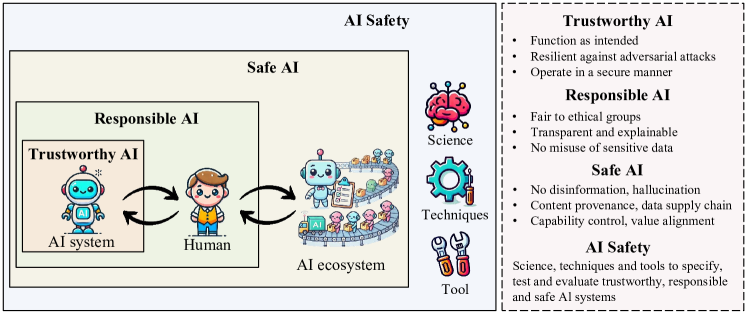
The paper proposes a three-pillar architectural framework for AI Safety—Trustworthy AI, Responsible AI, and Safe AI—and reviews challenges and mitigations with emphasis on LLM/GAI safety across ecosystems.
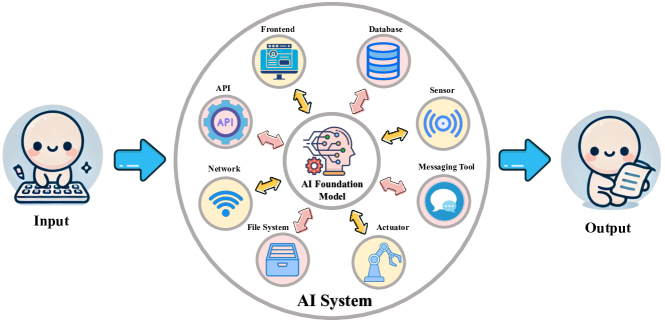
AI Safety is an emerging area of critical importance to the safe adoption and deployment of AI systems. With the rapid proliferation of AI and especially with the recent advancement of Generative AI (or GAI), the technology ecosystem behind the design, development, adoption, and deployment of AI systems has drastically changed, broadening the scope of AI Safety to address impacts on public safety and national security. In this paper, we propose a novel architectural framework for understanding and analyzing AI Safety; defining its characteristics from three perspectives: Trustworthy AI, Responsible AI, and Safe AI. We provide an extensive review of current research and advancements in AI safety from these perspectives, highlighting their key challenges and mitigation approaches. Through examples from state-of-the-art technologies, particularly Large Language Models (LLMs), we present innovative mechanism, methodologies, and techniques for designing and testing AI safety. Our goal is to promote advancement in AI safety research, and ultimately enhance people's trust in digital transformation.
Motivation & Objective
- Define an architectural framework for AI Safety built on three pillars: Trustworthy AI, Responsible AI, and Safe AI.
- Analyze challenges and vulnerabilities impacting each pillar in current AI systems and ecosystems.
- Review mitigation strategies spanning technical, ethical, and governance dimensions.
- Discuss lifecycle, governance, and testing approaches to ensure a trusted AI supply chain and societal safety.
- Illustrate concepts with examples from state-of-the-art AI technologies, especially LLMs and Generative AI.
Proposed method
- Proposes a coherent architectural framing of AI Safety around three pillars.
- Provides extensive literature review of current research and developments related to each pillar.
- Outlines challenges and vulnerabilities across input robustness, adversarial attacks, multi-modal and system-level risks.
- Discusses mitigation strategies integrating technical, ethical, and governance measures.
- Uses examples from LLMs to illustrate mechanisms, methodologies, and testing approaches for AI safety.
Experimental results
Research questions
- RQ1What are the key challenges and vulnerabilities threatening Trustworthy AI, Responsible AI, and Safe AI?
- RQ2What mitigation strategies exist to enhance AI Safety across technical, ethical, and governance dimensions?
- RQ3How do frontier AI ecosystems (e.g., LLMs/GAI) affect trust, responsibility, and safety at organizational and ecosystem levels?
- RQ4How can we test, evaluate, and govern AI models and systems to maintain a trusted AI supply chain?
Key findings
- Introduces a novel three-pillar architectural framework for AI Safety.
- Reviews broad challenges and vulnerabilities across technical, ethical, and ecosystem levels.
- Discusses mitigation strategies spanning technical safeguards, governance, and ethics.
- Highlights the role of LLMs and Generative AI in shaping safety considerations and mechanisms.
- Argues for comprehensive, ecosystem-aware safety practices to build public trust in digital transformation.
Read this paper
Open the full text in the Nubint reader and ask about any passage as you read.
Read this paper on NubintThis review was generated by AI from the original paper. Please check the paper before citing it.