
[Paper Review] Tuning charge-density wave order and superconductivity in the kagome metals KV$_3$Sb$_{5-x}$Sn$_x$ and RbV$_3$Sb$_{5-x}$Sn$_x$
This study investigates hole-doping effects in KV₃Sb₅₋ₓSnₓ and RbV₃Sb₅₋ₓSnₓ kagome metals via Sn substitution, revealing a single superconducting dome with rapidly suppressed charge-density wave (CDW) order. Hole-doping lifts the Γ pocket and van Hove singularities toward the Fermi level, enhancing superconducting transition temperature (T<sub>C</sub>) to ~4.5 K while suppressing CDW, indicating distinct parent CDW states in CsV₃Sb₅ compared to K and Rb analogs.
The family of AV$_3$Sb$_5$ (A = K, Rb, Cs) kagome metals exhibit charge density wave (CDW) order, proposed to be chiral, followed by a lower temperature superconducting state. Recent studies have proposed the importance of band structure saddle points proximal to the Fermi energy in governing these two transitions. Here we show the effects of hole-doping achieved via chemical substitution of Sn for Sb on the CDW and superconducting states in both KV$_3$Sb$_5$ and RbV$_3$Sb$_5$, and generate a phase diagram. Hole-doping lifts the $Γ$ pocket and van Hove singularities (vHs) toward $E_F$ causing the superconducting $T_C$ in both systems to increase to about 4.5 K, while rapidly suppressing the CDW state.
Motivation & Objective
- To investigate the effects of hole-doping via Sn substitution on charge-density wave (CDW) and superconducting (SC) order in KV₃Sb₅ and RbV₃Sb₅.
- To compare the resulting phase diagrams with the previously reported double superconducting dome in CsV₃Sb₅₋ₓSnₓ.
- To determine how electronic structure modifications—particularly shifts in the Γ pocket and M-point van Hove singularities—govern the interplay between CDW and SC.
- To explore the role of A-site cation size in determining solubility limits and electronic phase stability.
- To identify differences in parent CDW states between CsV₃Sb₅ and the K/Rb analogs based on doping response.
Proposed method
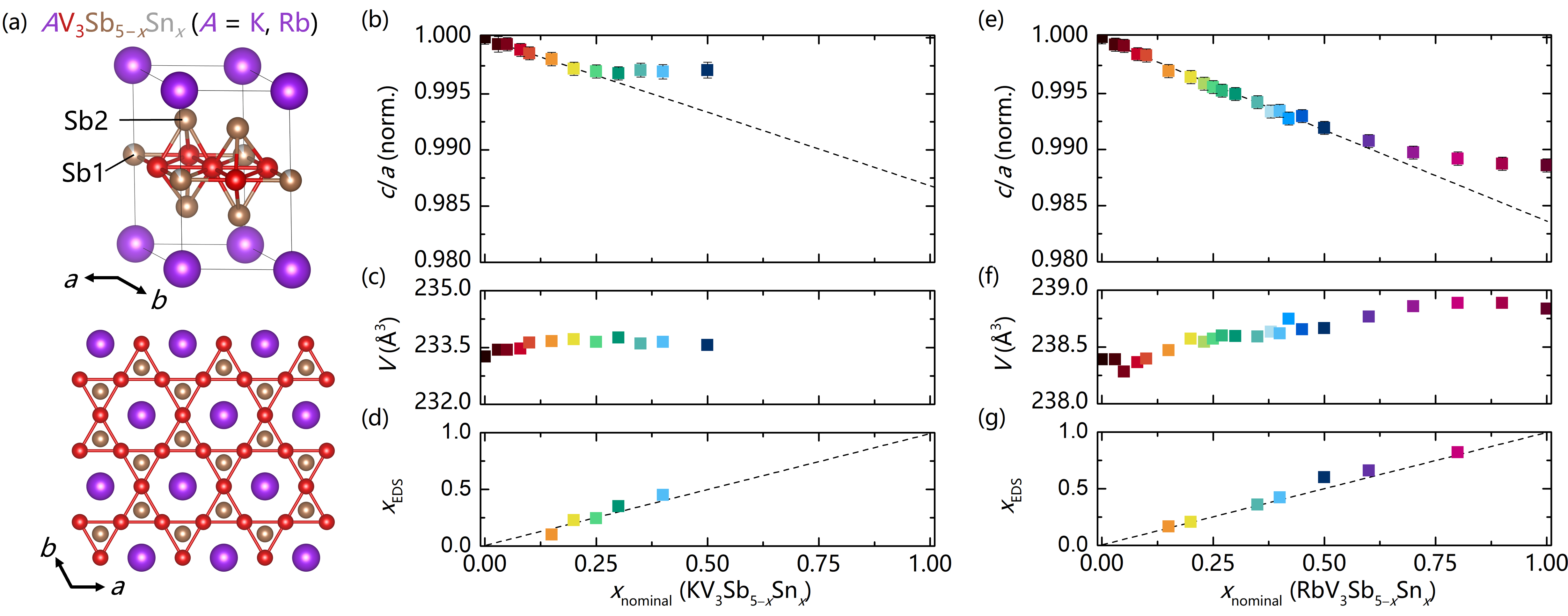
- Synthesized solid solutions KV₃Sb₅₋ₓSnₓ and RbV₃Sb₅₋ₓSnₓ across 0 ≤ x ≤ 1 using solid-state reactions.
- Performed X-ray powder diffraction and scanning electron microscopy with energy-dispersive X-ray spectroscopy (SEM-EDS) to confirm phase purity and Sn incorporation.
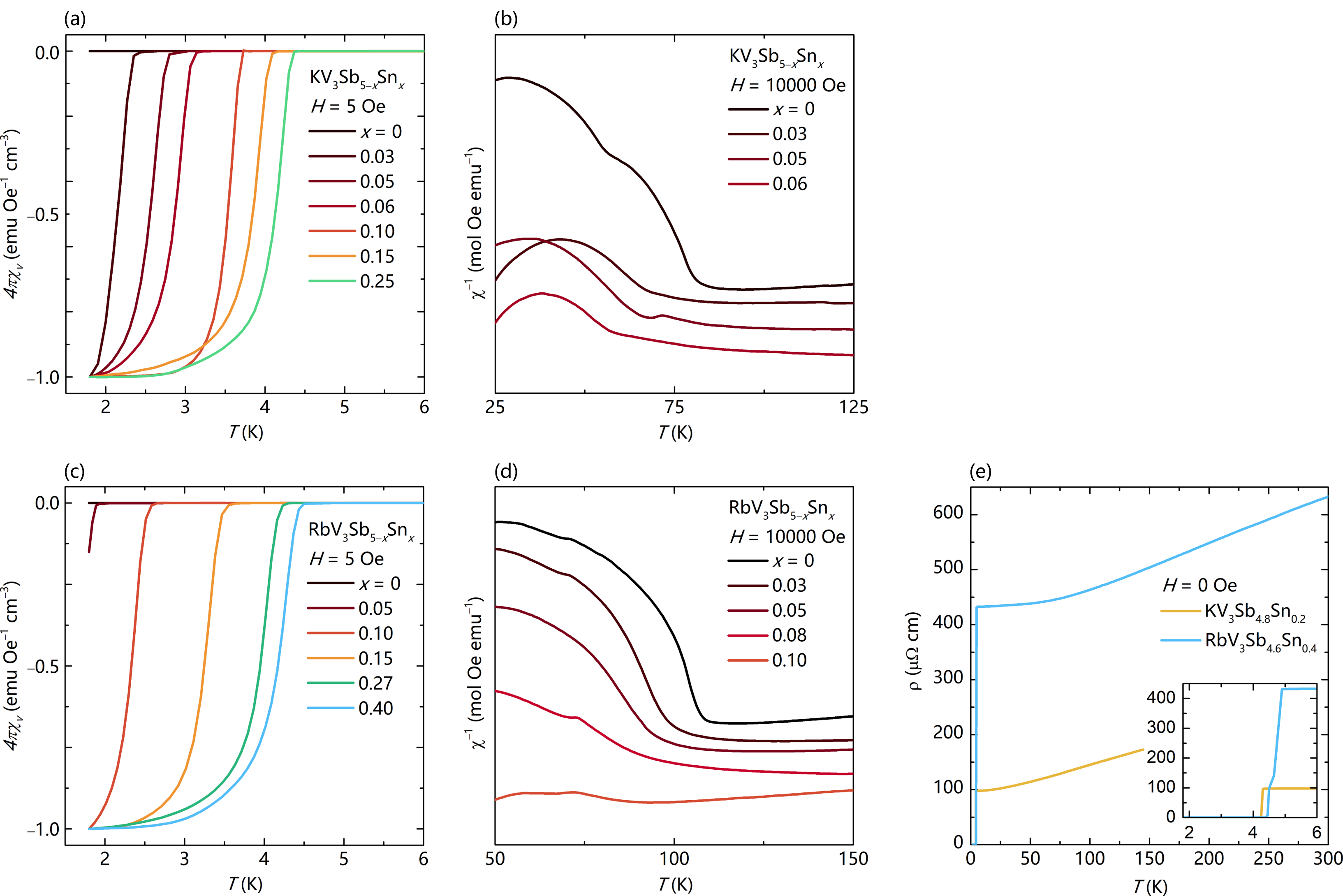
- Collected magnetization and resistivity data using MPMS and PPMS systems to determine superconducting transition temperature (T<sub>C</sub>) and CDW transition temperature (T*).
- Conducted first-principles density functional theory (DFT) calculations using VASP to compute band structures for Sn-substituted systems, focusing on Sb1 and Sb2 site substitutions.
- Analyzed changes in Fermi surface topology, including the Γ pocket and M-point van Hove singularities, under hole-doping conditions.
- Mapped the evolution of electronic structure and phase stability by comparing band structures of undoped and Sn-doped A V₃Sb₅ (A = K, Rb, Cs).
Experimental results
Research questions
- RQ1How does Sn substitution on Sb sites affect the superconducting and charge-density wave transitions in KV₃Sb₅ and RbV₃Sb₅?
- RQ2Why do KV₃Sb₅₋ₓSnₓ and RbV₃Sb₅₋ₓSnₓ exhibit a single superconducting dome, unlike the double dome observed in CsV₃Sb₅₋ₓSnₓ?
- RQ3What is the role of the Γ pocket and M-point van Hove singularities in tuning CDW and SC order in these kagome metals?
- RQ4How do differences in A-site cation size (K, Rb, Cs) influence the solubility of Sn and the resulting electronic phase diagrams?
- RQ5What are the underlying electronic structure differences that lead to distinct parent CDW states in CsV₃Sb₅ compared to K and Rb analogs?
Key findings
- Hole-doping via Sn substitution in KV₃Sb₅₋ₓSnₓ increases the superconducting transition temperature (T<sub>C</sub>) to a maximum of approximately 4.5 K, observed in compositions up to x = 0.30.
- The CDW transition temperature (T*) in KV₃Sb₅₋ₓSnₓ decreases from 86 K to 59 K and vanishes for x ≥ 0.05, indicating rapid suppression of CDW order.
- RbV₃Sb₅₋ₓSnₓ exhibits a similar single superconducting dome with T<sub>C</sub> peaking near 4.5 K, accompanied by rapid CDW suppression, consistent with KV₃Sb₅₋ₓSnₓ.
- The solubility limit of Sn in KV₃Sb₅ is low (x ≈ 0.25), while in RbV₃Sb₅ it reaches x ≈ 0.70, reflecting the influence of A-site cation size on solid solution stability.
- DFT calculations show that Sn substitution on the in-plane Sb1 site lifts the Γ pocket and M-point van Hove singularities toward the Fermi level, consistent with enhanced superconductivity and CDW suppression.
- The distinct phase diagram of CsV₃Sb₅₋ₓSnₓ—featuring a double superconducting dome—suggests a fundamentally different parent CDW state compared to KV₃Sb₅ and RbV₃Sb₅, likely due to differences in CDW symmetry and modulation patterns.
Read this paper
Open the full text in the Nubint reader and ask about any passage as you read.
Read this paper on NubintThis review was generated by AI from the original paper. Please check the paper before citing it.