
[Paper Review] Ubiquitous radio emission in quasars: predominant AGN origin and a connection to jets, dust and winds
This study establishes that compact radio emission in quasars at z < 2.5 is predominantly powered by active galactic nuclei (AGN), not star formation, with radio luminosity strongly linked to dust reddening and jet interactions in dense, circumnuclear environments. The authors find a continuous increase in radio detection fraction with E(B-V), supporting a model where jet-induced shocks in dusty media enhance radio emission, particularly in red quasars with compact morphologies and intermediate radio loudness.
We present a comprehensive study of the physical origin of radio emission in optical quasars at redshifts z < 2.5. We focus particularly on the associations between compact radio emission, dust reddening, and outflows identified in our earlier work. Leveraging the deepest low-frequency radio data available to date (LoTSS Deep DR1), we achieve radio detection fractions of up to 94%, demonstrating the virtual ubiquity of radio emission in quasars, and a continuous distribution in radio loudness. Through our analysis of radio properties, combined with spectral energy distribution modeling of multiwavelength photometry, we establish that the primary source of radio emission in quasars is the AGN, rather than star formation. Modeling the dust reddening of the accretion disk emission shows a continuous increase in radio detection in quasars as a function of the reddening parameter E(B-V), suggesting a causal link between radio emission and dust reddening. Confirming previous findings, we observe that the radio excess in red quasars is most pronounced for sources with compact radio morphologies and intermediate radio loudness. We find a significant increase in [Oiii] and Civ outflow velocities for red quasars not seen in our control sample, with particularly powerful [Oiii] winds in those around the radio-quiet/radio-loud threshold. Based on the combined characterisation of radio, reddening, and wind properties in our sample, we favor a model in which the compact radio emission observed in quasars originates in compact radio jets and their interaction with a dusty, circumnuclear environment. Our results align with the theory that jet-induced winds and shocks resulting from this interaction are the origin of the enhanced radio emission in red quasars. Further investigation of this model is crucial for advancing our understanding of quasar feedback mechanisms and their role in galaxy evolution.
Motivation & Objective
- To determine the dominant physical origin of faint radio emission in optical quasars at z < 2.5.
- To investigate the connection between radio emission, dust reddening (E(B-V)), and outflows in quasars.
- To test whether compact radio jets interacting with dense, dusty circumnuclear environments explain the observed radio excess in red quasars.
- To assess the role of jet-induced shocks and feedback in shaping quasar evolution and galaxy feedback mechanisms.
Proposed method
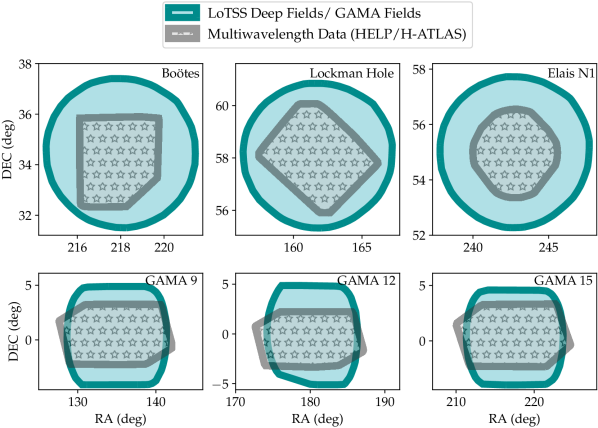
- Utilized the deepest low-frequency radio data to date (LoTSS Deep DR1) to achieve radio detection fractions up to 94% in quasars.
- Combined multiwavelength photometry with spectral energy distribution (SED) modelling to disentangle AGN and star formation contributions to radio emission.
- Quantified dust reddening using E(B-V) from SED fitting and correlated it with radio detection fractions and radio loudness.
- Analyzed [OIII] and CIV emission-line outflow velocities to identify wind activity in red versus control quasar samples.
- Classified radio morphologies as compact or extended to assess the role of environment in jet confinement and radio luminosity.
- Proposed a physical model where jet interaction with dense, dusty media produces shocks that enhance radio emission, particularly in compact sources.
Experimental results
Research questions
- RQ1What is the dominant physical origin of radio emission in quasars at z < 2.5: AGN jets or star formation?
- RQ2How is radio emission correlated with dust reddening (E(B-V)) in quasars, and does this imply a causal link?
- RQ3What is the role of compact radio jet morphology and environment in enhancing radio emission in red quasars?
- RQ4How do outflow velocities in [OIII] and CIV lines vary between red quasars and control samples, and is this linked to radio properties?
- RQ5Can jet-induced shocks in dusty, circumnuclear environments explain the observed radio excess in red quasars with compact morphologies?
Key findings
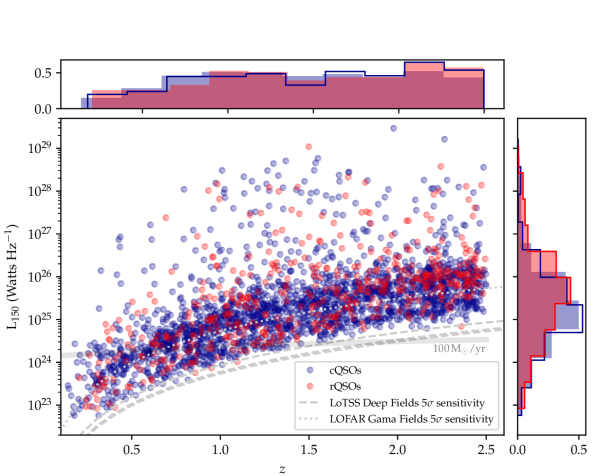
- Radio detection fractions in quasars reach up to 94% using LoTSS Deep DR1, demonstrating the near-ubiquity of radio emission in quasars.
- The primary source of radio emission is the AGN, not star formation, as confirmed by SED modelling and the dominance of compact, steep-spectrum radio components.
- Radio detection fraction increases continuously with dust reddening (E(B-V)), indicating a causal link between dust column density and enhanced radio emission.
- Radio excess in red quasars is most pronounced in sources with compact radio morphologies and intermediate radio loudness (L_1.4GHz ~ 10^44–10^45 erg/s).
- Red quasars show significantly higher [OIII] and CIV outflow velocities than the control sample, with the most powerful [OIII] winds occurring near the radio-quiet/radio-loud threshold.
- The data support a model in which compact radio jets interact with dense, dusty circumnuclear environments, producing shocks that enhance radio emission and drive outflows, linking radio, dust, and feedback mechanisms.
Read this paper
Open the full text in the Nubint reader and ask about any passage as you read.
Read this paper on NubintThis review was generated by AI from the original paper. Please check the paper before citing it.