
[Paper Review] Ultra-fast interpretable machine-learning potentials
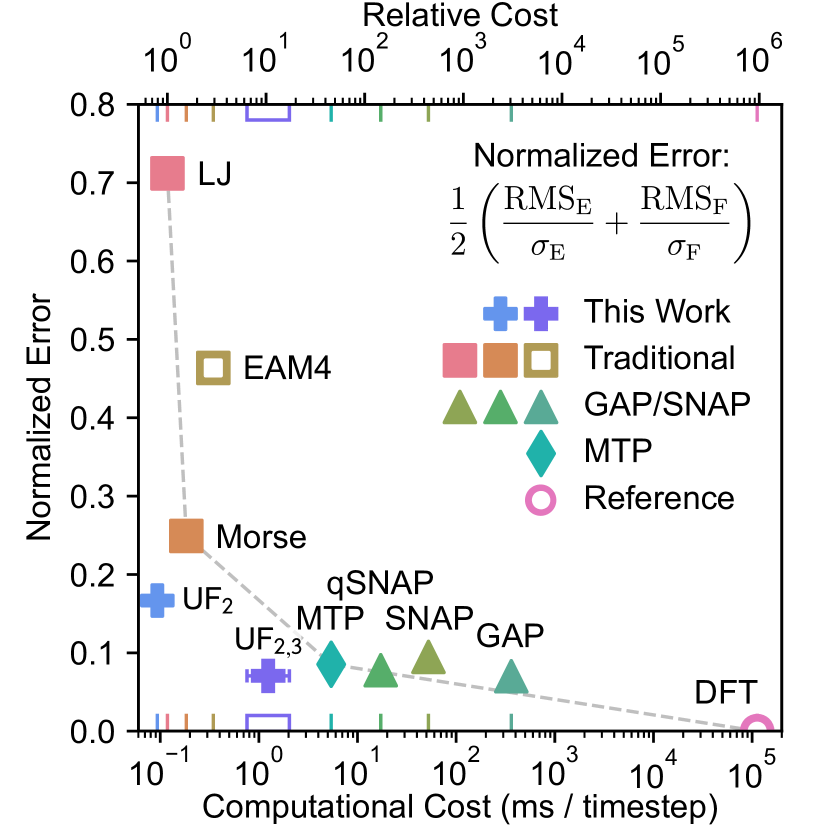
This paper introduces ultra-fast, interpretable machine-learning potentials (UF 2 and UF 2,3) that combine cubic B-spline basis functions with regularized linear regression to achieve computational speeds comparable to traditional empirical potentials (e.g., Morse, Lennard-Jones) while maintaining accuracy close to state-of-the-art machine learning potentials. The method enables accurate all-atom dynamics simulations of large systems over long timescales, with forces and properties like phonon spectra, elastic constants, and melting points matching reference density functional theory data.
All-atom dynamics simulations are an indispensable quantitative tool in physics, chemistry, and materials science, but large systems and long simulation times remain challenging due to the trade-off between computational efficiency and predictive accuracy. To address this challenge, we combine effective two- and three-body potentials in a cubic B-spline basis with regularized linear regression to obtain machine-learning potentials that are physically interpretable, sufficiently accurate for applications, as fast as the fastest traditional empirical potentials, and two to four orders of magnitude faster than state-of-the-art machine-learning potentials. For data from empirical potentials, we demonstrate exact retrieval of the potential. For data from density functional theory, the predicted energies, forces, and derived properties, including phonon spectra, elastic constants, and melting points, closely match those of the reference method. The introduced potentials might contribute towards accurate all-atom dynamics simulations of large atomistic systems over long time scales.
Motivation & Objective
- To develop machine-learning potentials that are both computationally ultra-fast and physically interpretable, overcoming the speed-accuracy trade-off in atomistic simulations.
- To enable large-scale all-atom dynamics simulations over long time scales by combining the speed of empirical potentials with the accuracy of machine-learning potentials.
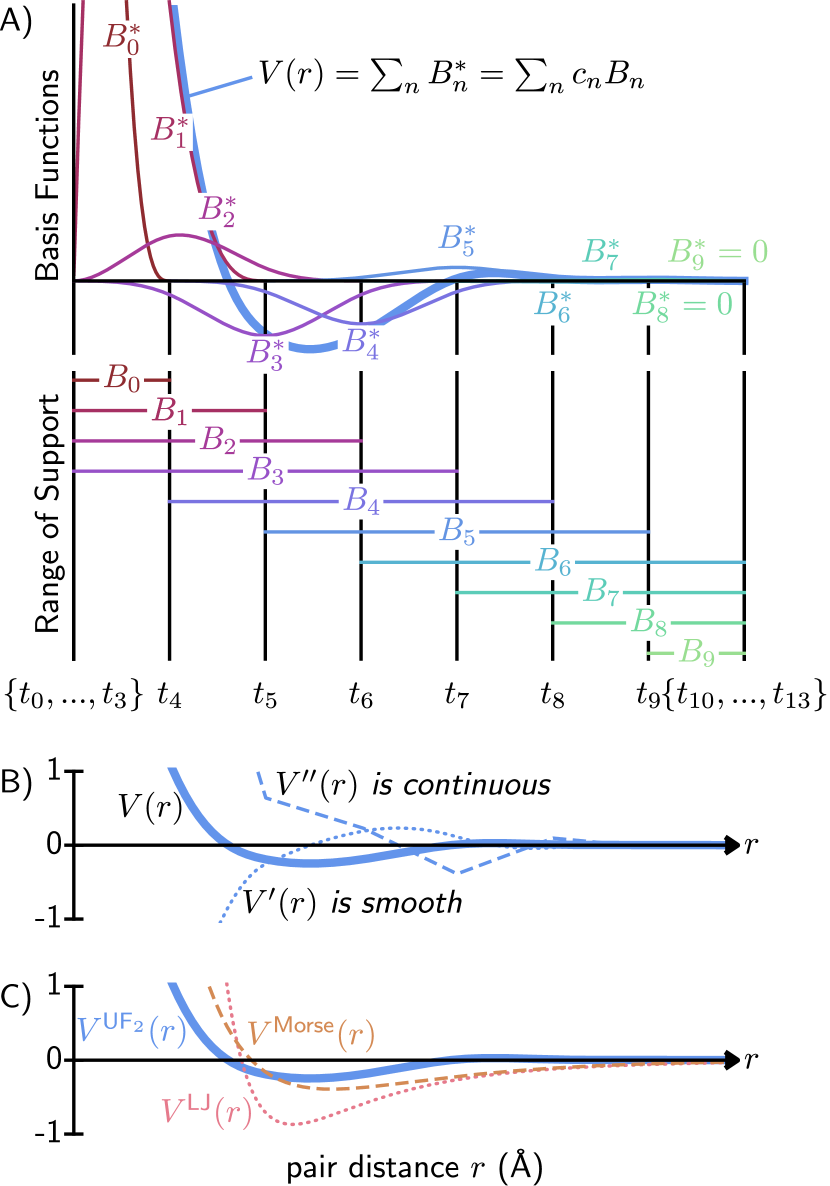
- To provide a framework for training interpretable, linear models based on effective two- and three-body interactions using flexible B-spline basis functions.
- To demonstrate that the proposed method achieves near-DFT accuracy in predicting key physical properties such as forces, phonon spectra, elastic constants, and melting points.
- To make the trained potentials accessible and interoperable with major molecular dynamics software like LAMMPS and GROMACS via tabulated force fields.
Proposed method
- The method uses a cubic B-spline basis to represent effective two- and three-body potentials, enabling smooth, flexible, and differentiable interpolation of energy and force data.
- Regularized linear regression is applied to fit the B-spline coefficients to reference data from empirical potentials or density functional theory (DFT).
- The approach truncates the many-body expansion after two- and three-body terms, focusing on pairwise and angular interactions while omitting higher-order terms for computational efficiency.
- The model is trained on data from DFT or empirical potentials, with exact retrieval of the original potential when trained on empirical data.
- The resulting potentials are exported as lookup tables compatible with LAMMPS, GROMACS, and other MD packages, enabling fast evaluation on CPUs and GPUs.
- The method supports multi-component systems through straightforward extension of the B-spline basis to include element species.
Experimental results
Research questions
- RQ1Can a linear machine-learning potential be designed to achieve both the speed of traditional empirical potentials and the accuracy of state-of-the-art machine-learning potentials?
- RQ2To what extent can interpretable, physically motivated functional forms (e.g., two- and three-body terms) combined with B-spline basis functions reproduce reference DFT data with minimal parametrization?
- RQ3How do the predicted physical properties—such as phonon spectra, elastic constants, and melting points—of the ultra-fast potentials compare to those from DFT and other machine-learning potentials?
- RQ4Can the method be generalized to multi-component systems while preserving accuracy and computational efficiency?
- RQ5What is the computational cost of the ultra-fast potential relative to existing machine-learning and empirical potentials across different system sizes?
Key findings
- The ultra-fast potential (UF 2,3) achieves computational speeds comparable to the fastest empirical potentials (e.g., Morse, Lennard-Jones), with a benchmark cost of 0.76–2.03 ms/step on an AMD EPYC 7702 CPU.
- When trained on empirical potential data, the model exactly retrieves the original potential, confirming its representational fidelity.
- For DFT-derived training data, the predicted energies, forces, phonon spectra, elastic constants, and melting points closely match reference DFT results, demonstrating high accuracy.
- The melting point predicted by the UF 2,3 potential (3650 K) is in excellent agreement with the DFT reference value of 3650 K, validating its thermodynamic accuracy.
- Elastic constants and phonon dispersion relations computed with the UF 2,3 potential show strong agreement with DFT, confirming its mechanical and vibrational accuracy.
- The method enables accurate all-atom dynamics simulations of large systems (e.g., 2048 atoms) over long timescales, as demonstrated by successful two-phase melting point calculations.
Read this paper
Open the full text in the Nubint reader and ask about any passage as you read.
Read this paper on NubintThis review was generated by AI from the original paper. Please check the paper before citing it.