
[Paper Review] Ultrabroadband thin-film lithium tantalate modulator for high-speed communications
This paper demonstrates a 110 GHz ultrabroadband thin-film lithium tantalate (LiTaO₃) Mach-Zehnder modulator on a lithium tantalate-on-insulator (LTOI) platform, achieving a net data rate of 405 Gbit/s using 176 GBd PAM8 signaling. The device leverages silver electrodes to reduce microwave loss and exhibits superior DC bias stability compared to lithium niobate counterparts, positioning LTOI as a scalable, low-cost alternative for high-speed, energy-efficient optical communications.
The continuous growth of global data traffic over the past three decades, along with advances in disaggregated computing architectures, presents significant challenges for optical transceivers in communication networks and high-performance computing systems. Specifically, there is a growing need to significantly increase data rates while reducing energy consumption and cost. High-performance optical modulators based on materials such as InP, thin-film lithium niobate (LiNbO3), or plasmonics have been developed, with LiNbO3 excelling in high-speed and low-voltage modulation. Nonetheless, the widespread industrial adoption of thin film LiNbO3 remains compounded by the rather high cost of the underlying 'on insulator' substrates -- in sharp contrast to silicon photonics, which can benefit from strong synergies with high-volume applications in conventional microelectronics. Here, we demonstrate an integrated 110 GHz modulator using thin-film lithium tantalate (LiTaO3) -- a material platform that is already commercially used for millimeter-wave filters and that can hence build upon technological and economic synergies with existing high-volume applications to offer scalable low-cost manufacturing. We show that the LiTaO3 photonic integrated circuit based modulator can support 176 GBd PAM8 transmission at net data rates exceeding 400 Gbit/s. Moreover, we show that using silver electrodes can reduce microwave losses compared to previously employed gold electrodes. Our demonstration positions LiTaO3 modulator as a novel and highly promising integration platform for next-generation high-speed, energy-efficient, and cost-effective transceivers.
Motivation & Objective
- Address the growing demand for higher data rates, lower energy consumption, and reduced cost in optical transceivers for data centers and communication networks.
- Overcome the high substrate cost barrier limiting industrial adoption of thin-film lithium niobate (LNOI) modulators despite their superior performance.
- Leverage the existing high-volume manufacturing ecosystem of lithium tantalate (LiTaO₃) for millimeter-wave filters to enable cost-effective, scalable photonic integrated circuits.
- Demonstrate a high-speed, low-loss, and stable electro-optic modulator using thin-film LiTaO₃ on insulator (LTOI) substrates with improved electrode and device design.
- Establish LTOI as a viable alternative to LNOI and silicon photonics for next-generation optical transceivers by combining performance, stability, and manufacturability.
Proposed method
- Fabricated a thin-film lithium tantalate (LiTaO₃) Mach-Zehnder modulator (MZM) on a lithium tantalate-on-insulator (LTOI) substrate using CMi and IPHYS cleanroom facilities.
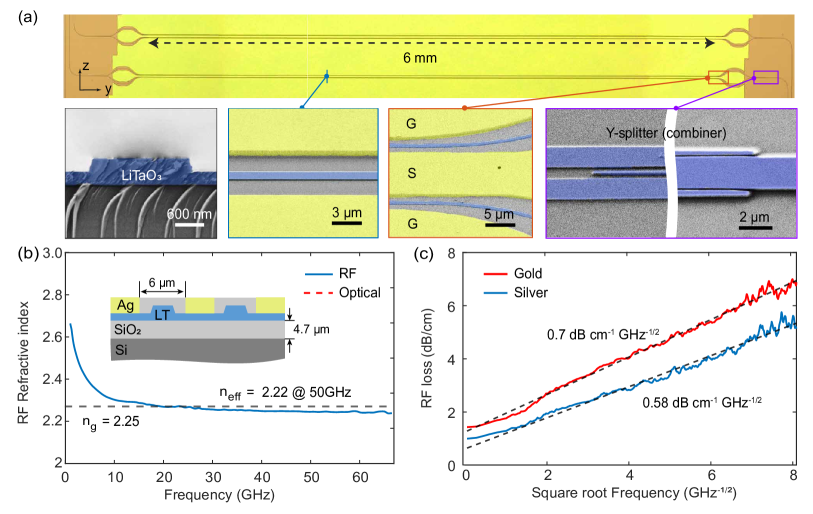
- Employed silver electrodes instead of gold to reduce microwave propagation losses in the high-frequency electrical signal path.
- Designed a ground-single-ground (GSG) electrode configuration to enhance impedance matching and reduce signal distortion at high frequencies.
- Utilized a Y-splitter and waveguide structure to achieve efficient optical power splitting and phase control in the MZM.
- Conducted intensity-modulation direct-detection (IMDD) transmission experiments with PAM signaling (PAM2, PAM4, PAM8) at symbol rates up to 176 GBd.
- Analyzed bit error rate (BER), achieved information rate (AIR), and net data rate (NDR) using log-likelihood ratio (LLR) and additive white Gaussian noise (AWGN) channel modeling.
Experimental results
Research questions
- RQ1Can a thin-film lithium tantalate (LiTaO₃) modulator on an LTOI platform achieve high bandwidth and low loss comparable to state-of-the-art LNOI devices?
- RQ2Does replacing gold electrodes with silver electrodes in LiTaO₃ modulators significantly reduce microwave propagation losses?
- RQ3How does the DC bias stability of LTOI modulators compare to that of LNOI modulators under high-speed operation?
- RQ4What is the maximum net data rate achievable using PAM signaling on an LTOI-based MZM with advanced signal processing?
- RQ5Can the LTOI platform enable scalable, low-cost manufacturing of high-speed optical modulators by leveraging existing industrial infrastructure?
Key findings
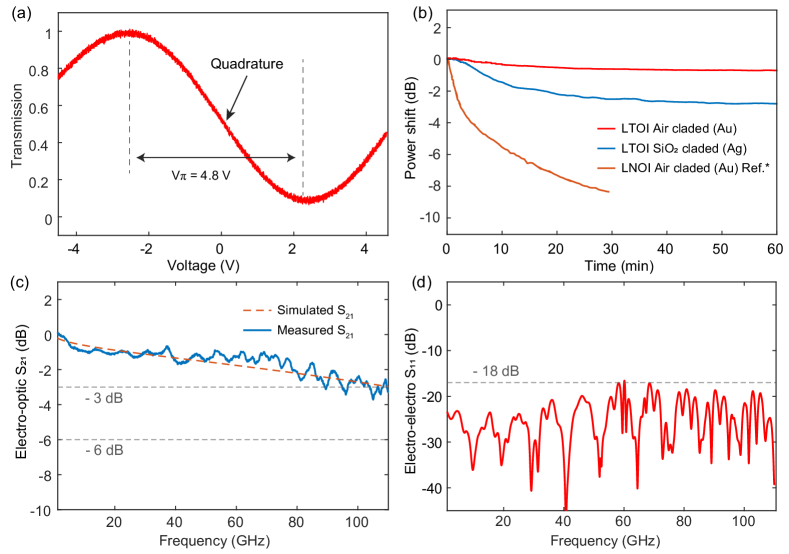
- The LTOI-based MZM achieved an electro-optic 3 dB bandwidth of 110 GHz, enabling high-speed operation suitable for next-generation optical links.
- Using silver electrodes reduced microwave losses compared to gold, improving signal integrity at high frequencies.
- The device exhibited significantly lower DC bias drift than comparable LNOI modulators, enhancing long-term stability.
- A net data rate of 405 Gbit/s was achieved using 176 GBd PAM8 signaling, with a BER of 3.8×10⁻², which remains below the 25% soft-decision FEC threshold.
- The highest achieved information rate (AIR) was 432 Gbit/s, demonstrating the platform’s potential for terabit-scale transmission.
- The results position LTOI as a scalable, cost-effective alternative to LNOI and silicon photonics, with strong potential for industrial adoption due to existing manufacturing synergy in the LiTaO₃ industry.
Read this paper
Open the full text in the Nubint reader and ask about any passage as you read.
Read this paper on NubintThis review was generated by AI from the original paper. Please check the paper before citing it.