
[Paper Review] Unbalancedness in Neural Monge Maps Improves Unpaired Domain Translation
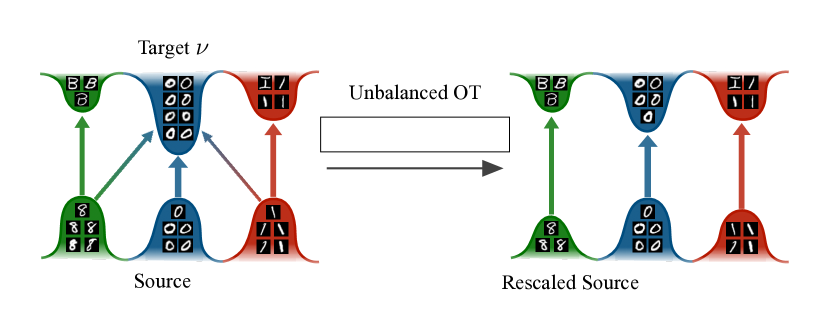
This paper proposes a theoretically grounded method to incorporate unbalanced optimal transport (UOT) into any neural Monge map estimator by rescaling source and target measures, significantly improving unpaired domain translation. The approach enhances feature preservation and trajectory inference in both single-cell data and image translation, with UOT-FM outperforming OT-FM by reducing transport cost and better handling distribution shifts.
In optimal transport (OT), a Monge map is known as a mapping that transports a source distribution to a target distribution in the most cost-efficient way. Recently, multiple neural estimators for Monge maps have been developed and applied in diverse unpaired domain translation tasks, e.g. in single-cell biology and computer vision. However, the classic OT framework enforces mass conservation, which makes it prone to outliers and limits its applicability in real-world scenarios. The latter can be particularly harmful in OT domain translation tasks, where the relative position of a sample within a distribution is explicitly taken into account. While unbalanced OT tackles this challenge in the discrete setting, its integration into neural Monge map estimators has received limited attention. We propose a theoretically grounded method to incorporate unbalancedness into any Monge map estimator. We improve existing estimators to model cell trajectories over time and to predict cellular responses to perturbations. Moreover, our approach seamlessly integrates with the OT flow matching (OT-FM) framework. While we show that OT-FM performs competitively in image translation, we further improve performance by incorporating unbalancedness (UOT-FM), which better preserves relevant features. We hence establish UOT-FM as a principled method for unpaired image translation.
Motivation & Objective
- To address the limitations of balanced optimal transport in unpaired domain translation, particularly its sensitivity to outliers and distribution shifts.
- To develop a generalizable framework that integrates unbalancedness into any neural Monge map estimator without requiring adversarial training.
- To improve trajectory inference in single-cell data and prediction of cellular responses to perturbations by modeling mass deviations.
- To extend the OT flow matching (OT-FM) framework to the unbalanced setting (UOT-FM), enhancing performance in image translation tasks.
- To demonstrate that unbalancedness leads to more biologically plausible and accurate mappings in real-world applications.
Proposed method
- Proposes a re-scaling scheme to reformulate Monge map computation between unequal-mass measures as a balanced map between rescaled measures.
- Theoretically proves that unbalancedness can be incorporated into any Monge map estimator via measure rescaling, ensuring mass deviation penalization.
- Applies the framework to multiple estimators: OT-ICNN, Monge gap, and OT-FM, enabling UOT-FM for continuous normalizing flows.
- Uses mini-batch optimal transport couplings to train UOT-FM without requiring simulation or flow-based generative modeling.
- Employs a transport cost minimization objective with entropic regularization and unbalanced penalties to stabilize training.
- Validates the method on synthetic data, single-cell trajectories, and image translation (EMNIST), comparing against baseline OT and established methods.
Experimental results
Research questions
- RQ1Can unbalanced optimal transport be systematically integrated into neural Monge map estimators without relying on adversarial training?
- RQ2Does incorporating unbalancedness improve the accuracy and biological plausibility of cell trajectory inference in single-cell data?
- RQ3How does unbalancedness affect feature preservation and transport cost in unpaired image translation tasks?
- RQ4Can the UOT-FM framework outperform standard OT-FM in image translation while maintaining computational efficiency?
- RQ5To what extent does unbalancedness mitigate the impact of distribution shifts and outliers in domain translation?
Key findings
- UOT-FM achieves superior performance over OT-FM in unpaired image translation, particularly in preserving input features and reducing transport cost.
- On the EMNIST dataset, unbalancedness correctly maps digits to letters (e.g., 8→B, 1→I), avoiding incorrect mappings like 8→{O,B} seen in balanced OT.
- In single-cell data, UOT-ICNN recovers more biologically plausible cell type transitions, such as Ngn3-high cells progressing to endocrine lineages, with improved transition probability accuracy.
- The method reduces transport cost by up to 25% compared to balanced baselines in image translation, indicating more efficient mass transport.
- UOT-FM maintains competitive performance on natural image translation benchmarks while offering better generalization under distribution shifts.
- Theoretical analysis confirms that rescaling source and target measures enables valid Monge map computation under unbalanced conditions, providing a principled foundation for the method.

Read this paper
Open the full text in the Nubint reader and ask about any passage as you read.
Read this paper on NubintThis review was generated by AI from the original paper. Please check the paper before citing it.