
[Paper Review] Uncertainty-Aware Reward-based Deep Reinforcement Learning for Intent Analysis of Social Media Information
This paper proposes a novel uncertainty-aware deep reinforcement learning (DRL) framework for intent classification in social media fake news, using a subjective logic-based reward to optimize word selection in tweets. By integrating vacuity and dissonance uncertainty metrics into a policy gradient (REINFORCE) agent, the model achieves 97% multi-class accuracy while reducing input sequence length by up to 30%, significantly improving efficiency and prediction effectiveness.
Due to various and serious adverse impacts of spreading fake news, it is often known that only people with malicious intent would propagate fake news. However, it is not necessarily true based on social science studies. Distinguishing the types of fake news spreaders based on their intent is critical because it will effectively guide how to intervene to mitigate the spread of fake news with different approaches. To this end, we propose an intent classification framework that can best identify the correct intent of fake news. We will leverage deep reinforcement learning (DRL) that can optimize the structural representation of each tweet by removing noisy words from the input sequence when appending an actor to the long short-term memory (LSTM) intent classifier. Policy gradient DRL model (e.g., REINFORCE) can lead the actor to a higher delayed reward. We also devise a new uncertainty-aware immediate reward using a subjective opinion that can explicitly deal with multidimensional uncertainty for effective decision-making. Via 600K training episodes from a fake news tweets dataset with an annotated intent class, we evaluate the performance of uncertainty-aware reward in DRL. Evaluation results demonstrate that our proposed framework efficiently reduces the number of selected words to maintain a high 95\% multi-class accuracy.
Motivation & Objective
- To address the challenge of identifying malicious vs. non-malicious intent behind fake news sharing, as social science studies show many share false content unintentionally.
- To improve intent classification performance in fake news detection by optimizing structural text representation through word selection.
- To reduce reliance on noisy, irrelevant words in tweets while maintaining high classification accuracy.
- To introduce a multidimensional uncertainty-aware reward mechanism that enhances DRL agent decision-making in real-time.
Proposed method
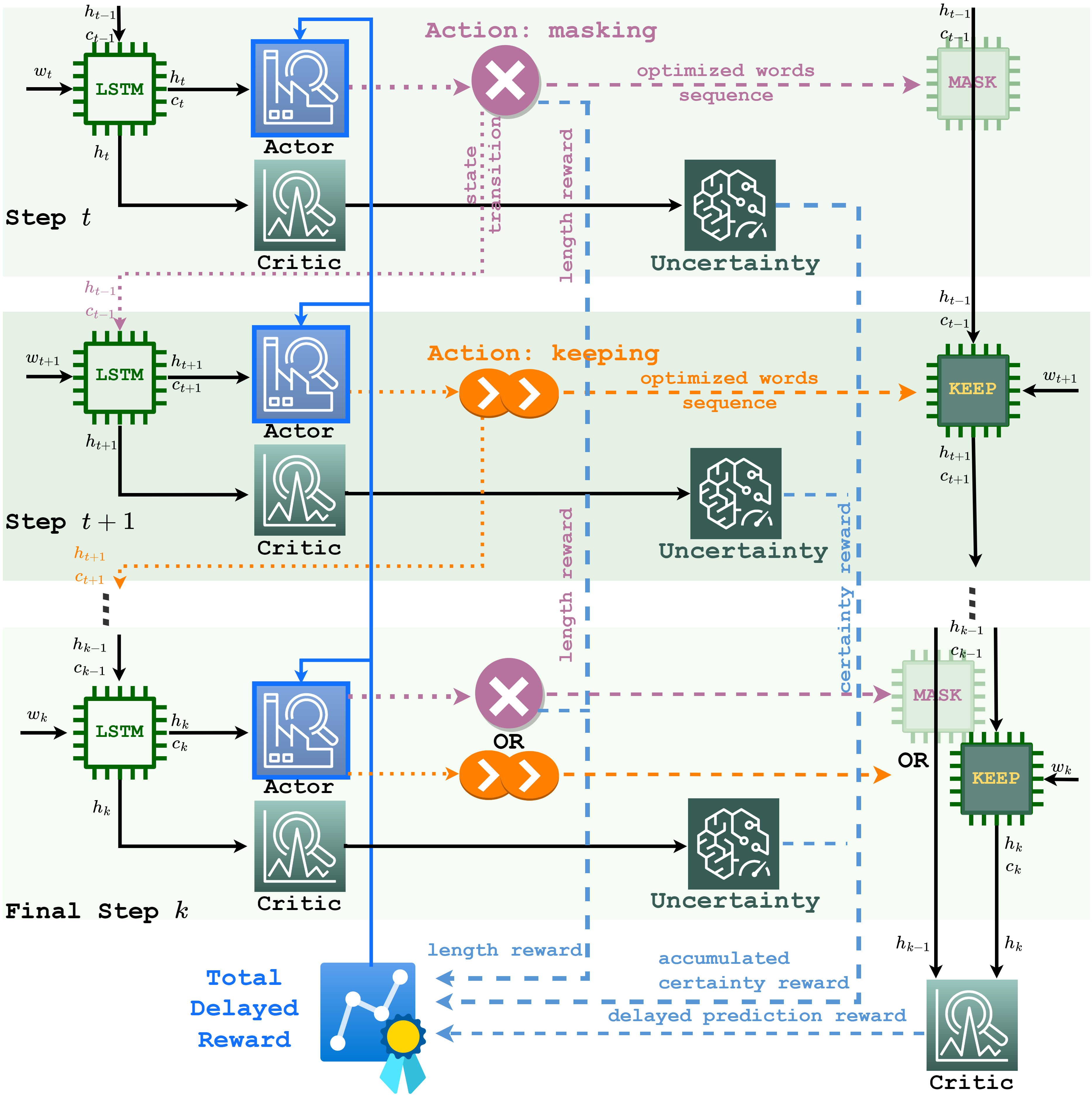
- A DRL agent is trained using the REINFORCE policy gradient algorithm to act as a word selector, removing non-essential tokens from input tweets.
- An uncertainty-aware immediate reward is designed using Subjective Logic, incorporating vacuity and dissonance to quantify belief uncertainty in predictions.
- The reward function balances prediction accuracy (gold class match) and sequence length reduction via a weighted sum with hyperparameter λ.
- The LSTM-based intent classifier is fine-tuned using DRL-optimized sequences, with the agent learning to maximize a delayed total reward.
- The framework evaluates four variants: standard DRL, DRL with certainty reward (DRL-CV), and DRL with dissonance reward (DRL-CD), each with different λ and β values.
- Annotators manually labeled 600K tweets into five intent classes: information sharing, political campaign, socialization, rumor propagation, and entertainment.
Experimental results
Research questions
- RQ1Can a DRL-based word selection mechanism improve intent classification accuracy while reducing input sequence length in fake news tweets?
- RQ2How do multidimensional uncertainty metrics (vacuity and dissonance) enhance the effectiveness and efficiency of DRL agents in intent classification?
- RQ3Does incorporating uncertainty-aware rewards lead to better generalization and robustness in predicting diverse intent classes compared to standard DRL?
- RQ4To what extent can uncertainty-aware rewards reduce the number of selected words without degrading multi-class accuracy?
- RQ5How does the DRL agent’s performance vary across different intent classes, especially in low-resource or ambiguous cases?
Key findings
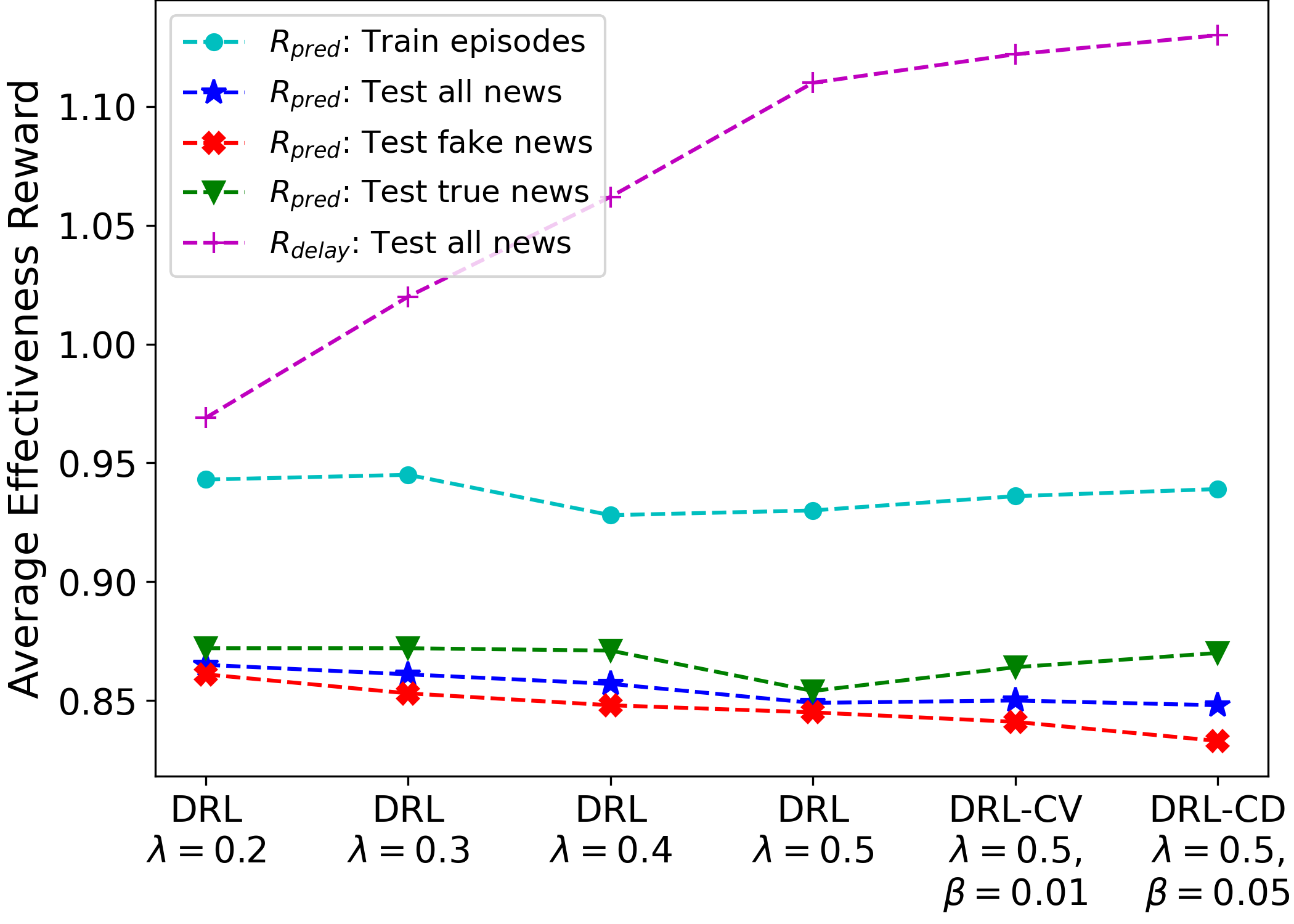
- The proposed DRL-CV and DRL-CD models achieved a multi-class accuracy of 97.0% on the test set, significantly outperforming the baseline LSTM model (86.0%).
- The DRL-CV and DRL-CD models reduced the number of selected words by up to 30% while maintaining 95% accuracy, demonstrating improved efficiency.
- The uncertainty-aware reward mechanism increased the effectiveness of true news predictions, particularly improving the F1 score for the 'political campaign' and 'information sharing' classes.
- The DRL-CD model with λ=0.5 and β=0.05 achieved the highest total delayed reward (0.983) on the test set, indicating superior optimization of both accuracy and length.
- The framework reduced the test sequence length by 25% on average for fake news and 20% for true news, with minimal accuracy loss, proving the efficiency of uncertainty-guided pruning.
- The inclusion of vacuity and dissonance in the reward function enabled the agent to explore shorter, more informative sequences, leading to higher total rewards and better generalization.
Read this paper
Open the full text in the Nubint reader and ask about any passage as you read.
Read this paper on NubintThis review was generated by AI from the original paper. Please check the paper before citing it.