
[Paper Review] Uncertainty-Aware Semi-Supervised Few Shot Segmentation
This paper proposes an uncertainty-aware semi-supervised few-shot segmentation method that improves prototype-based segmentation by refining pseudo labels from unlabeled images using uncertainty estimation. By filtering out high-uncertainty predictions during pseudo label generation, the model learns more robust foreground and background prototypes, achieving state-of-the-art performance on PASCAL-5i and COCO-20i benchmarks without additional training.
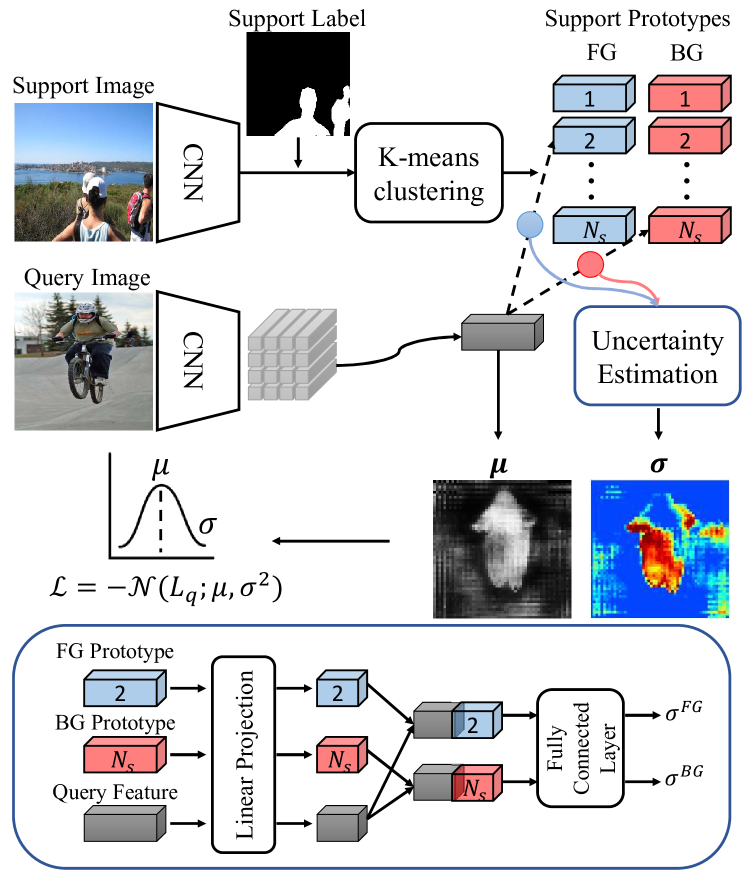
Few shot segmentation (FSS) aims to learn pixel-level classification of a target object in a query image using only a few annotated support samples. This is challenging as it requires modeling appearance variations of target objects and the diverse visual cues between query and support images with limited information. To address this problem, we propose a semi-supervised FSS strategy that leverages additional prototypes from unlabeled images with uncertainty guided pseudo label refinement. To obtain reliable prototypes from unlabeled images, we meta-train a neural network to jointly predict segmentation and estimate the uncertainty of predictions. We employ the uncertainty estimates to exclude predictions with high degrees of uncertainty for pseudo label construction to obtain additional prototypes based on the refined pseudo labels. During inference, query segmentation is predicted using prototypes from both support and unlabeled images including low-level features of the query images. Our approach is end-to-end and can easily supplement existing approaches without the requirement of additional training to employ unlabeled samples. Extensive experiments on PASCAL-$5^i$ and COCO-$20^i$ demonstrate that our model can effectively remove unreliable predictions to refine pseudo labels and significantly improve upon state-of-the-art performances.
Motivation & Objective
- To address the challenge of limited support data in few-shot segmentation, where appearance variations and distribution shifts between support and query images degrade performance.
- To improve prototype-based few-shot segmentation by leveraging unlabeled images to generate additional, reliable prototypes.
- To reduce performance degradation from noisy or overconfident pseudo labels in semi-supervised FSS by incorporating uncertainty estimation during pseudo label refinement.
- To enable end-to-end training that integrates unlabeled data without requiring additional learning or fine-tuning steps.
Proposed method
- The model jointly predicts segmentation masks and estimates uncertainty (variance) for each pixel using a neural network trained under a Gaussian assumption on output distributions.
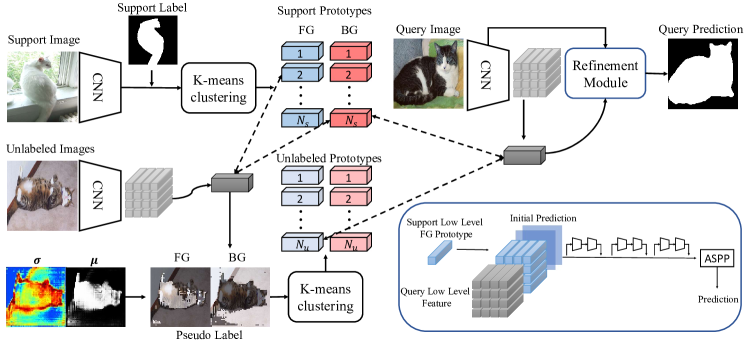
- Uncertainty estimates are used to filter out high-uncertainty predictions during pseudo label generation from unlabeled images, retaining only high-mean, low-uncertainty predictions.
- Refined pseudo labels are used to extract additional foreground and background prototypes from unlabeled images, enriching the prototype set.
- During inference, the model combines support-set prototypes with the newly acquired unlabeled prototypes, along with low-level query features, to improve segmentation accuracy.
- The uncertainty estimation module is integrated end-to-end into the base FSS model, allowing plug-and-play integration without retraining.
- The method uses a refinement module R that processes query features and pseudo-labeled unlabeled images to generate improved prototypes.
Experimental results
Research questions
- RQ1Can uncertainty estimation improve the reliability of pseudo labels generated from unlabeled images in few-shot segmentation?
- RQ2How does filtering high-uncertainty predictions during pseudo label construction affect the quality of learned prototypes and segmentation performance?
- RQ3Can additional prototypes from unlabeled data significantly improve few-shot segmentation when combined with uncertainty-aware refinement?
- RQ4Does the proposed method generalize across different backbones and benchmarks without requiring additional training?
Key findings
- On PASCAL-5i with ResNet-50, the proposed method achieved a 1-shot mean-IoU of 31.1 and 5-shot mean-IoU of 41.0, outperforming the baseline PPNet* by +2.2% and +2.5% respectively.
- On COCO-20i, the model achieved a 1-shot mean-IoU of 32.8 and 5-shot mean-IoU of 43.9, setting new state-of-the-art results, especially in the 5-shot setting.
- The method achieved the best 1-shot binary-IoU on COCO-20i, indicating superior performance on hard positive examples.
- Qualitative results showed that uncertainty filtering suppressed false positive activations (e.g., misclassifying legs as foreground), improving pseudo label quality.
- t-SNE visualization confirmed that prototypes from unlabeled images provided better-aligned representations in feature space, improving decision boundaries.
- The model demonstrated consistent performance gains even with increasing numbers of unlabeled images, showing robustness to data scale.
Read this paper
Open the full text in the Nubint reader and ask about any passage as you read.
Read this paper on NubintThis review was generated by AI from the original paper. Please check the paper before citing it.