
[Paper Review] Uncorrelated estimations of $H_0$ redshift evolution from DESI baryon acoustic oscillation observations
This study uses non-parametric estimation with diagonalized covariance matrices to analyze DESI's first-year baryon acoustic oscillation data, revealing a significant 8.6σ decreasing trend in the Hubble constant $H_0$ with redshift. The result supports evolving Hubble parameter dynamics, offering a potential resolution to the Hubble tension within a flat $\Lambda$CDM framework.
The Dark Energy Spectroscopic Instrument (DESI) collaboration recently released the first year data of baryon acoustic oscillations (BAOs). Based on the five different tracers, the cosmological constraint shows a hint of deviation from the standard $Λ$CDM model. In this letter, we combine the DESI BAOs with other cosmic probes to constrain the evolution of Hubble constant as a function of redshift in the flat $Λ$CDM model. The non-parametric method is used to estimate the value of Hubble constant at different redshift bins. The correlation among different bins are removed by diagonalizing the covariance matrix. The joint data sample demonstrate a decreasing trend of Hubble constant with a significance of $6.4 σ$, which can naturally resolve the Hubble tension. To avoid statistical effects caused by the binning methods, we tested other three different binning methods and also found a decreasing trend. It may be due to dynamical dark energy or modified gravity.
Motivation & Objective
- To investigate the redshift evolution of the Hubble constant $H_0$ using the latest DESI baryon acoustic oscillation (BAO) data.
- To test whether the observed Hubble tension can be resolved by a redshift-dependent $H_0$ rather than a constant value.
- To apply a non-parametric method that removes correlations between redshift bins for more robust cosmological constraints.
- To combine DESI BAO data with H(z), Pantheon+ SNe Ia, and BAO data to improve constraints on $H_0(z)$ evolution.
- To assess the significance of a decreasing $H_0(z)$ trend and evaluate its implications for dynamical dark energy or modified gravity models.
Proposed method
- Employs a non-parametric method to estimate $H_0$ in nine redshift bins from $z=0$ to $z=2.4$, avoiding parametric assumptions about the evolution form.
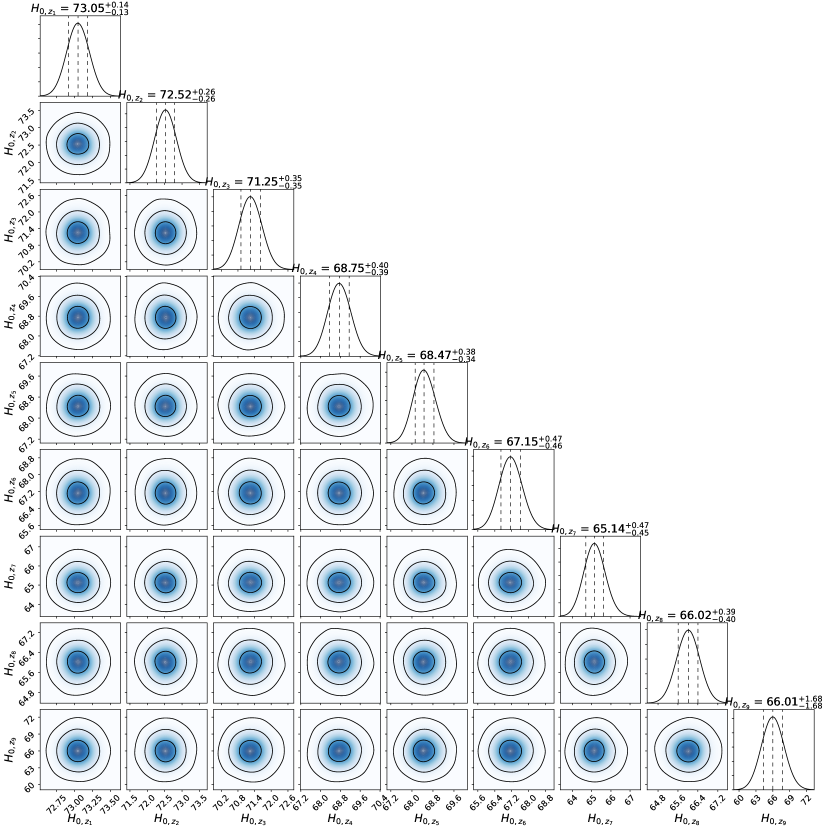
- Uses principal component analysis (PCA) to diagonalize the covariance matrix, thereby removing correlations between $H_0$ estimates in different redshift bins.
- Combines DESI's first-year BAO measurements—$D_M/r_d$, $D_H/r_d$, and $D_V/r_d$—from five tracers: bright galaxies, luminous red galaxies, emission line galaxies, quasars, and Lyman-$\alpha$ forest.
- Incorporates additional data: 33 $H(z)$ measurements from cosmic chronometers, 12 old BAO measurements, and 1550 SNe Ia from the Pantheon+ sample.
- Applies the null hypothesis test to quantify the significance of the decreasing $H_0(z)$ trend, using the test statistic $\chi^2_{\text{null}}$.
- Calibrates all BAO distances using the CMB-determined sound horizon $r_d = 147.1$ Mpc from Planck 2020.
Experimental results
Research questions
- RQ1Does the Hubble constant exhibit measurable evolution with redshift when constrained by the latest DESI BAO data?
- RQ2What is the statistical significance of a decreasing $H_0(z)$ trend across the redshift range $0 \leq z \leq 2.4$?
- RQ3How does the inclusion of DESI's first-year BAO data improve constraints on $H_0(z)$ compared to previous studies?
- RQ4Can the observed $H_0$ evolution resolve the Hubble tension without invoking new physics beyond the $\Lambda$CDM model?
- RQ5To what extent do systematic uncertainties in SNe Ia or BAO data affect the inferred $H_0(z)$ evolution?
Key findings
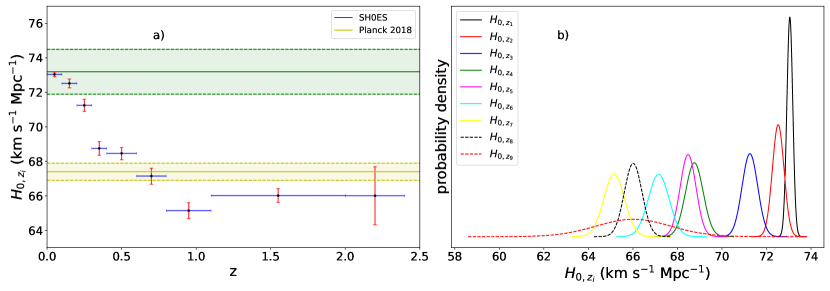
- A significant decreasing trend in the Hubble constant with redshift is observed, with a statistical significance of $8.6\sigma$.
- The $H_0$ value at low redshifts ($z \lesssim 0.1$) is consistent with the local distance ladder measurement ($H_0 \approx 73.2$ km s⁻¹ Mpc⁻¹) within $1\sigma$.
- The $H_0$ value at high redshifts ($z \approx 2.4$) is consistent with the CMB-derived $H_0$ from Planck 2020 ($H_0 \approx 67.4$ km s⁻¹ Mpc⁻¹) within $1\sigma$.
- The DESI BAO data significantly tighten constraints on $H_0(z)$ at high redshifts compared to previous studies, reducing uncertainties.
- The non-parametric method with diagonalized covariance matrix successfully removes bin-to-bin correlations, improving reliability of the $H_0(z)$ estimation.
- Systematic uncertainties in SNe Ia, including stretch and Cepheid calibration, contribute less than 0.7 km s⁻¹ Mpc⁻¹ and are insufficient to explain the observed $H_0$ evolution.
Read this paper
Open the full text in the Nubint reader and ask about any passage as you read.
Read this paper on NubintThis review was generated by AI from the original paper. Please check the paper before citing it.