
[Paper Review] UNCOVER: A NIRSpec Census of Lensed Galaxies at z=8.50-13.08 Probing a High AGN Fraction and Ionized Bubbles in the Shadow
JWST/NIRSpec prism spectroscopy of lensed galaxies behind Abell 2744 confirms 10 galaxies at z≥8.5, reveals evidence for a non-negligible AGN fraction, and identifies a giant ionized bubble at z=8.5, suggesting AGN contribute to reionization.
We present JWST NIRSpec prism spectroscopy of gravitationally lensed galaxies at $z\gtrsim9$ found behind the massive galaxy cluster Abell 2744 in the UNCOVER Cycle 1 Treasury Program. We confirm the source redshift via emission lines and/or the Ly$α$ break feature for ten galaxies at z=8.50-13.08 down to $M_{ m UV}=-17.3$. We achieve a high confirmation rate of 100\% for $z>9$ candidates reported in Atek et al. (2023). Using six sources with multiple emission line detections, we find that the offset of the redshift estimates between the lines and the Ly$α$ break alone with prism can be as large as $\pm0.2$, raising caution in designing future follow-up spectroscopy for the break-only sources with ALMA. With spec-$z$ confirmed sources in UNCOVER and the literature, we derive lower limits on the rest-frame ultraviolet (UV) luminosity function (LF) at $z\simeq9$-12 and find these lower limits to be consistent with recent photometric measurements. We identify at least two unambiguous and several possible active galactic nucleus (AGN) systems based on X-ray emission, broad line (BL) H$β$, high ionization line (e.g., NIV]1487, CIV1549) detections, and excess in UVLF. This requires the AGN LFs at $z\simeq$ 9-10 to be comparable or even higher than the X-ray AGN LF estimated at $z\sim6$ and indicates a plausible cause of the high abundance of $z>9$ galaxies claimed in recent photometric studies may be AGNs. One UV-luminous source is confirmed at the same redshift as a dusty BL AGN at $z=8.50$ with a physical separation of 380 kpc in the source plane. These two sources show blueward Ly$α$ line or continuum emission, suggesting that they reside in the same ionized bubble with a radius of $7.69\pm0.18$ pMpc. Our results imply that AGNs have a non-negligible contribution to cosmic reionization.
Motivation & Objective
- Confirm redshifts of z≥8.5 galaxy candidates identified in UNCOVER behind Abell 2744 using JWST NIRSpec prism spectroscopy.
- Assess the UV luminosity function at z≈9–12 with spectroscopic redshifts, including faint sources aided by lensing.
- Identify AGN signatures (broad lines, high-ionization lines, X-ray associations) and evaluate their impact on reionization.
- Investigate the presence and properties of ionized bubbles around high-redshift sources inferred from Lyα break behavior and line emission.
Proposed method
- Use JWST NIRCam imaging from UNCOVER to select z≥9 galaxy candidates with lensing magnification.
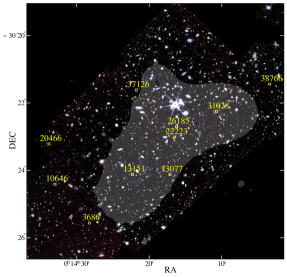
- Perform NIRSpec prism MOS observations across seven MSA masks to obtain low-resolution spectra of multiple high-z candidates.
- Reduce data with the JWST pipeline and msaexp, apply custom corrections, and extract 1D spectra with inverse-variance weighting.
- Fit spectra with eazy-based template fitting over z=0.1–20 to determine z_spec, incorporating redshift-dependent SFH, dust attenuation, and IGM damping wings.
- Identify Lyα break and faint emission lines (SNR ≥ 2.5) to secure redshifts; compare z_line and z_break for multiple-line sources.
Experimental results
Research questions
- RQ1What is the spectroscopic redshift distribution of z≥8.5 galaxies behind Abell 2744 in UNCOVER?
- RQ2What is the UV luminosity function at z≈9–12 when using spectroscopically confirmed sources, including lensed, faint galaxies?
- RQ3Do high-redshift sources show signs of AGN activity, and how does this affect the ionizing budget during reionization?
- RQ4Is there evidence for giant ionized bubbles around close-proximity high-z sources, and what does that imply about their ionizing sources?
Key findings
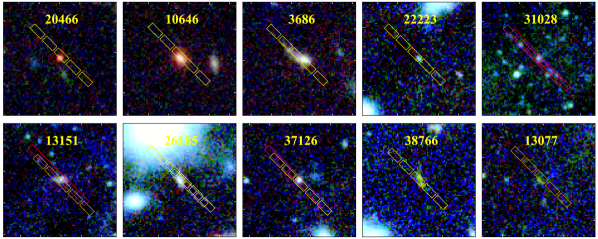
- Ten galaxies are spectroscopically confirmed at z≥8.5, with UV magnitudes down to M_UV≈−17.3 after lensing correction.
- At least two unambiguous AGN systems are identified based on X-ray, broad Hβ, and high-ionization lines (e.g., N IV], C IV, He II), suggesting AGN LFs at z≈9–10 may be comparable to or higher than the z∼6 X-ray AGN LF.
- One UV-luminous source at z=8.50 is physically associated with a broad-line AGN at z=8.50 with a 380 kpc separation in the source plane, and they exhibit emission blueward of Lyα, indicating a giant ionized bubble with radius 7.69±0.18 pMpc.
- Several sources show unusually high [O III] 5008/Hβ ratios (e.g., >10, up to 16.3+21.8−5.9) that may indicate AGN activity or strong radiation fields; some results persist under various background subtraction methods.
- The z_phot–z_spec comparison for four A23 sources shows agreement within ~1–2σ, and z_phot estimates generally do not overestimate redshifts as strongly as some prior studies; breaks and lines yield consistent redshift constraints for most sources.
- Redshift offsets between z_line and z_break for multi-line sources are small (Δz′ ≈ −0.2 to +0.2), implying Lyα break-based redshift estimates can have ~±0.2 uncertainty.
Read this paper
Open the full text in the Nubint reader and ask about any passage as you read.
Read this paper on NubintThis review was generated by AI from the original paper. Please check the paper before citing it.