
[Paper Review] UNCOVER: A NIRSpec Identification of a Broad Line AGN at z = 8.50
This paper presents the identification of a broad-line active galactic nucleus (AGN) at redshift z = 8.50 using JWST/NIRSpec spectroscopy from the UNCOVER survey. The source exhibits a Hβ line with FWHM = 3439 ± 413 km s⁻¹, indicating a black hole mass of log₁₀(M_BH/M☉) = 8.17 ± 0.42 and accretion at ~40% of the Eddington limit, with a black hole to host mass ratio exceeding 30%, suggesting rapid early growth or massive black hole seeds.
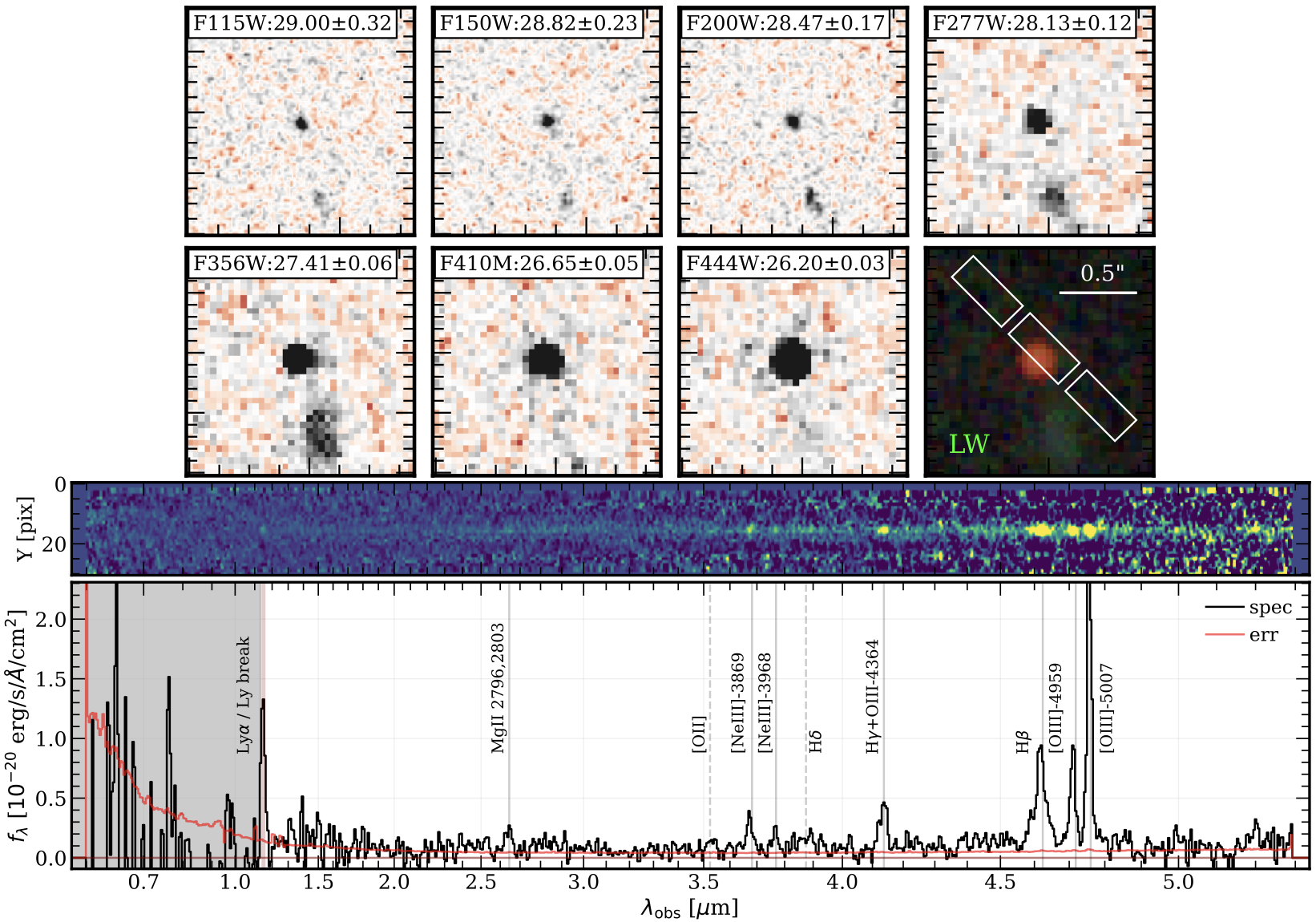
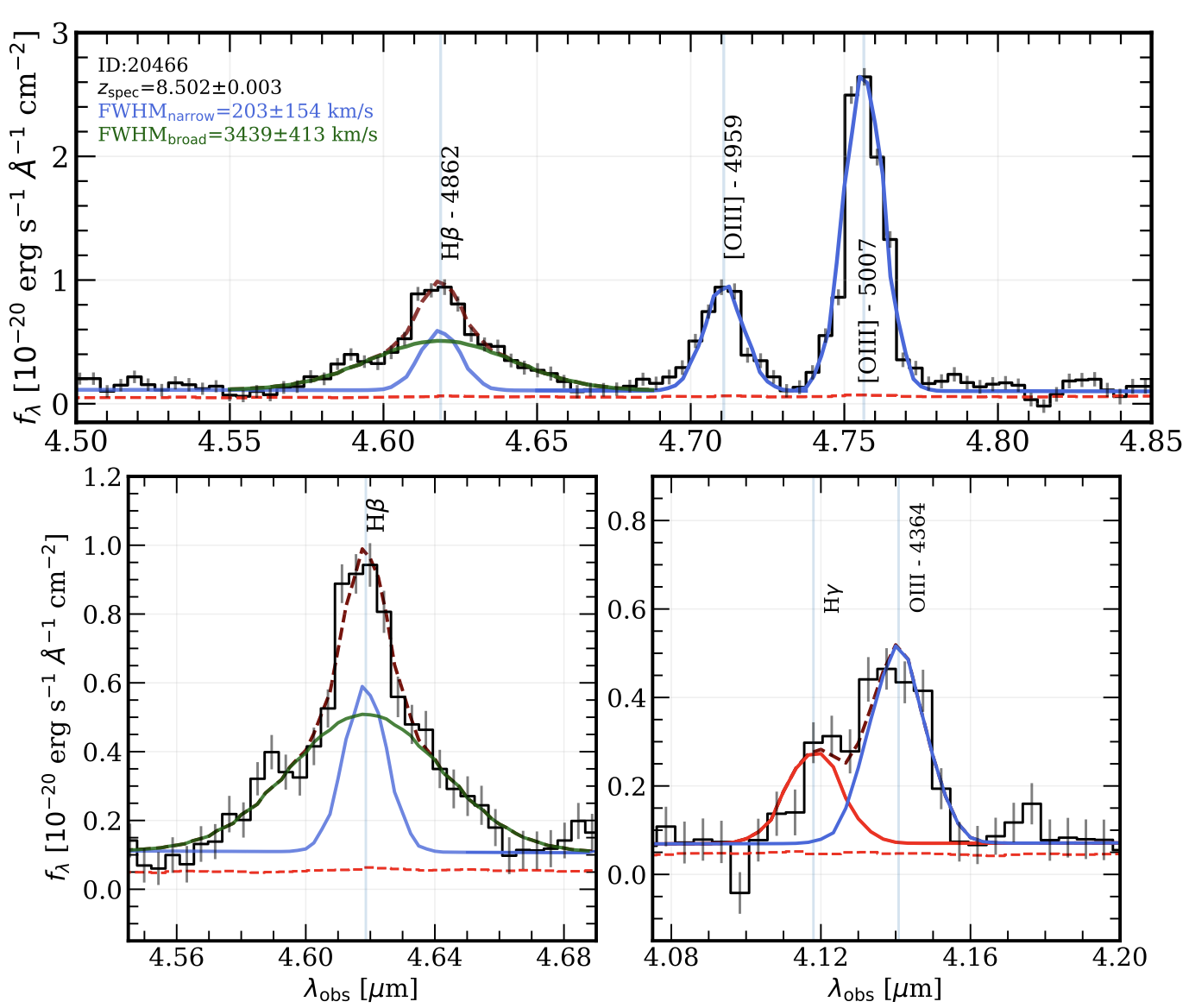
Deep observations with JWST have revealed an emerging population of red point-like sources that could provide a link between the postulated supermassive black hole seeds and observed quasars. In this work we present a JWST/NIRSpec spectrum from the JWST Cycle 1 UNCOVER Treasury survey, of a massive accreting black hole at $z=8.50$, displaying a clear broad-line component as inferred from the H$β$ line with FWHM = $3439\pm413$ km s$^{-1}$, typical of the broad line region of an active galactic nucleus (AGN). The AGN nature of this object is further supported by high ionization, as inferred from emission lines, and a point-source morphology. We compute the black hole mass of log$_{10}(M_{ m BH}/M_\odot)=8.17\pm0.42$, and a bolometric luminosity of $L_{ m bol}\sim6.6 imes10^{45}$ erg s$^{-1}$. These values imply that our object is accreting at $\sim 40\%$ of the Eddington limit. Detailed modeling of the spectral energy distribution in the optical and near-infrared, together with constraints from ALMA, indicate an upper limit on the stellar mass of log$_{10}(M_{ m *}/M_\odot)<8.7$, which would lead to an unprecedented ratio of black hole to host mass of at least $\sim 30 \%$. This is orders of magnitude higher compared to the local QSOs, but is consistent with recent AGN studies at high redshift with JWST. This finding suggests that a non-negligible fraction of supermassive black holes either started out from massive seeds and/or grew at a super-Eddington rate at high redshift. Given the predicted number densities of high-$z$ faint AGN, future NIRSpec observations of larger samples will allow us to further investigate the galaxy-black hole co-evolution in the early Universe.
Motivation & Objective
- To identify and characterize high-redshift AGN at z > 8 using deep JWST observations.
- To determine the black hole mass and accretion rate of a candidate AGN at z = 8.50.
- To investigate the black hole to host galaxy mass ratio and its implications for early black hole seed formation.
- To assess the role of such AGN in cosmic reionization and early galaxy evolution.
- To constrain the formation pathways of supermassive black holes in the early universe through multi-wavelength SED modeling and ALMA constraints.
Proposed method
- Acquisition of a JWST/NIRSpec spectrum from the UNCOVER Treasury survey for a high-redshift candidate source.
- Identification of broad emission lines, particularly Hβ, with FWHM = 3439 ± 413 km s⁻¹ to confirm AGN nature.
- Estimation of black hole mass using the FWHM of the Hβ line and continuum luminosity via the virial mass estimator.
- Bolometric luminosity derived from SED fitting using FSPS and EAZY, yielding L_bol ~ 6.6 × 10⁴⁵ erg s⁻¹.
- Stellar mass upper limit of log₁₀(M*/M☉) < 8.7 derived from SED modeling and ALMA constraints.
- Computation of Eddington ratio and BH-to-host mass ratio to assess accretion history and formation models.
Experimental results
Research questions
- RQ1What is the redshift and black hole mass of the most distant AGN identified with JWST/NIRSpec?
- RQ2To what extent is the AGN accreting at or above the Eddington limit, and what does this imply for seed formation?
- RQ3What is the black hole to host galaxy mass ratio, and how does it compare to local quasars and other high-redshift AGN?
- RQ4Can the extreme BH-to-host mass ratio be explained by direct collapse black hole seeds or super-Eddington accretion?
- RQ5What is the contribution of such high-redshift AGN to cosmic reionization?
Key findings
- A broad-line AGN at z = 8.50 is confirmed via a Hβ line with FWHM = 3439 ± 413 km s⁻¹ in a JWST/NIRSpec spectrum.
- The black hole mass is measured as log₁₀(M_BH/M☉) = 8.17 ± 0.42, indicating a supermassive black hole of ~1.5 × 10⁸ M☉.
- The source is accreting at approximately 40% of the Eddington limit, with a bolometric luminosity of L_bol ~ 6.6 × 10⁴⁵ erg s⁻¹.
- The stellar mass is constrained to log₁₀(M*/M☉) < 8.7, resulting in a black hole to host mass ratio of at least 30%, far exceeding local quasars.
- The high BH-to-host mass ratio is consistent with models involving massive black hole seeds (e.g., 10⁴ M☉) or super-Eddington accretion at high redshift.
- The AGN resides in a large ionized bubble of radius 7.6 proper Mpc, suggesting a significant role in early cosmic reionization.
Read this paper
Open the full text in the Nubint reader and ask about any passage as you read.
Read this paper on NubintThis review was generated by AI from the original paper. Please check the paper before citing it.