
[Paper Review] Uncurated Image-Text Datasets: Shedding Light on Demographic Bias
This paper introduces PHASE, a newly annotated subset of the Google Conceptual Captions dataset with demographic (age, gender, skin-tone, ethnicity) and contextual (emotion, activity) attributes, to study societal bias in uncurated vision-and-language datasets. It reveals significant demographic imbalances—especially in gender and skin-tone—across image-text pairs and demonstrates that bias persists in downstream tasks like image captioning, CLIP embeddings, and text-to-image generation, with models systematically underrepresenting women and darker-skinned individuals.
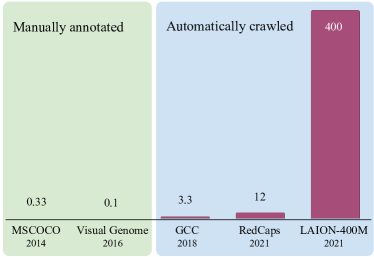
The increasing tendency to collect large and uncurated datasets to train vision-and-language models has raised concerns about fair representations. It is known that even small but manually annotated datasets, such as MSCOCO, are affected by societal bias. This problem, far from being solved, may be getting worse with data crawled from the Internet without much control. In addition, the lack of tools to analyze societal bias in big collections of images makes addressing the problem extremely challenging. Our first contribution is to annotate part of the Google Conceptual Captions dataset, widely used for training vision-and-language models, with four demographic and two contextual attributes. Our second contribution is to conduct a comprehensive analysis of the annotations, focusing on how different demographic groups are represented. Our last contribution lies in evaluating three prevailing vision-and-language tasks: image captioning, text-image CLIP embeddings, and text-to-image generation, showing that societal bias is a persistent problem in all of them.
Motivation & Objective
- To address the lack of demographic annotations in large-scale, uncurated vision-and-language datasets like Google Conceptual Captions (GCC).
- To analyze representation imbalances across key demographic attributes—gender, skin-tone, ethnicity, age, emotion, and activity—in GCC.
- To evaluate whether societal bias persists in major vision-and-language tasks: image captioning, text-image CLIP embeddings, and text-to-image generation.
- To provide a publicly available, human-annotated benchmark for detecting and mitigating bias in vision-and-language models.
Proposed method
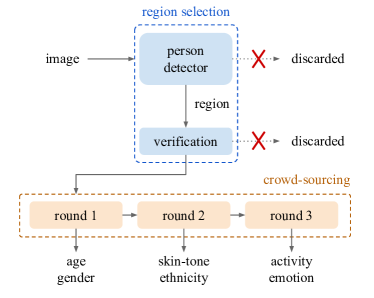
- Crowd-sourced annotation of 18,889 image-region pairs from GCC with six attributes: age, gender, skin-tone, ethnicity, emotion, and activity.
- Creation of the PHASE dataset, a curated subset of GCC with standardized, perceived demographic labels for bias analysis.
- Comprehensive statistical analysis of demographic distribution across the GCC dataset, comparing representation gaps to manually annotated datasets like MSCOCO.
- Evaluation of three vision-and-language tasks: (1) image captioning using fine-tuned models, (2) CLIP embedding similarity, and (3) text-to-image generation with Stable Diffusion.
- Use of a safety checker module to detect NSFW outputs and compare demographic distributions between original and generated images.
- Manual validation of 100 generated images to assess demographic bias in text-to-image generation.
Experimental results
Research questions
- RQ1How unbalanced are demographic attributes—especially gender and skin-tone—in large, uncurated image-text datasets like GCC compared to manually annotated datasets?
- RQ2To what extent do vision-and-language models exhibit performance disparities across demographic groups in image captioning, CLIP embedding similarity, and text-to-image generation?
- RQ3Does the safety checker in text-to-image models like Stable Diffusion show bias in flagging images based on gender or skin-tone?
- RQ4How do perceived demographic attributes in generated images compare to those in the original training data?
- RQ5Can the PHASE dataset serve as a reliable benchmark for detecting and mitigating societal bias in vision-and-language models?
Key findings
- The GCC dataset exhibits significant demographic imbalance, with men overrepresented at 64.96% of images, compared to 35.04% women, and lighter skin-toned individuals at 73.4%.
- Compared to MSCOCO, GCC shows larger representation gaps in gender (64.96% male vs. 35.04% female) and skin-tone (73.4% lighter vs. 26.6% darker).
- In text-to-image generation, 47.4% of generated images depict men versus 35.5% women, and 54.0% are lighter-skinned versus 26.6% darker-skinned, indicating systematic underrepresentation of women and darker skin tones.
- The safety checker in Stable Diffusion flagged 51.61% of unsafe outputs as originating from prompts related to women, despite women constituting only 35.04% of original images, suggesting potential gender bias in detection.
- When prompts used neutral language (e.g., 'person'), the model predominantly generated images of White men, indicating a strong bias in default generation behavior.
- The study confirms that societal bias is not only present in training data but is also amplified in downstream vision-and-language tasks, including captioning, embeddings, and generation.
Read this paper
Open the full text in the Nubint reader and ask about any passage as you read.
Read this paper on NubintThis review was generated by AI from the original paper. Please check the paper before citing it.