
[Paper Review] Unleashing the Power of Edge-Cloud Generative AI in Mobile Networks: A Survey of AIGC Services
The paper surveys how mobile edge networks can provision AIGC services via cloud-edge-mobile collaboration, outlining lifecycle, infrastructure, applications, challenges, and future directions.
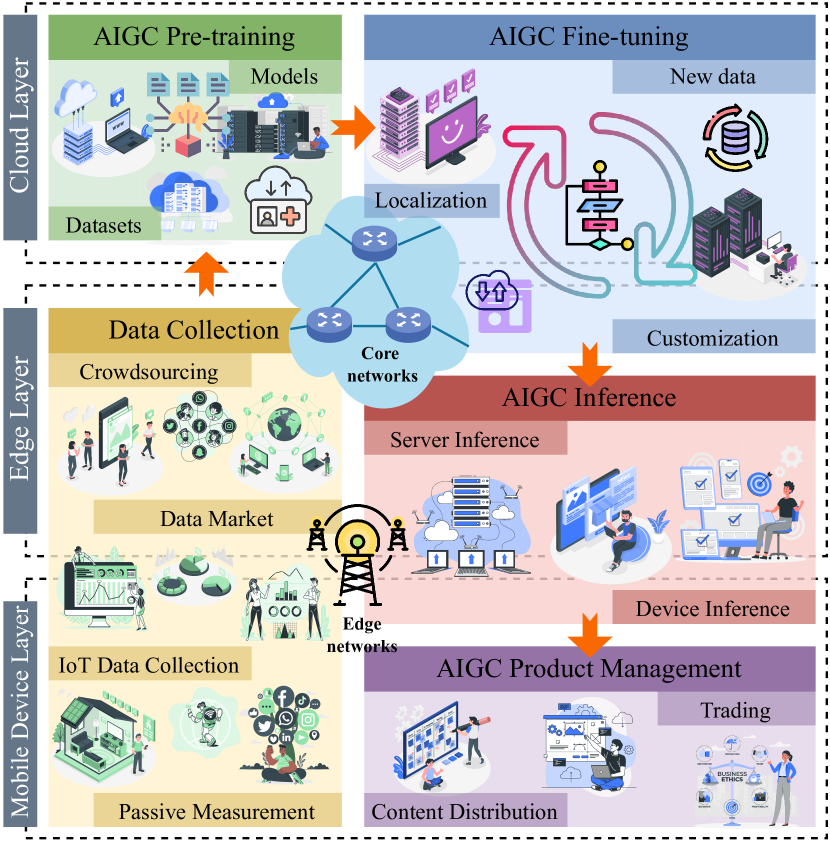
Artificial Intelligence-Generated Content (AIGC) is an automated method for generating, manipulating, and modifying valuable and diverse data using AI algorithms creatively. This survey paper focuses on the deployment of AIGC applications, e.g., ChatGPT and Dall-E, at mobile edge networks, namely mobile AIGC networks, that provide personalized and customized AIGC services in real time while maintaining user privacy. We begin by introducing the background and fundamentals of generative models and the lifecycle of AIGC services at mobile AIGC networks, which includes data collection, training, finetuning, inference, and product management. We then discuss the collaborative cloud-edge-mobile infrastructure and technologies required to support AIGC services and enable users to access AIGC at mobile edge networks. Furthermore, we explore AIGCdriven creative applications and use cases for mobile AIGC networks. Additionally, we discuss the implementation, security, and privacy challenges of deploying mobile AIGC networks. Finally, we highlight some future research directions and open issues for the full realization of mobile AIGC networks.
Motivation & Objective
- Define AIGC, PGC, and UGC and establish the lifecycle of AIGC services in mobile networks.
- Propose mobile AIGC networks with collaborative cloud-edge-mobile infrastructure for real-time, private AIGC provisioning.
- Survey creative AIGC applications and exemplify use cases in mobile edge environments.
- Identify implementation, security, and privacy challenges and discuss future research directions.
Proposed method
- Provide background on AIGC and its lifecycle in mobile networks (data collection, pre-training, fine-tuning, inference, product management).
- Describe the cloud-edge-mobile collaborative infrastructure required to support AIGC services at mobile edge networks.
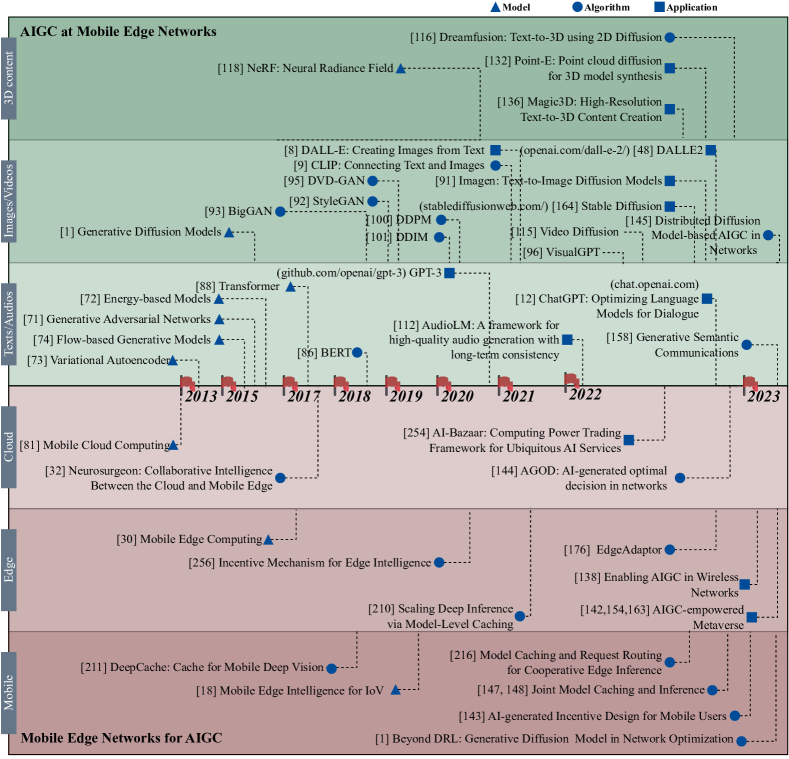
- Present use cases and applications spanning text, image, video, and 3D content generation in mobile AIGC networks.
- Analyze implementation challenges including resource allocation, caching, mobility, privacy, and security considerations.
- Discuss future research directions across networking, computing, and ML perspectives.
Experimental results
Research questions
- RQ1How can AIGC services be provisioned in mobile edge networks using cloud-edge-mobile collaboration?
- RQ2What infrastructure and technologies are required to support low-latency, privacy-preserving mobile AIGC services?
- RQ3What realistic use cases and applications demonstrate the benefits of mobile AIGC networks?
- RQ4What are the key implementation challenges and open issues in deploying mobile AIGC networks?
- RQ5What future research directions are suggested to realize full mobile AIGC deployment?
Key findings
- AIGC enables fast, personalized content generation across text, image, video, and 3D modalities in mobile contexts.
- Mobile AIGC networks rely on cloud for pre-training and edge for data collection, inference, and management to achieve low latency.
- Data collection, fine-tuning, and inference can be localized at the edge to enhance privacy and customization.
- Resource allocation, caching of models, mobility management, and incentive mechanisms are essential for practical edge deployment.
- Security, privacy, and content integrity are critical challenges to address in mobile AIGC provisioning.
Read this paper
Open the full text in the Nubint reader and ask about any passage as you read.
Read this paper on NubintThis review was generated by AI from the original paper. Please check the paper before citing it.