
[Paper Review] Unraveling a cavity induced molecular polarization mechanism from collective vibrational strong coupling
The paper shows that collective vibrational strong coupling can induce significant local electronic polarizations in a thermodynamic molecular ensemble, through self-consistent cavity-Hartree interactions, leading to a polarization-glass-like local structure with hotspots.
We demonstrate that collective vibrational strong coupling of molecules in thermal equilibrium can give rise to significant local electronic polarizations in the thermodynamic limit. We do so by first showing that the full non-relativistic Pauli-Fierz problem of an ensemble of strongly-coupled molecules in the dilute-gas limit reduces in the cavity Born-Oppenheimer approximation to a cavity-Hartree equation for the electronic structure. Consequently, each individual molecule experiences a self-consistent coupling to the dipoles of all other molecules, which amount to non-negligible values in the thermodynamic limit (large ensembles). Thus collective vibrational strong coupling can alter individual molecules strongly for localized "hotspots" within the ensemble. Moreover, the discovered cavity-induced polarization pattern possesses a zero net polarization, which resembles a continuous form of a spin glass (or better polarization glass). Our findings suggest that the thorough understanding of polaritonic chemistry, requires a self-consistent treatment of dressed electronic structure, which can give rise to numerous, so far overlooked, physical mechanisms.
Motivation & Objective
- Motivate understanding of how collective vibrational strong coupling modifies individual molecular properties under thermodynamic conditions.
- Develop a self-consistent, ab-initio-capable framework to describe many-molecule interactions within a cavity.
- Demonstrate that local polarization effects persist in the thermodynamic limit despite zero net macroscopic polarization.
- Link theoretical predictions to experimental observations of cavity-induced red shifts and polarization effects.
Proposed method
- Formulate the full non-relativistic Pauli-Fierz problem for an ensemble of strongly-coupled molecules in the dilute-gas limit.
- Reduce to a cavity-Hartree set of equations via the cavity Born-Oppenheimer approximation (cBOA).
- Treat the electronic state of the ensemble with a mean-field ansatz assuming negligible overlaps between local molecular ground states.
- Include a self-consistent inter-molecular dipole-dipole energy term that scales as N(N−1).
- Propagate classical Langevin dynamics for nuclei and displacement fields to obtain the polarization-dressed ground-state potential energy surface.
- Compute observables such as local dipole vibrations and cavity detuning from self-consistent solutions and Langevin trajectories.

Experimental results
Research questions
- RQ1Does collective vibrational strong coupling induce nonzero local polarization of individual molecules in the thermodynamic limit?
- RQ2How does self-consistent treatment of cavity-induced polarization affect the cavity frequency (detuning) and observed polaritonic features?
- RQ3Can local polarization patterns arise with zero net macroscopic polarization, and what is their chemical relevance?
- RQ4Are local polarization effects qualitatively different for molecular ensembles versus atomic ensembles under vibro-polaritonic coupling?
Key findings
- A self-consistent cavity-Hartree treatment reveals nonzero cavity-induced local polarizations persisting in the large-N limit.
- The total electronic polarization of the ensemble remains zero, but individual molecules exhibit local polarization changes (hotspots).
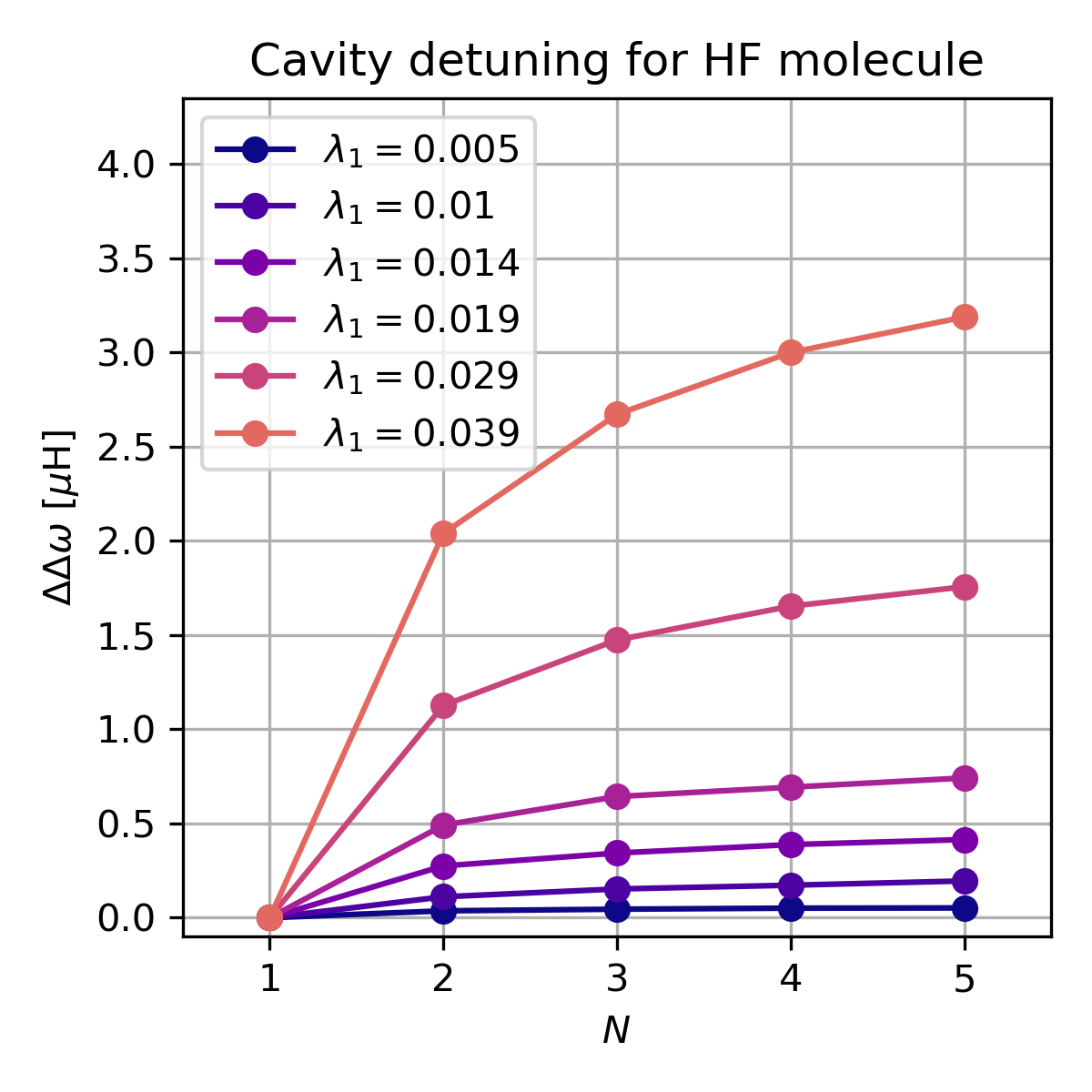
- The cavity experiences a red shift (detuning to lower frequencies) due to the self-consistent polarization field, consistent with experiments.
- Local polarization patterns resemble a continuous polarization-glass phase, with a distribution of local polarizations rather than a single uniform value.
- For atomic ensembles, the local polarization mechanism is absent under similar conditions, highlighting molecule-specific physics.
- The results imply that polaritonic chemistry requires self-consistent polarization treatments beyond displacement-field-only models.
Read this paper
Open the full text in the Nubint reader and ask about any passage as you read.
Read this paper on NubintThis review was generated by AI from the original paper. Please check the paper before citing it.