
[Paper Review] Unveiling Dark Matter free-streaming at the smallest scales with high redshift Lyman-alpha forest
This study improves constraints on warm dark matter (WDM) by analyzing high-redshift Lyman-alpha forest flux power spectra from high-resolution quasar spectra (z=4.2–5.0). Using a Bayesian inference framework with simulation-based likelihood, it establishes a 95% credible lower limit of 5.7 keV on the thermal relic WDM particle mass, representing a significant improvement due to increased statistical sample and probing of smaller scales (k_max = 0.2 km⁻¹s).
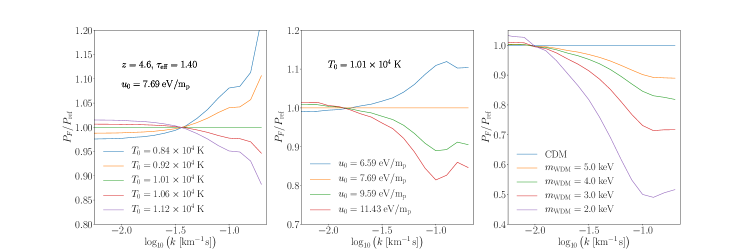
This study introduces novel constraints on the free-streaming of thermal relic warm dark matter (WDM) from Lyman-$α$ forest flux power spectra. Our analysis utilises a high-resolution, high-redshift sample of quasar spectra observed using the HIRES and UVES spectrographs ($z=4.2-5.0$). We employ a Bayesian inference framework and a simulation-based likelihood that encompasses various parameters including the free-streaming of dark matter, cosmological parameters, the thermal history of the intergalactic medium, and inhomogeneous reionization, to establish lower limits on the mass of a thermal relic WDM particle of $5.7\;\mathrm{keV}$ (at 95\% C.L.). This result surpasses previous limits from the Lyman-$α$ forest through reduction of the measured uncertainties due to a larger statistical sample and by measuring clustering to smaller scales ($k_{ m max}=0.2\;\mathrm{km^{-1}\,s}$). The approximately two-fold improvement due to the expanded statistical sample suggests that the effectiveness of Lyman-$α$ forest constraints on WDM models at high redshifts are limited by the availability of high-quality quasar spectra. Restricting the analysis to comparable scales and thermal history priors as in prior studies ($k_{ m max}<0.1\;\mathrm{km^{-1}\,s}$) lowers the bound on the WDM mass to $4.1\;\mathrm{keV}$. As the precision of the measurements increases, it becomes crucial to examine the instrumental and modelling systematics. On the modelling front, we argue that the impact of the thermal history uncertainty on the WDM particle mass constraint has diminished due to improved independent observations. At the smallest scales, the primary source of modeling systematic arises from the structure in the peculiar velocity of the intergalactic medium and inhomogeneous reionization.
Motivation & Objective
- To tighten constraints on warm dark matter (WDM) by probing dark matter free-streaming at the smallest cosmological scales using high-redshift Lyman-alpha forest data.
- To reduce uncertainties in WDM mass limits by utilizing a larger, high-quality sample of high-resolution quasar spectra at z=4.2–5.0.
- To assess the impact of instrumental systematics and modeling uncertainties—particularly in peculiar velocity structures and thermal history—on WDM constraints.
- To evaluate the effectiveness of the Lyman-alpha forest as a probe of dark matter physics at small scales, especially in the context of future surveys.
Proposed method
- Employed a Bayesian inference framework with a simulation-based likelihood to jointly constrain WDM free-streaming, cosmological parameters, intergalactic medium (IGM) thermal history, and inhomogeneous reionization.
- Analyzed high-resolution, high-signal-to-noise quasar spectra from HIRES and UVES spectrographs covering redshifts z=4.2–5.0 to probe small-scale flux power spectra up to k_max = 0.2 km⁻¹s.
- Used state-of-the-art hydrodynamical simulations incorporating realistic physics (e.g., radiative heating, reionization) to model the IGM and flux power spectrum.
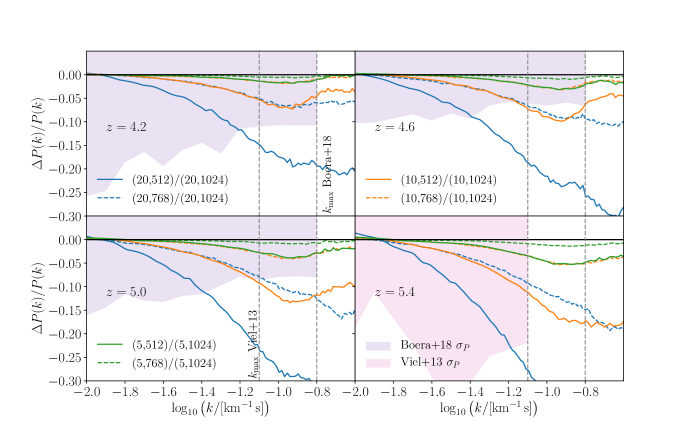
- Quantified systematics by testing flux noise underestimation (up to 40%) and the impact of peculiar velocity structures on WDM constraints.
- Compared results under different thermal history priors and scale cuts (e.g., k_max < 0.1 km⁻¹s) to assess robustness and sensitivity to modeling assumptions.
- Applied a 50% higher constraining power from small scales (k > 0.1 km⁻¹s) while validating its reliability through systematic checks.
Experimental results
Research questions
- RQ1What is the tightest constraint on the mass of a thermal relic warm dark matter particle using high-redshift Lyman-alpha forest data at the smallest observable scales?
- RQ2How do instrumental noise and flux measurement uncertainties affect WDM constraints at high-k modes (k > 0.1 km⁻¹s)?
- RQ3To what extent do uncertainties in the IGM thermal history and inhomogeneous reionization impact the inferred WDM mass limits?
- RQ4How do peculiar velocity structures in the baryonic gas influence the small-scale flux power spectrum and WDM constraints?
- RQ5Can the Lyman-alpha forest at high redshift provide a competitive probe of dark matter free-streaming compared to other astrophysical and cosmological constraints?
Key findings
- The fiducial analysis yields a 95% credible lower limit of 5.7 keV on the thermal relic warm dark matter particle mass, representing a significant improvement over previous constraints.
- When restricted to scales k_max < 0.1 km⁻¹s and with comparable thermal priors, the WDM mass lower limit is 4.1 keV at 95% C.L., a factor of two tighter than earlier studies.
- A 50% higher constraining power from small scales (k > 0.1 km⁻¹s) is robust, though flux noise may be underestimated by up to 40% in the data, potentially weakening constraints.
- Modeling uncertainties from peculiar velocity structures and inhomogeneous reionization can reduce the constraining power on WDM mass by up to 25%.
- WDM particle masses of 2.5 keV are ruled out at more than 5σ, and 3 keV at more than 3σ, across all analysis choices, with 3 keV ruled out at 5σ under reasonable thermal priors.
- The study demonstrates that the primary limitation on WDM constraints from the Lyman-alpha forest at high redshift is the availability of high-quality quasar spectra, not theoretical modeling.
Read this paper
Open the full text in the Nubint reader and ask about any passage as you read.
Read this paper on NubintThis review was generated by AI from the original paper. Please check the paper before citing it.