
[Paper Review] Updated Planetary Mass Constraints of the Young V1298 Tau System Using MAROON-X
This study presents updated mass constraints for the young, multi-planet system V1298 Tau using new TESS photometry and high-precision MAROON-X radial velocity (RV) measurements. It reports a 2.6σ detection of planet e with a mass of 0.66±0.26 M<sub>Jup</sub>, and 2σ upper limits for planets b, c, and d, while confirming that planet e likely has a period >55.4 d, consistent with a 46.77-day ephemeris solution.
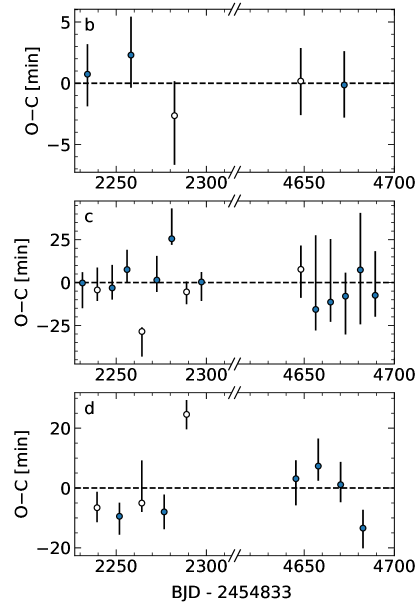
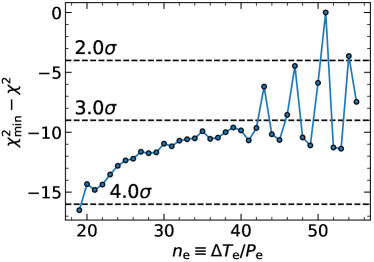
The early K-type T-Tauri star, V1298 Tau ($V=10\,{ m mag}$, ${ m age}\approx20-30\,{ m Myr}$) hosts four transiting planets with radii ranging from $4.9-9.6\,R_\oplus$. The three inner planets have orbital periods of $\approx8-24\,{ m d}$ while the outer planet's period is poorly constrained by single transits observed with \emph{K2} and \emph{TESS}. Planets b, c, and d are proto-sub-Neptunes that may be undergoing significant mass loss. Depending on the stellar activity and planet masses, they are expected to evolve into super-Earths/sub-Neptunes that bound the radius valley. Here we present results of a joint transit and radial velocity (RV) modelling analysis, which includes recently obtained \emph{TESS} photometry and MAROON-X RV measurements. Assuming circular orbits, we obtain a low-significance ($\approx2σ$) RV detection of planet c implying a mass of $19.8_{-8.9}^{+9.3}\,M_\oplus$ and a conservative $2σ$ upper limit of $<39\,M_\oplus$. For planets b and d, we derive $2σ$ upper limits of $M_{ m b}<159\,M_\oplus$ and $M_{ m d}<41\,M_\oplus$. For planet e, plausible discrete periods of $P_{ m e}>55.4\,{ m d}$ are ruled out at a $3σ$ level while seven solutions with $43.3
Motivation & Objective
- To improve mass constraints for the four transiting planets in the young V1298 Tau system using high-precision radial velocity measurements from MAROON-X.
- To refine orbital period estimates for the outer planet e, which was previously poorly constrained by single transits from K2 and TESS.
- To assess the dynamical stability and interior structure of the planets by combining updated mass and radius measurements with planetary evolution models.
- To test the detectability of low-amplitude RV signals in the presence of strong stellar activity using injection-recovery simulations.
- To determine whether the planets are consistent with primordial gas-rich compositions or have undergone significant atmospheric mass loss.
Proposed method
- Joint modeling of TESS transit light curves and MAROON-X radial velocity data using a hierarchical Bayesian framework with Gaussian process regression to model stellar activity.
- Incorporation of circular and non-circular orbital models, with eccentricity distributions sampled in the non-circular case.
- Application of the SPOCK code to estimate dynamical stability probabilities for each posterior sample, followed by rejection sampling to enforce stability.
- Injection-recovery tests using simulated planetary RV signals injected into activity models to assess detection sensitivity and measurement bias.
- Use of the exoplanet and celerite2 packages for efficient Gaussian process regression and nested sampling with PyMC3.
- Adoption of informative priors on transit times based on ephemerides from David et al. (2019b) and Feinstein et al. (2022), with 0.05 d uncertainty.
Experimental results
Research questions
- RQ1What are the updated mass constraints for the four transiting planets in the V1298 Tau system using new MAROON-X radial velocity data?
- RQ2Is the outer planet e consistent with a stable orbital period near 46.77 days, or are longer periods ruled out at high significance?
- RQ3How do the measured masses of planets b, c, d, and e compare with predictions from planetary interior and evolution models?
- RQ4To what extent does stellar activity in the young K-type star V1298 Tau affect the detectability of low-amplitude planetary RV signals?
- RQ5What is the dynamical stability status of the system under the updated orbital and mass constraints?
Key findings
- A 2.6σ radial velocity detection of planet e is obtained, yielding a mass of 0.66±0.26 M<sub>Jup</sub> under the most probable 46.768131±0.000076 d ephemeris.
- For planet c, a 2σ RV detection yields a mass of 19.8<sub>-8.9</sub><sup>+9.3</sup> M<sub>⊕</sub>, with a conservative 2σ upper limit of <39 M<sub>⊕</sub>.
- 2σ upper limits of <159 M<sub>⊕</sub> for planet b and <41 M<sub>⊕</sub> for planet d are derived, indicating low-mass or non-detections.
- A plausible period of 55.4 d or longer for planet e is ruled out at the 3σ level, while periods between 43.3 and 55.4 d are consistent with the 46.77 d solution.
- Injection-recovery tests show that planet c has the highest detection accuracy, with signals recovered within 0.5σ, while planet d shows a systematic bias of ~10–15% low in recovered mass.
- Comparison with planetary evolution models indicates that planets b, d, and e are consistent with primordial gas-rich compositions, while planet c is consistent with a water-rich core and a ~5% H<sub>2</sub> envelope by mass.
Read this paper
Open the full text in the Nubint reader and ask about any passage as you read.
Read this paper on NubintThis review was generated by AI from the original paper. Please check the paper before citing it.