
[Paper Review] Use of LLMs for Illicit Purposes: Threats, Prevention Measures, and Vulnerabilities
The paper presents a taxonomy of threats, prevention measures, and vulnerabilities related to illicit uses of large language models (LLMs), surveying existing literature and discussing safety challenges, defenses, and attack surfaces.
Spurred by the recent rapid increase in the development and distribution of large language models (LLMs) across industry and academia, much recent work has drawn attention to safety- and security-related threats and vulnerabilities of LLMs, including in the context of potentially criminal activities. Specifically, it has been shown that LLMs can be misused for fraud, impersonation, and the generation of malware; while other authors have considered the more general problem of AI alignment. It is important that developers and practitioners alike are aware of security-related problems with such models. In this paper, we provide an overview of existing - predominantly scientific - efforts on identifying and mitigating threats and vulnerabilities arising from LLMs. We present a taxonomy describing the relationship between threats caused by the generative capabilities of LLMs, prevention measures intended to address such threats, and vulnerabilities arising from imperfect prevention measures. With our work, we hope to raise awareness of the limitations of LLMs in light of such security concerns, among both experienced developers and novel users of such technologies.
Motivation & Objective
- Characterize how LLMs enable malicious activities through their generative capabilities.
- Map existing research into threats, defenses, and vulnerabilities in a unified taxonomy.
- Highlight limitations of current prevention methods and outline future security concerns.
Proposed method
- Curate and synthesize peer-reviewed and non-peer-reviewed literature on LLM safety and security.
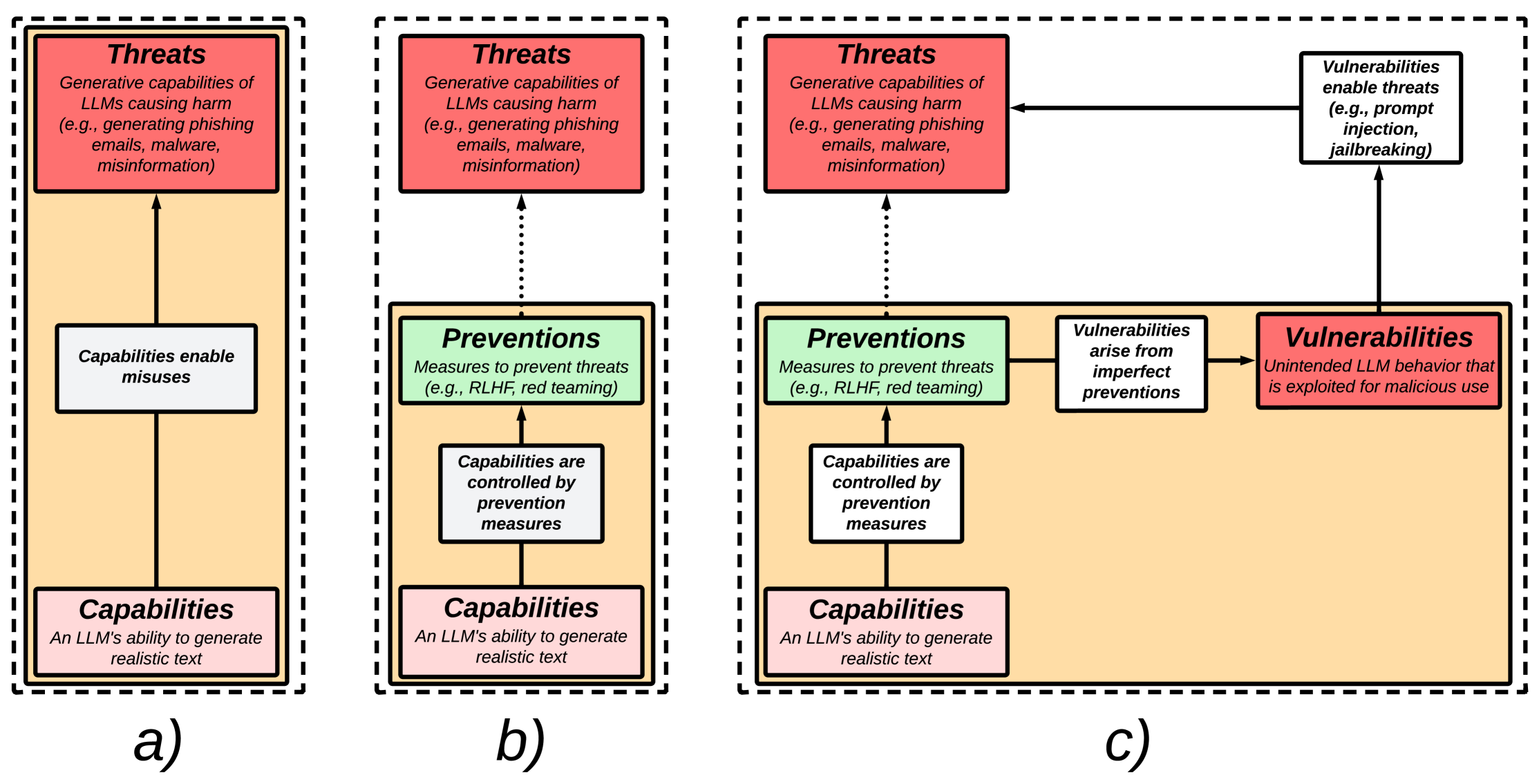
- Propose a taxonomy linking threats, prevention measures, and vulnerabilities.
- Summarize empirical and qualitative findings from diverse studies to illustrate risk landscapes.
Experimental results
Research questions
- RQ1What threats arise from the generative capabilities of LLMs (e.g., fraud, impersonation, malware, misinformation)?
- RQ2What prevention measures are proposed to mitigate these threats (e.g., content filtering, RLHF, red teaming)?
- RQ3What vulnerabilities emerge when prevention is imperfect (e.g., prompt injection, jailbreaking)?
- RQ4What are the broader limitations and future security concerns of LLM safety research?
Key findings
- LLMs can be misused for fraud, impersonation, malware generation, misinformation, and data-related harms.
- Prevention measures include content detection, red teaming, RLHF, safety via instruction-following, and data-protection strategies.
- Vulnerabilities such as prompt injection and jailbreaking can re-enable threats despite prevention efforts.
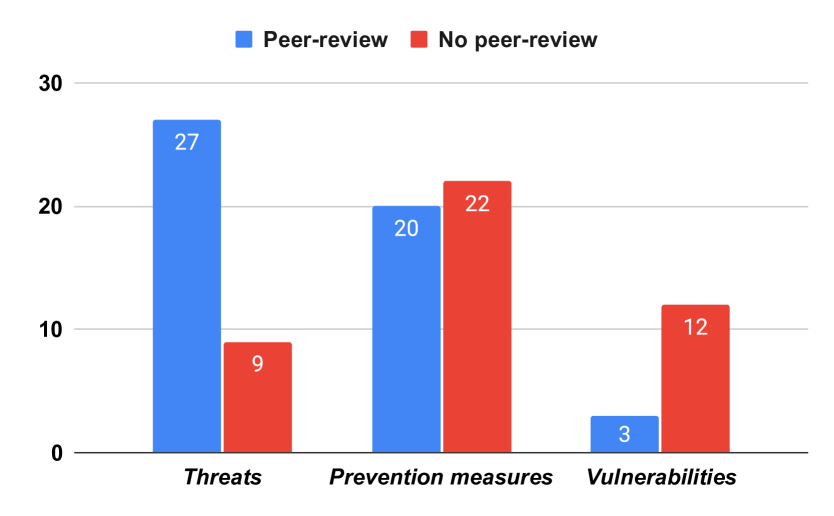
- The literature base includes a mix of peer-reviewed and non-peer-reviewed works, with varying degrees of formal validation.
- The paper discusses public concern and the need for ongoing evaluation of LLM safety against evolving attack surfaces.
Read this paper
Open the full text in the Nubint reader and ask about any passage as you read.
Read this paper on NubintThis review was generated by AI from the original paper. Please check the paper before citing it.