
[Paper Review] Using non-DESI data to confirm and strengthen the DESI 2024 spatially-flat $w_0w_a$CDM cosmological parameterization result
The paper uses Planck 2018 CMB data combined with non-CMB data (Pantheon+ SNIa, H(z), fσ₈, BAO) to confirm and slightly strengthen DESI 2024 constraints on a flat w0 wa CDM model, finding w0≈-0.850 and wa≈-0.59 with ~2σ preference for dynamical dark energy over ΛCDM.
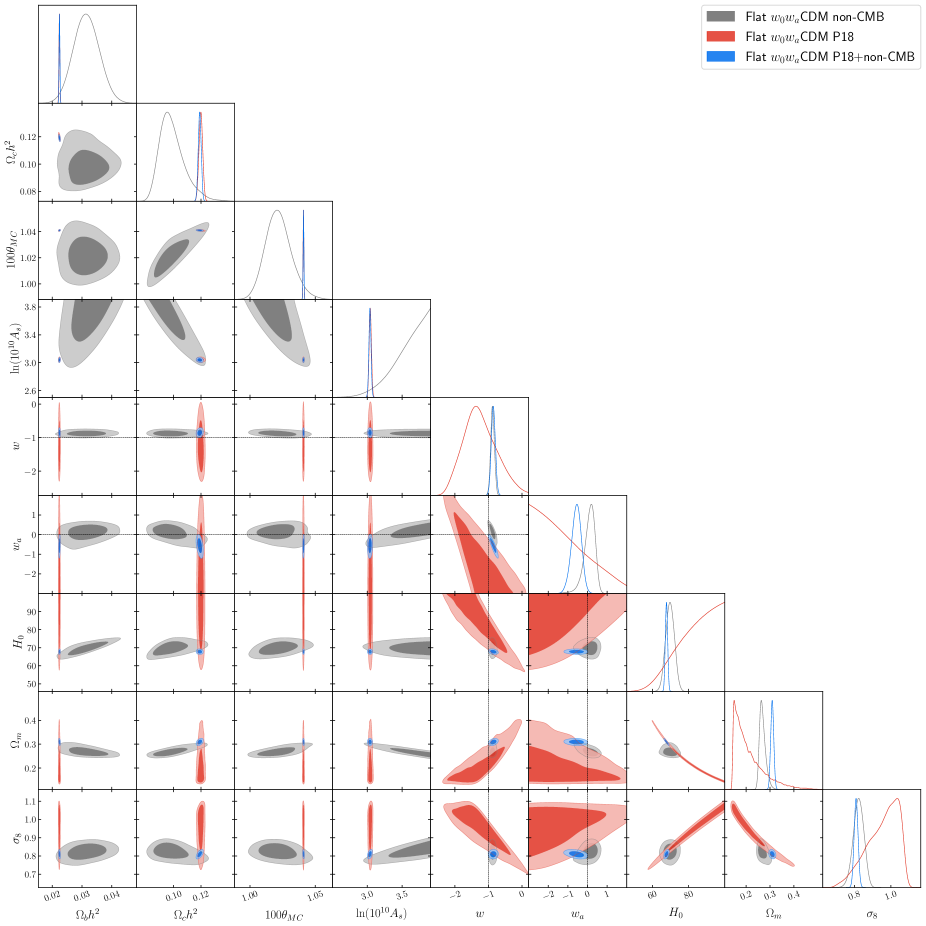
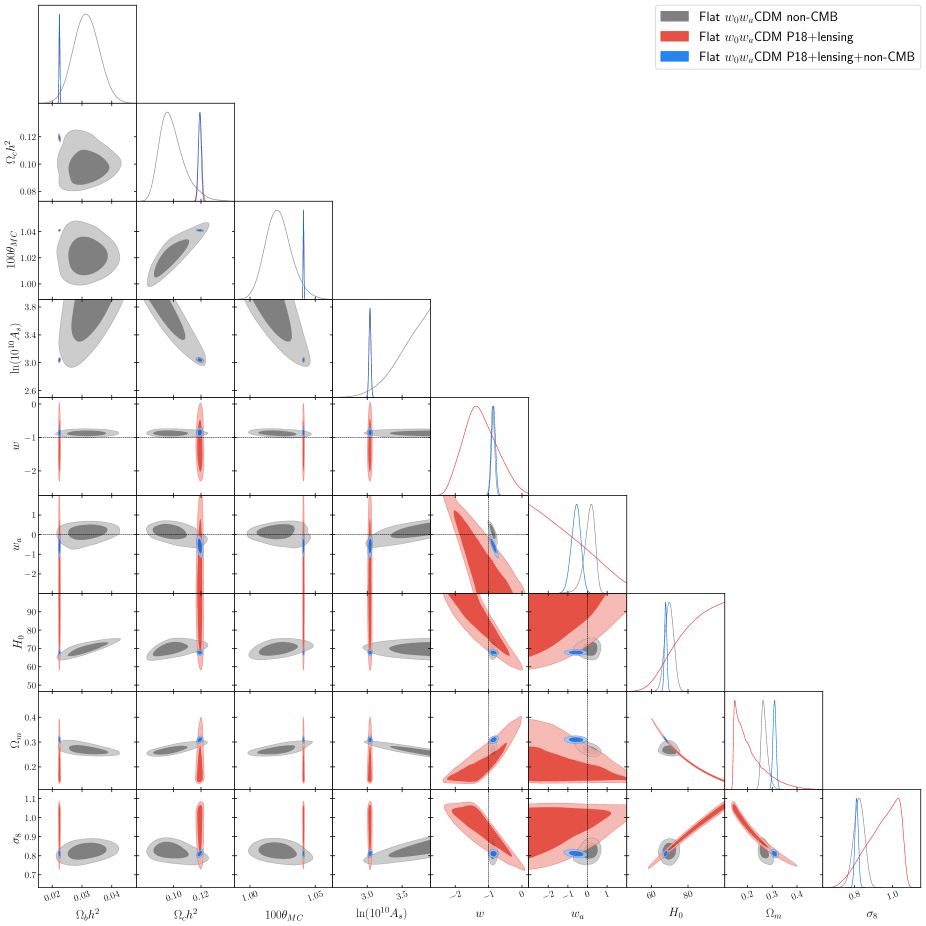
We use a combination of Planck cosmic microwave background (CMB) anisotropy data and non-CMB data that include Pantheon+ type Ia supernovae (SNIa), Hubble parameter [$H(z)$], growth factor ($fσ_8$) measurements, and a collection of baryon acoustic oscillation (BAO) data, but not recent DESI 2024 BAO measurements, to confirm the DESI 2024 (DESI+CMB+PantheonPlus) data compilation support for dynamical dark energy with an evolving equation of state parameter $w(z) = w_0 + w_a z/(1+z)$. From our joint compilation of CMB and non-CMB data, in a spatially-flat cosmological model, we obtain $w_0 = -0.850 \pm 0.059$ and $w_a = -0.59^{+0.26}_{-0.22}$ and find that this dynamical dark energy is favored over a cosmological constant by $\sim 2σ$. Our data constraints on the flat $w_0w_a$CDM parameterization are slightly more restrictive than the DESI 2024 constraints, with the DESI 2024 and our values of $w_0$ and $w_a$ differing by $-0.27σ$ and $0.44σ$, respectively. Our data compilation slightly more strongly favors the flat $w_0w_a$CDM model over the flat $Λ$CDM model than does the DESI 2024 data compilation. We note that our CMB and non-CMB data $w_0w_a$CDM parameterization cosmological constraints are discrepant at 2.7$σ$, a little larger than the 1.9$σ$ discrepancy between DESI DR1 BAO and CMB data flat $Λ$CDM model cosmological constraints. We also show that if we remove the Pantheon+ SNIa contribution from the non-CMB data, for the $w_0w_a$CDM parameterization we still find tension between P18 and non-CMB data (2.5$σ$) and P18+lensing and non-CMB data (2.4$σ$). Even after the exclusion of Pantheon+ SNIa data the $Λ$CDM model is still disfavoured at $\sim 2σ$ c.l.
Motivation & Objective
- Motivate testing whether DESI 2024 dynamical dark energy results persist with non-DESI data.
- Constrain flat w0 wa CDM using Planck 2018 CMB plus Pantheon+ SNIa, H(z), fσ8, and BAO data (excluding DESI 2024 BAO).
- Compare constraints to DESI 2024 findings and assess statistical significance of dynamical dark energy.
- Discuss implications for ΛCDM and physically motivated dark energy models.
- Assess consistency between data sets and evaluate model preference using information criteria.
Proposed method
- Use CAMB/COSMOMC (2018) to compute theoretical predictions and perform MCMC parameter estimation.
- Model dark energy with equation of state w(z)=w0+wa z/(1+z) in a spatially flat geometry.
- Fix τ and ns when analyzing non-CMB data; adopt flat priors on w0 and wa with -3≤w0≤0.2 and -3<wa<2.
- Combine five data sets: P18, P18+lensing, non-CMB, P18+non-CMB, and P18+lensing+non-CMB, and compare constraints.
- Quantify model comparison with ΔAIC, ΔDIC, and tension/consistency metrics including log10 I and p-values.
Experimental results
Research questions
- RQ1Do non-CMB data combined with Planck 2018 CMB data favor a dynamical dark energy model with evolving w(z) over ΛCDM in a flat universe?
- RQ2What are the extracted constraints on w0 and wa from the non-CMB data relative to DESI 2024 results?
- RQ3How do information criteria (AIC, DIC) and consistency measures reflect the preference for flat w0 wa CDM versus ΛCDM?
- RQ4Are the data sets (non-CMB vs. P18+lensing+non-CMB) statistically consistent within the flat w0 wa CDM framework?
- RQ5How do derived parameters H0, Ωm, and σ8 compare across data sets and with DESI 2024 findings?
Key findings
- Non-CMB data yield tighter constraints on w and wa than Planck-only or Planck+lensing alone.
- For P18+lensing+non-CMB data in flat w0 wa CDM, w0= -0.850±0.059 and wa= -0.59^{+0.26}_{-0.22}.
- Dynamical dark energy is favored over a cosmological constant by ~2σ with these data.
- The flat w0 wa CDM constraints are slightly more restrictive than the DESI 2024 results, with w0, wa differences of -0.27σ and 0.44σ respectively.
- The flat w0 wa CDM model is modestly preferred over flat ΛCDM by ΔDIC ≈ -2.45 (P18+lensing+non-CMB) and slightly more than DESI+CMB+PantheonPlus in this work.
- The DESI 2024 and this work show broadly compatible w0 wa constraints within ~1σ–2σ for the combined data sets.
- Derived parameters H0=67.80±0.64 km/s/Mpc, Ωm=0.3094±0.0063, σ8=0.8108±0.0091 align with other cross-checks and are in mild tension with some local H0 measurements.
Read this paper
Open the full text in the Nubint reader and ask about any passage as you read.
Read this paper on NubintThis review was generated by AI from the original paper. Please check the paper before citing it.