
[論文レビュー] Valence Bonds in Random Quantum Magnets: Theory and Application to YbMgGaO4
本稿では、YbMgGaO4 などのスピン1/2量子スピン磁性体におけるクエンチド disorder が、スピン1/2モーメントをもつトポロジカルな欠陥のネットワークを必然的に生成し、系を特異な低エネルギー励起を示す強いランダムスピンネットワークに転換すると提案する。理論は、disorder が価鍵固体秩序を破壊し、分数の力則的比熱や異常な熱伝導度を示すような特異な量子的挙動を引き起こすと予測しており、これは YbMgGaO4 における実験的観測と整合する。
We analyze the effect of quenched disorder on spin-1/2 quantum magnets in which magnetic frustration promotes the formation of local singlets. Our results include a theory for 2d valence-bond solids subject to weak bond randomness, as well as extensions to stronger disorder regimes where we make connections with quantum spin liquids. We find, on various lattices, that the destruction of a valence-bond solid phase by weak quenched disorder leads inevitably to the nucleation of topological defects carrying spin-1/2 moments. This renormalizes the lattice into a strongly random spin network with interesting low-energy excitations. Similarly when short-ranged valence bonds would be pinned by stronger disorder, we find that this putative glass is unstable to defects that carry spin-1/2 magnetic moments, and whose residual interactions decide the ultimate low energy fate. Motivated by these results we conjecture Lieb-Schultz-Mattis-like restrictions on ground states for disordered magnets with spin-1/2 per statistical unit cell. These conjectures are supported by an argument for 1d spin chains. We apply insights from this study to the phenomenology of YbMgGaO$_4$, a recently discovered triangular lattice spin-1/2 insulator which was proposed to be a quantum spin liquid. We instead explore a description based on the present theory. Experimental signatures, including unusual specific heat, thermal conductivity, and dynamical structure factor, and their behavior in a magnetic field, are predicted from the theory, and compare favorably with existing measurements on YbMgGaO$_4$ and related materials.
研究の動機と目的
- frustrated な量子スピン磁性体において、局所的なスピン対形成を促進する状況下でのクエンチド結合ランダムネスの影響を理解すること。
- 価鍵固体(VBS)秩序が弱い disorder によって破壊された際に、トポロジカルな欠陥(スピン1/2モーメントを有する)がどのように出現するかを説明すること。
- 仮想の価鍵ガラス状態が不安定となる強 disorder 境界において、欠陥の増殖が支配的になる状況への解析の拡張。
- 単位セルあたりスピン1/2を有する不純物磁性体に対して、Lieb-Schultz-Mattis 型の制約を提案すること。
- YbMgGaO4 における実験的異常(力則的比熱や異常な動的構造因子など)を説明するための理論の適用。
提案手法
- 2次元価鍵固体における弱い結合ランダムネスを、レノルミズーション群(RG)フローと欠陥場理論を用いて分析する。
- VBS を vison 凝縮を伴う Z2 スピン液体に写像することで、欠陥形成とトポロジカル秩序の記述を行う。
- 強い disorder における欠陥統計とスピンガラスの凍結を研究するため、古典的ディマーのランダムエネルギー模型を用いる。
- ニュートロン散乱データと一致させるために、短距離相関を調整した、ランダムに配向されたスピン対からなる最小有効模型を構築する。
- 1次元スピン鎖におけるエンタングルメント構造とスピンギャップ解析を用いて、スピン相関に関する制約を導出する。
- スピン軌道結合ハミルトニアンに擬似双極子項と Kitaev 的項を含めた、YbMgGaO4 の微視的解析により、交換異方性をモデル化する。
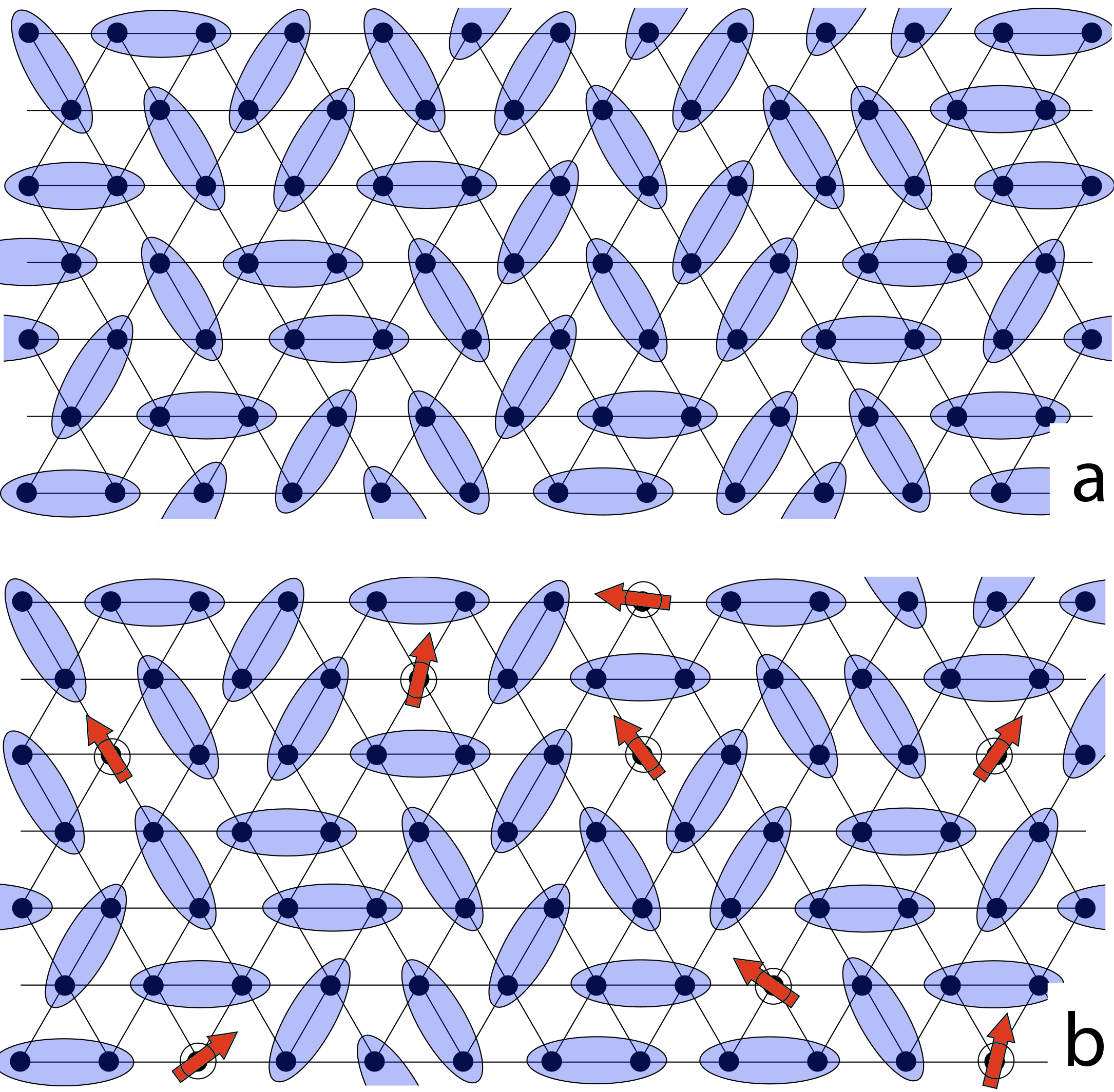
![Figure 1: Spin–1/2 defects in a valence bond solid. The Valence Bond Solid (VBS) patterns on the triangular lattice shown here [top] admit two types of defects: point defects (vortices) and line defects (domain walls). Each vortex hosts a protected spin–1/2 in its core. A particular type of domain w](https://ar5iv.labs.arxiv.org/html/1710.06860/assets/Figures/disorderedVBSfig.png)
実験結果
リサーチクエスチョン
- RQ1 どのようにして弱いクエンチド disorder が、フラストレーションを示す量子スピン磁性体における価鍵固体秩序を破壊するのか?
- RQ2 トポロジカル欠陥(渦とドメイン壁)が disorder によって生成された際に、どのような低エネルギー励起が出現するのか?
- RQ3 強い disorder において、価鍵ガラス状態は安定であるのか、それとも常に欠陥の増殖に対して不安定になるのか?
- RQ4 顕在するスピン1/2モーメントが、低エネルギー物理学および熱力学的応答に与える影響は何か?
- RQ5 YbMgGaO4 における観測された力則的比熱と異常な熱伝導度は、どのようにランダムスピン対ネットワークによって説明できるか?
主な発見
- VBS 相における弱い disorder は、保護されたスピン1/2モーメントを有するトポロジカル欠陥の疎なネットワークを必然的に生成する。
- その結果、長距離にわたるランダムスピン対を有する強力なランダムスピンネットワークに進化し、低エネルギーでスピンガラスの凍結が起こり得る。
- 理論は、分数の力則的比熱 C(T) ∼ T^0.7 を予測しており、これは YbMgGaO4 における実験データ(60 mK まで)と一致する。
- 熱伝導度は、ランダムスピンネットワークと局在化したモーメントによる散乱のため、異常に低くなると予測される。
- 動的構造因子は、低エネルギーで広がった不規則なスペクトル重みを示し、ニュートロン散乱データと整合する。
- 磁場がスピン励起スペクトルにクロスオーバーを引き起こすと予測され、比熱および構造因子に磁場依存の変化が現れる。
より良い研究を、今すぐ始めましょう
論文設計から論文執筆まで、研究時間を劇的に削減しましょう。
クレジットカード登録不要
このレビューはAIが作成し、人間の編集者が確認しました。