
[Paper Review] Vector-Quantized Autoregressive Predictive Coding
This paper proposes Vector-Quantized Autoregressive Predictive Coding (VQ-APC), a self-supervised speech representation model that uses vector quantization to explicitly control model capacity and study how information is preserved in learned representations. By limiting capacity through VQ, the model reveals that phonetic and speaker information are amplified when the self-supervised objective is optimized, and the resulting discrete codes closely correspond to English phonemes.
Autoregressive Predictive Coding (APC), as a self-supervised objective, has enjoyed success in learning representations from large amounts of unlabeled data, and the learned representations are rich for many downstream tasks. However, the connection between low self-supervised loss and strong performance in downstream tasks remains unclear. In this work, we propose Vector-Quantized Autoregressive Predictive Coding (VQ-APC), a novel model that produces quantized representations, allowing us to explicitly control the amount of information encoded in the representations. By studying a sequence of increasingly limited models, we reveal the constituents of the learned representations. In particular, we confirm the presence of information with probing tasks, while showing the absence of information with mutual information, uncovering the model's preference in preserving speech information as its capacity becomes constrained. We find that there exists a point where phonetic and speaker information are amplified to maximize a self-supervised objective. As a byproduct, the learned codes for a particular model capacity correspond well to English phones.
Motivation & Objective
- To investigate the connection between low self-supervised loss and strong downstream performance in speech representation learning.
- To understand what information is encoded in representations learned via Autoregressive Predictive Coding (APC) when model capacity is constrained.
- To explore whether vector quantization (VQ) can serve as a precise mechanism to control and study the information content in learned representations.
- To determine whether the learned representations contain phonetic and speaker information, and how this changes with model capacity.
- To evaluate whether the discrete codes produced by VQ-APC correspond meaningfully to linguistic units such as English phonemes.
Proposed method
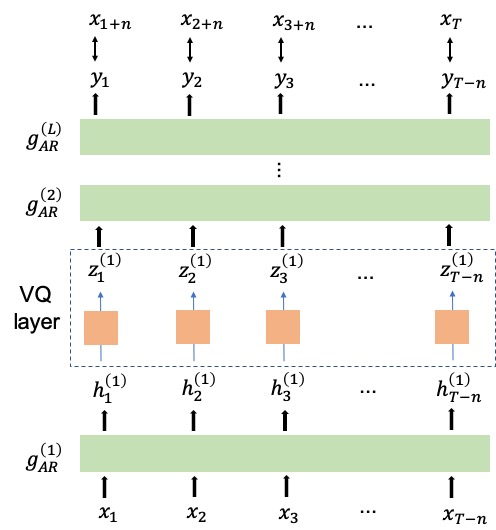
- Introduces VQ-APC, an extension of APC that inserts vector quantization layers between hidden layers of an autoregressive model to create a bottleneck.
- Uses L1 loss between predicted future frames and ground-truth frames to train the model, maintaining the original APC objective.
- Employs a learnable codebook to quantize hidden representations, with the number of bits per frame controlled by codebook size and sequence length.
- Studies model behavior across multiple configurations with varying codebook sizes to analyze information retention under capacity constraints.
- Uses probing tasks and mutual information estimation to assess the presence or absence of phonetic and speaker information in representations.
- Compares VQ-APC with other self-supervised models (CPC, BMR, Mockingjay, MT-APC) on phonetic and speaker classification using linear classifiers.
Experimental results
Research questions
- RQ1What information is preserved in APC representations when model capacity is constrained via vector quantization?
- RQ2How does the presence of phonetic and speaker information in representations change as model capacity is reduced?
- RQ3Do the discrete codes produced by VQ-APC correspond to meaningful linguistic units such as English phonemes?
- RQ4What is the relationship between minimizing the self-supervised prediction loss and the downstream performance of the learned representations?
- RQ5How does VQ-APC compare to other self-supervised models in terms of representation quality and information content?
Key findings
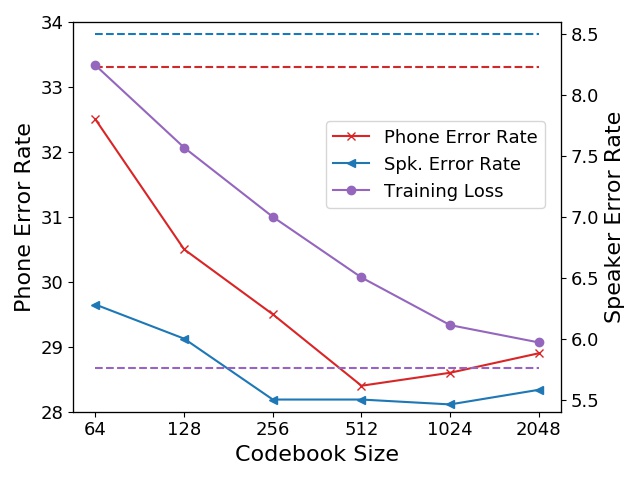
- VQ-APC achieves a phone error rate of 28.4% on phonetic classification, outperforming APC (33.3%) and MT-APC (30.5%), demonstrating the effectiveness of VQ in improving representation quality.
- On speaker classification, VQ-APC achieves a 5.5% error rate, outperforming APC (8.5%) and MT-APC (7.3%), and matching the best-performing model, Mockingjay (5.1%).
- Mutual information estimates show increasing information content with larger codebooks: normalized mutual information of 0.167, 0.285, and 0.406 for codebook sizes 1, 2, and 3, respectively.
- Probing tasks confirm the presence of phonetic and speaker information in representations with larger codebooks, while mutual information confirms the absence of such information in smaller configurations.
- The learned VQ codes for a specific model capacity show strong correspondence to English phonemes, suggesting that the discrete units learned are linguistically meaningful.
- The model exhibits a preference for preserving phonetic and speaker information when capacity is constrained, indicating that the self-supervised objective implicitly favors such information under bottlenecks.
Read this paper
Open the full text in the Nubint reader and ask about any passage as you read.
Read this paper on NubintThis review was generated by AI from the original paper. Please check the paper before citing it.