
[Paper Review] Very high energy gamma-ray emission beyond 10 TeV from GRB 221009A
LHAASO detects the highest-energy gamma-ray emission ever observed from a gamma-ray burst, GRB 221009A, with photons up to 13 TeV. The observation challenges the standard synchrotron self-Compton model for afterglow emission and suggests either enhanced intergalactic transparency or new physics such as Lorentz Invariance Violation or axion-like particles.
The highest energy gamma-rays from gamma-ray bursts (GRBs) have important implications for their radiation mechanism. Here we report for the first time the detection of gamma-rays up to 13 TeV from the brightest GRB 221009A by the Large High Altitude Air-shower Observatory (LHAASO). The LHAASO-KM2A detector registered more than 140 gamma-rays with energies above 3 TeV during 230$-$900s after the trigger. The intrinsic energy spectrum of gamma-rays can be described by a power-law after correcting for extragalactic background light (EBL) absorption. Such a hard spectrum challenges the synchrotron self-Compton (SSC) scenario of relativistic electrons for the afterglow emission above several TeV. Observations of gamma-rays up to 13 TeV from a source with a measured redshift of z=0.151 hints more transparency in intergalactic space than previously expected. Alternatively, one may invoke new physics such as Lorentz Invariance Violation (LIV) or an axion origin of very high energy (VHE) signals.
Motivation & Objective
- To investigate the origin of very high energy (VHE) gamma-ray emission from GRB 221009A, the brightest GRB ever recorded.
- To test the validity of the synchrotron self-Compton (SSC) scenario for VHE emission in GRB afterglows.
- To assess the role of extragalactic background light (EBL) absorption and alternative physics such as Lorentz Invariance Violation (LIV) or axion-like particles (ALPs) in shaping the observed spectrum.
- To determine the intrinsic spectral energy distribution (SED) of GRB 221009A above 3 TeV using combined data from LHAASO's KM2A and WCDA detectors.
- To constrain the transparency of intergalactic space at VHE energies using a source with a well-measured redshift (z = 0.151).
Proposed method
- Utilized the Large High Altitude Air-shower Observatory (LHAASO), a multi-detector array at 4,410 m altitude in Sichuan, China, comprising the Water Cherenkov Detector Array (WCDA) and the Kilometer Squared Array (KM2A).
- Combined data from KM2A (sensitive to 10 TeV–10 PeV) and WCDA (0.2–7 TeV) using a joint forward-folded spectral fitting method to reconstruct the intrinsic SED.
- Applied a log-parabola (LP) and a power-law with exponential cutoff (PLEC) function to model the spectral energy distribution, with corrections for EBL absorption using multiple EBL models.
- Employed a 'muon-less' criterion to suppress cosmic ray background in KM2A, achieving 98% rejection efficiency below 10 TeV.
- Conducted spectral fitting with and without EBL absorption, and tested alternative models including ALP oscillation and LIV effects using chi-squared minimization.
- Used the LHAASO-constrained EBL model derived from the data itself to improve spectral fitting robustness.
Experimental results
Research questions
- RQ1What is the highest energy of gamma-rays detected from GRB 221009A, and does it exceed the theoretical limits of standard emission mechanisms?
- RQ2Does the observed VHE spectrum above 10 TeV challenge the synchrotron self-Compton (SSC) model for GRB afterglows?
- RQ3To what extent is the intergalactic medium transparent to VHE gamma-rays from GRB 221009A, given its redshift of z = 0.151?
- RQ4Can the observed spectrum be explained by standard EBL absorption models, or are new physics effects like Lorentz Invariance Violation (LIV) or axion-like particles (ALPs) required?
- RQ5What are the constraints on the coupling strength of axion-like particles (g_aγ) or the energy scale of LIV (E_LIV) based on the observed SED?
Key findings
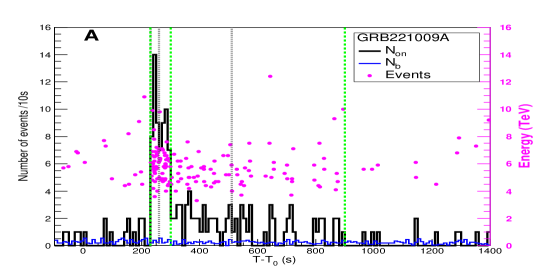
- LHAASO detected 142 gamma-ray events with energies above 3 TeV from GRB 221009A between T₀+230s and T₀+900s, with a significance of 20.6σ.
- The highest-energy photon observed had an energy of 13.6 TeV (with a 95% credible interval of 9.4–19.7 TeV), the highest ever recorded from a GRB.
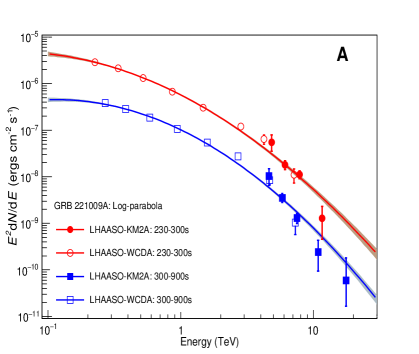
- The intrinsic energy spectrum, corrected for EBL absorption, is best described by a hard power-law or log-parabola, with a reduced χ²/ndf of 11.42/16 when using the LHAASO-constrained EBL model.
- The observed spectrum is inconsistent with the standard SSC model for relativistic electrons, which predicts a steeper spectrum above several TeV.
- The data suggest higher transparency in intergalactic space than predicted by standard EBL models, with the LHAASO-constrained EBL model yielding a significantly better fit than prior models.
- Constraints on new physics: the data exclude LIV at energy scales below 1.5 times the Planck scale (E_LIV > 1.5 M_Pl), and place an upper limit on the axion-like particle coupling of g_aγ < (6 × 10⁻¹¹ GeV⁻¹) for m_a = 10⁻⁷ eV.
Read this paper
Open the full text in the Nubint reader and ask about any passage as you read.
Read this paper on NubintThis review was generated by AI from the original paper. Please check the paper before citing it.