
[Paper Review] Video Anomaly Detection in 10 Years: A Survey and Outlook
This survey reviews deep learning-based video anomaly detection (VAD), including supervised, weakly supervised, self-supervised, unsupervised methods, and vision-language models, and discusses datasets, losses, and future directions.
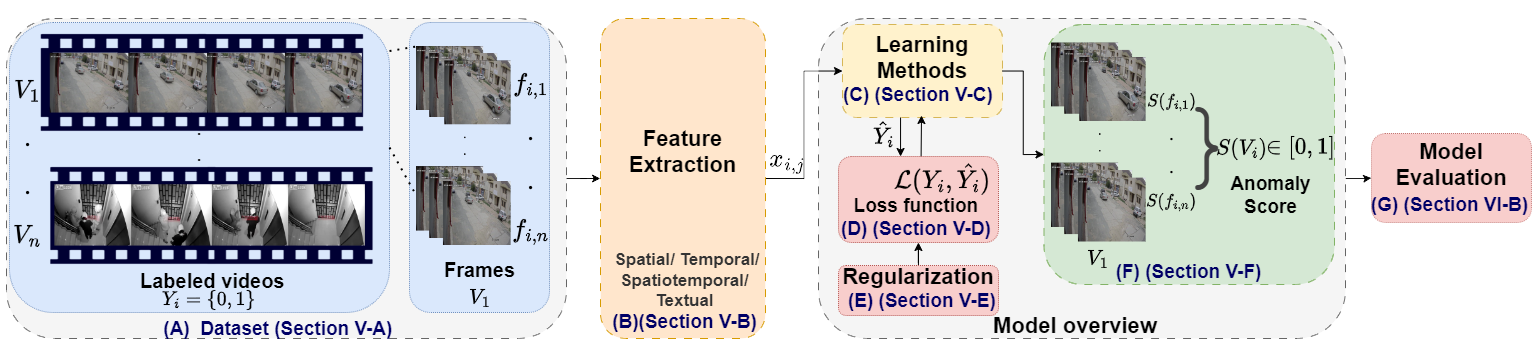
Video anomaly detection (VAD) holds immense importance across diverse domains such as surveillance, healthcare, and environmental monitoring. While numerous surveys focus on conventional VAD methods, they often lack depth in exploring specific approaches and emerging trends. This survey explores deep learning-based VAD, expanding beyond traditional supervised training paradigms to encompass emerging weakly supervised, self-supervised, and unsupervised approaches. A prominent feature of this review is the investigation of core challenges within the VAD paradigms including large-scale datasets, features extraction, learning methods, loss functions, regularization, and anomaly score prediction. Moreover, this review also investigates the vision language models (VLMs) as potent feature extractors for VAD. VLMs integrate visual data with textual descriptions or spoken language from videos, enabling a nuanced understanding of scenes crucial for anomaly detection. By addressing these challenges and proposing future research directions, this review aims to foster the development of robust and efficient VAD systems leveraging the capabilities of VLMs for enhanced anomaly detection in complex real-world scenarios. This comprehensive analysis seeks to bridge existing knowledge gaps, provide researchers with valuable insights, and contribute to shaping the future of VAD research.
Motivation & Objective
- Identify core challenges in modern VAD, including large-scale datasets, feature extraction, loss functions, regularization, and anomaly score prediction.
- Assess the impact of deep learning approaches (supervised, weakly supervised, self-supervised, unsupervised) on VAD performance.
- Explore the potential of vision-language models as feature extractors for VAD.
- Synthesize dataset benchmarks and provide recommendations to guide future VAD research and practice.
Proposed method
- Systematic review of literature from top computer vision venues (CVPR, ICCV, ECCV, TPAMI, IJCV, CVIU) over the past decade.
- Classification of methods into supervised, unsupervised, self-supervised, and weakly supervised categories.
- Analysis of datasets, feature extraction techniques (spatial, temporal, spatiotemporal, textual), and loss/regularization schemes.
- Evaluation of state-of-the-art models on benchmark datasets (qualitative and quantitative) to identify strengths and weaknesses.
- Discussion of vision-language models (VLMs) as feature extractors for VAD and their impact on performance.
- Proposed future directions and recommendations for robust VAD systems.
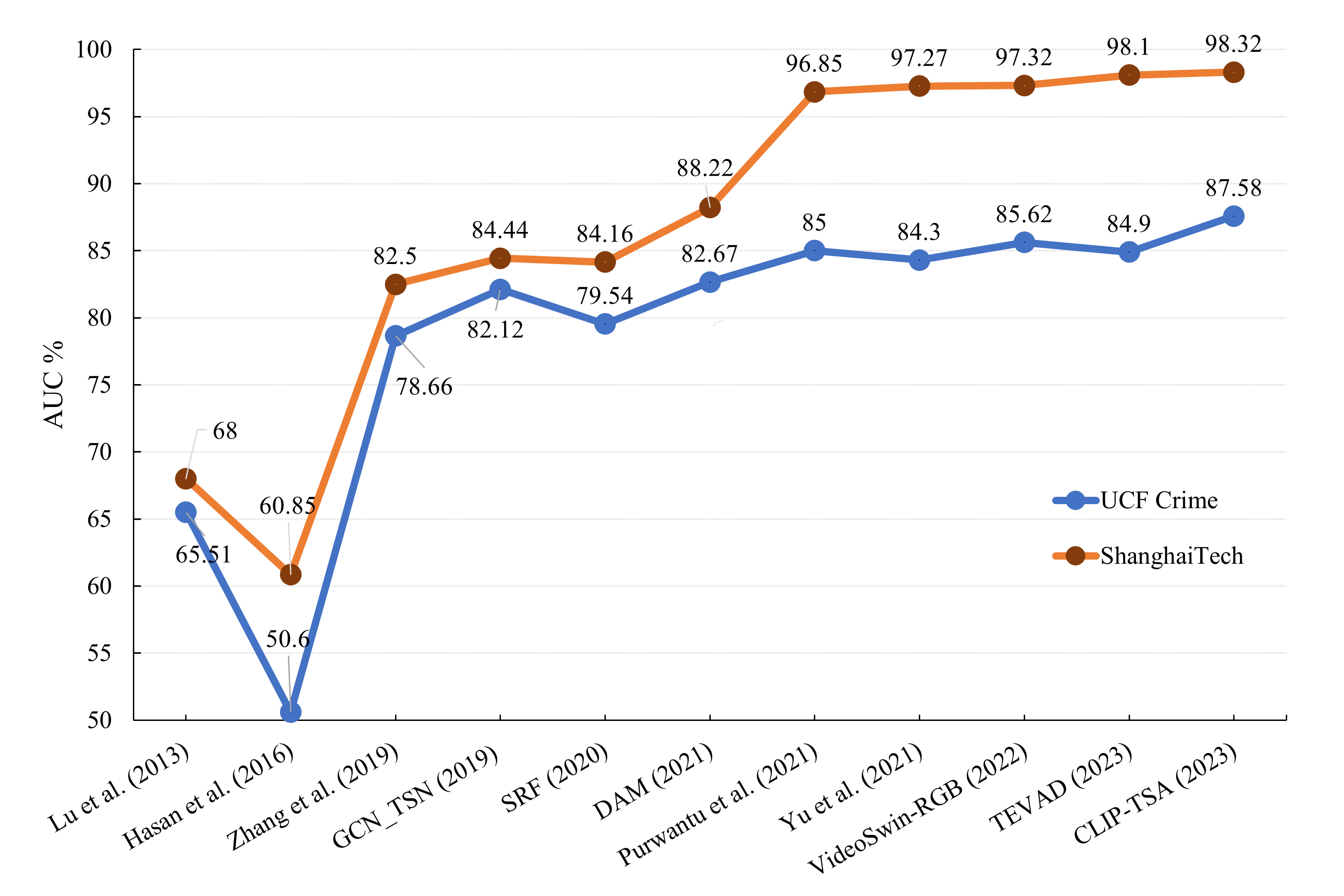
Experimental results
Research questions
- RQ1What are the prevailing deep learning paradigms used for video anomaly detection (supervised, weakly supervised, self-supervised, unsupervised) and how do they compare?
- RQ2How do feature extraction choices (spatial, temporal, spatiotemporal, textual) and loss functions affect VAD performance?
- RQ3What is the role of vision-language models in VAD, and how do they influence anomaly score prediction and localization?
- RQ4What datasets and evaluation protocols best capture real-world VAD challenges and how should benchmarks evolve?
- RQ5What future directions can address current limitations (data diversity, realism, long-term context, multi-modal data) in VAD?
Key findings
- Deep learning-based VAD has significantly improved performance over the past decade, with notable gains from vision-language models.
- Datasets vary in complexity and realism, with issues like limited anomaly diversity and class imbalance highlighted as challenges.
- Both spatial and temporal features are essential; integrating them into spatiotemporal representations improves detection and localization.
- Weakly supervised and unsupervised paradigms are increasingly important to reduce annotation burden while maintaining robust detection.
- Vision-language features offer complementary semantic context that can enhance anomaly understanding and scoring.
Read this paper
Open the full text in the Nubint reader and ask about any passage as you read.
Read this paper on NubintThis review was generated by AI from the original paper. Please check the paper before citing it.