
[Paper Review] Video-ChatGPT: Towards Detailed Video Understanding via Large Vision and Language Models
Video-ChatGPT combines a video-adapted CLIP encoder with a Vicuna-based LLM, trained on 100k video-instruction pairs, and introduces a quantitative video conversation evaluation framework to enable detailed open-ended video dialogues.
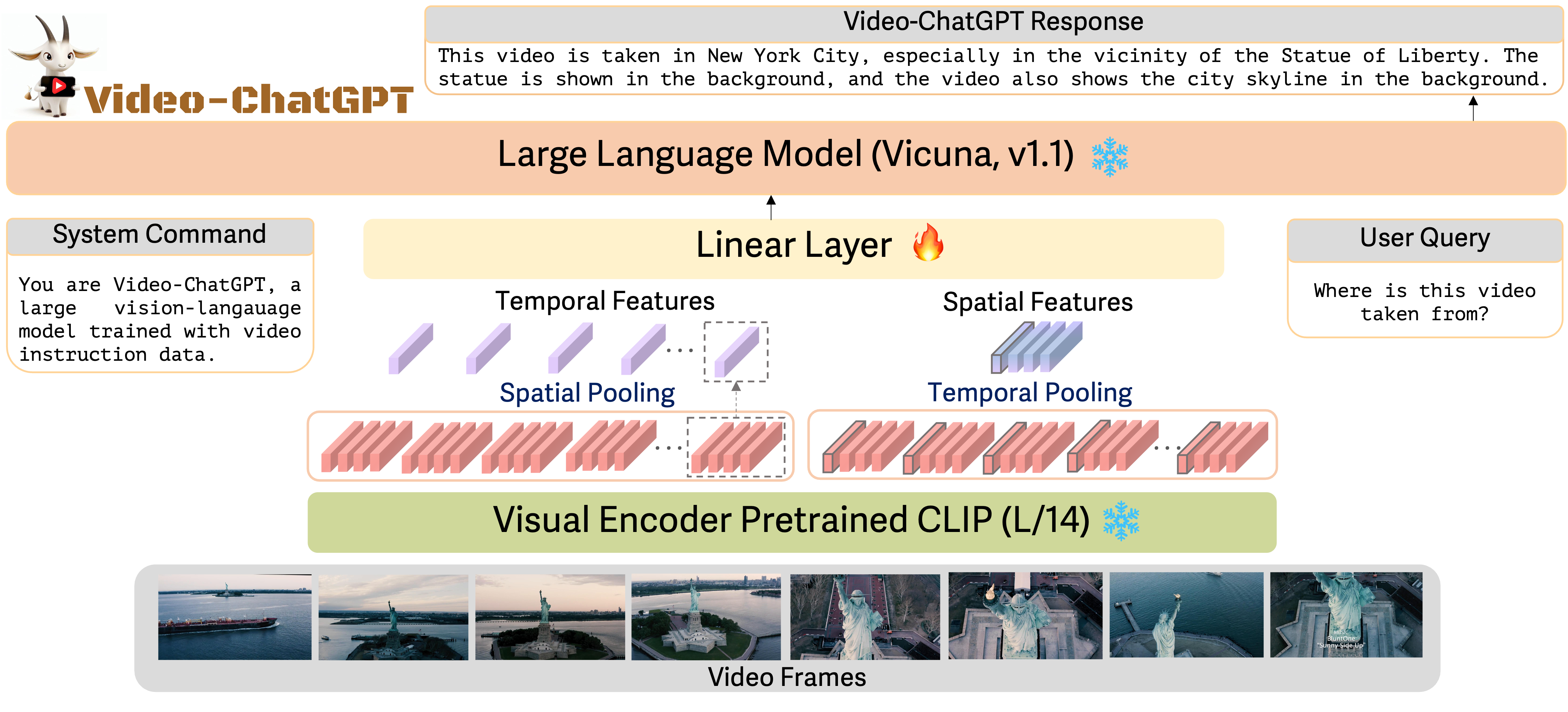
Conversation agents fueled by Large Language Models (LLMs) are providing a new way to interact with visual data. While there have been initial attempts for image-based conversation models, this work addresses the under-explored field of \emph{video-based conversation} by introducing Video-ChatGPT. It is a multimodal model that merges a video-adapted visual encoder with an LLM. The resulting model is capable of understanding and generating detailed conversations about videos. We introduce a new dataset of 100,000 video-instruction pairs used to train Video-ChatGPT acquired via manual and semi-automated pipeline that is easily scalable and robust to label noise. We also develop a quantitative evaluation framework for video-based dialogue models to objectively analyze the strengths and weaknesses of video-based dialogue models. Code: https://github.com/mbzuai-oryx/Video-ChatGPT.
Motivation & Objective
- Motivate open-ended, coherent conversations about videos beyond traditional QA.
- Enable temporal and spatial understanding with a vision-language model tailored for videos.
- Provide a scalable data-generation framework for high-quality video instruction data.
- Offer a benchmark framework to quantitatively assess video-based conversational abilities.
Proposed method
- Architect a video-extended VL model by adapting CLIP ViT-L/14 as a visual encoder and Vicuna as the language decoder.
- Create and fine-tune on 100k video-instruction pairs via instruction tuning while keeping most backbone components frozen.
- Develop a simple adapter g to project spatiotemporal video features into the LLM input space.
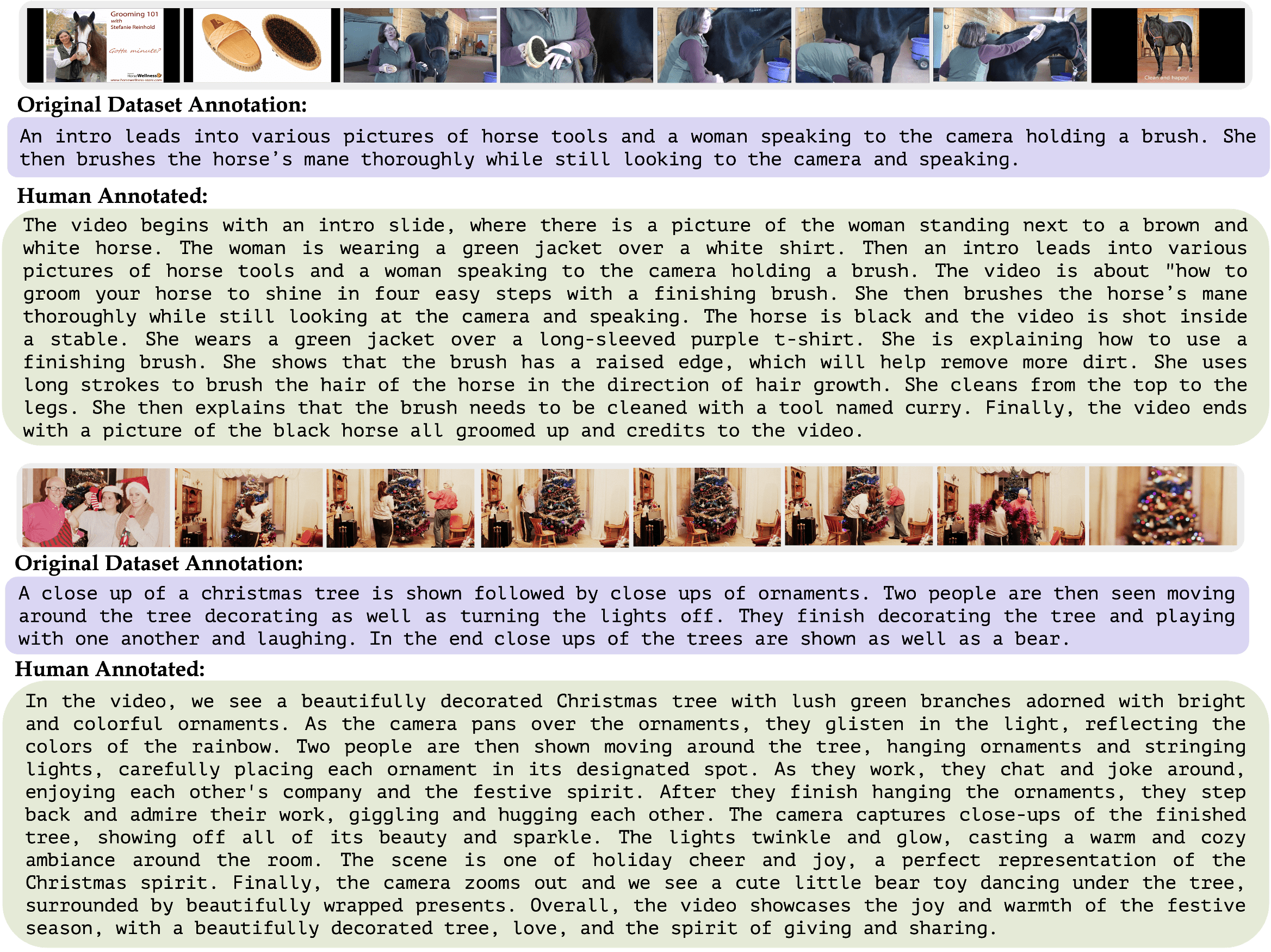
- Generate rich video instruction data through a hybrid human-assisted and semi-automatic annotation pipeline.
- Propose a quantitative evaluation framework for video-based dialogue covering correctness, detail, context, temporal and consistency aspects.
Experimental results
Research questions
- RQ1How well can a vision-language model understand and converse about spatiotemporal video content?
- RQ2Can a lightweight adapter with a frozen backbone achieve competitive video-based dialogue performance?
- RQ3What is the impact of high-quality, video-specific instruction data on open-ended video conversations?
- RQ4How can we quantify the strengths and weaknesses of video-based conversational models across multiple capabilities?
Key findings
- Video-ChatGPT achieves competitive zero-shot QA performance across multiple datasets compared with contemporary models.
- On MSVD-QA, MSRVTT-QA, TGIF-QA, and ActivityNet-QA, Video-ChatGPT attains higher accuracy/score than Video Chat and FrozenBiLM baselines.
- The model demonstrates strong temporal understanding and context-aware responses due to instruction tuning on video data.
- A 100k video-instruction dataset with human-assisted and semi-automatic annotations enhances video-specific understanding and conversation capabilities.
- The paper introduces a first quantitative video conversation evaluation framework to benchmark video-based dialogue models.
Read this paper
Open the full text in the Nubint reader and ask about any passage as you read.
Read this paper on NubintThis review was generated by AI from the original paper. Please check the paper before citing it.