
[Paper Review] VITA: A Multi-modal LLM-based System for Longitudinal, Autonomous, and Adaptive Robotic Mental Well-being Coaching
VITA is a multi-modal, LLM-powered robotic coaching system that autonomously adapts to users' facial expressions and speech patterns to deliver personalized mental well-being interventions. In a 4-week real-world study with 17 participants, VITA significantly improved mental well-being, reduced interaction ruptures, and was perceived as more responsive and empathetic than pre-scripted models.
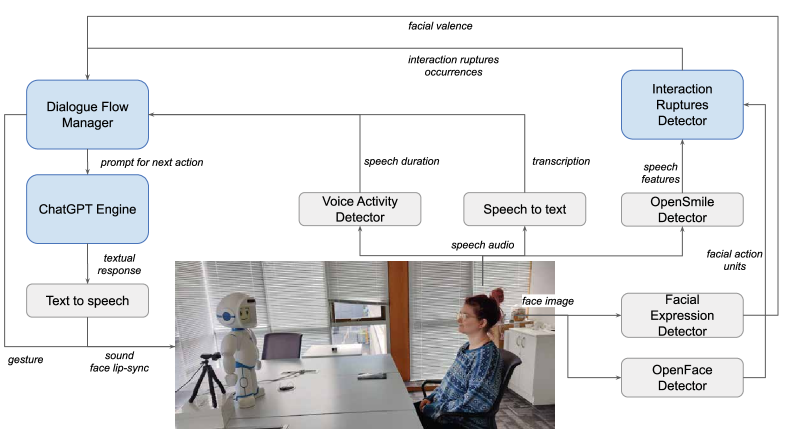
Recently, several works have explored if and how robotic coaches can promote and maintain mental well-being in different settings. However, findings from these studies revealed that these robotic coaches are not ready to be used and deployed in real-world settings due to several limitations that span from technological challenges to coaching success. To overcome these challenges, this paper presents VITA, a novel multi-modal LLM-based system that allows robotic coaches to autonomously adapt to the coachee's multi-modal behaviours (facial valence and speech duration) and deliver coaching exercises in order to promote mental well-being in adults. We identified five objectives that correspond to the challenges in the recent literature, and we show how the VITA system addresses these via experimental validations that include one in-lab pilot study (N=4) that enabled us to test different robotic coach configurations (pre-scripted, generic, and adaptive models) and inform its design for using it in the real world, and one real-world study (N=17) conducted in a workplace over 4 weeks. Our results show that: (i) coachees perceived the VITA adaptive and generic configurations more positively than the pre-scripted one, and they felt understood and heard by the adaptive robotic coach, (ii) the VITA adaptive robotic coach kept learning successfully by personalising to each coachee over time and did not detect any interaction ruptures during the coaching, (iii) coachees had significant mental well-being improvements via the VITA-based robotic coach practice. The code for the VITA system is openly available via: https://github.com/Cambridge-AFAR/VITA-system.
Motivation & Objective
- Address the lack of interactivity and responsiveness in existing robotic coaches, which leads to negative user perceptions.
- Enable longitudinal personalization by adapting to individual coachees' behavioral patterns over time.
- Detect and mitigate interaction ruptures to maintain coaching alliance and session flow.
- Enhance conversational quality by integrating advanced large language models (LLMs) to imitate human-like coaching behaviors.
- Demonstrate sustained, significant improvements in coachees' mental well-being through long-term robotic coaching.
Proposed method
- Integrates multi-modal inputs—facial valence from video and speech duration from audio—using real-time behavioral analysis.
- Employs a reinforcement learning framework to dynamically adapt coaching strategies based on coachee feedback and behavior.
- Embeds a large language model (LLM) to generate natural, contextually appropriate, and empathetic verbal responses.
- Uses a safety moderation layer (e.g., OpenAI Moderation API) to filter responses and ensure ethical interaction quality.
- Employs a reward function that increases over time, reflecting improved coachee engagement and perceived adaptation.
- Deploys a real-time, autonomous coaching loop that selects and delivers positive psychology exercises based on adaptive models.
Experimental results
Research questions
- RQ1Can an autonomous, multi-modal robotic coach improve coachees’ perception of interactivity and responsiveness compared to pre-scripted models?
- RQ2To what extent can the robotic coach adapt to individual coachees’ behavioral patterns (e.g., facial expression, speech duration) over a 4-week period?
- RQ3Can interaction ruptures be effectively detected and minimized in real-world robotic coaching sessions?
- RQ4How do LLM-powered conversational capabilities affect coachees’ sense of being understood and heard?
- RQ5Does long-term robotic coaching with VITA lead to significant, measurable improvements in mental well-being?
Key findings
- Coachees perceived the adaptive and generic VITA configurations significantly more positively than the pre-scripted model, reporting feeling understood and heard.
- The adaptive VITA system successfully personalized to each coachee over time, with a measurable increase in the reinforcement learning reward signal across sessions.
- Interaction ruptures were reduced to an average of 3 per session (lasting ~3 seconds each), a significant improvement over prior work (15–20 ruptures, ~10 seconds each).
- Coachees reported significant improvements in mental well-being, with statistically significant gains on the RPWS scale after four weeks of coaching.
- Interviews revealed that coachees felt the LLM-driven responses were natural and content-wise empathetic, though some noted a lack of emotional depth in the responses.
- The system demonstrated robust performance in real-world deployment without any detected system failures or major breakdowns during the 4-week study.
Read this paper
Open the full text in the Nubint reader and ask about any passage as you read.
Read this paper on NubintThis review was generated by AI from the original paper. Please check the paper before citing it.