
[Paper Review] VLM See, Robot Do: Human Demo Video to Robot Action Plan via Vision Language Model
SeeDo uses a vision-language model pipeline with keyframe selection and visual perception prompts to convert human demonstration videos into robot task plans, executed via language model programs on simulation and real robots.
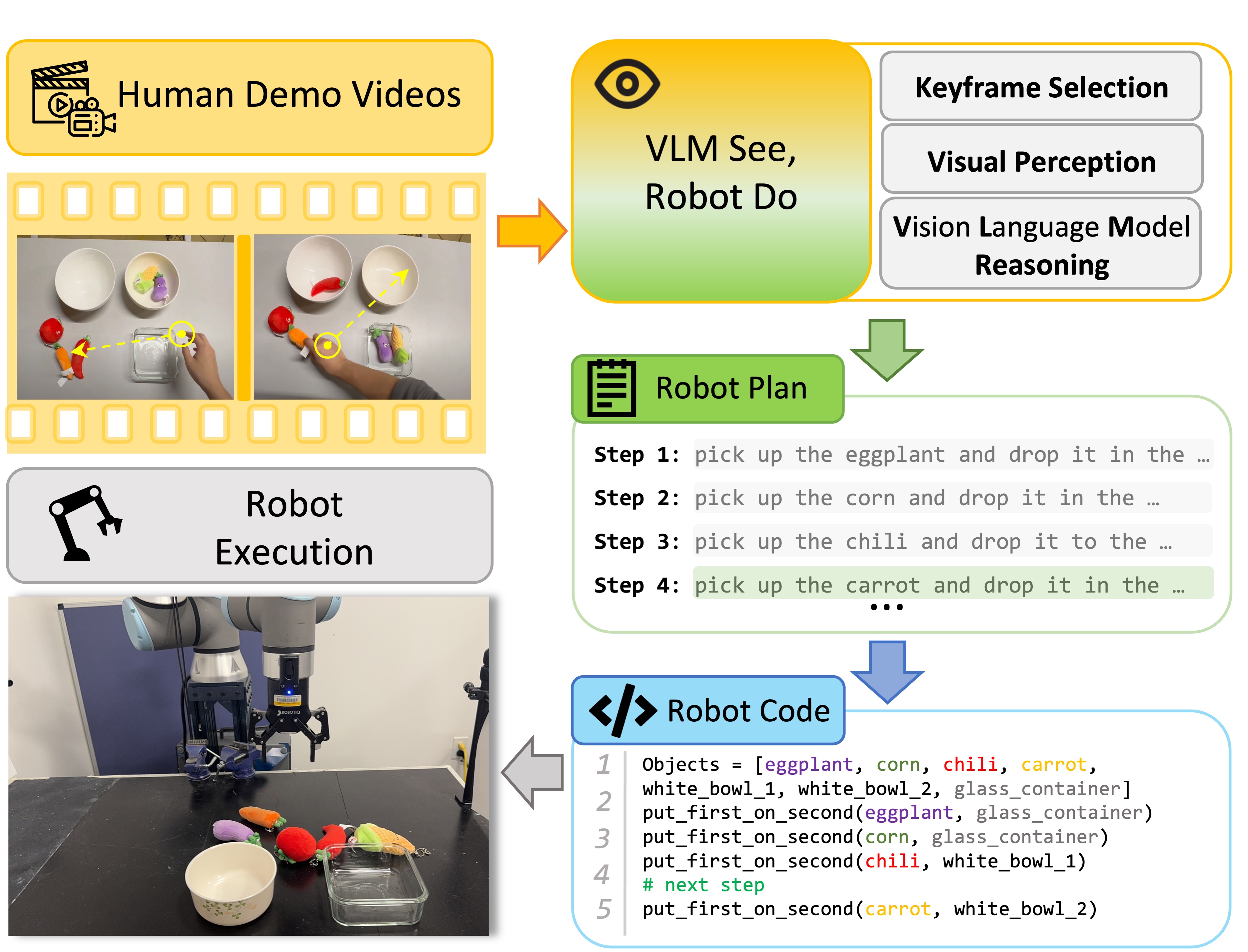
Vision Language Models (VLMs) have recently been adopted in robotics for their capability in common sense reasoning and generalizability. Existing work has applied VLMs to generate task and motion planning from natural language instructions and simulate training data for robot learning. In this work, we explore using VLM to interpret human demonstration videos and generate robot task planning. Our method integrates keyframe selection, visual perception, and VLM reasoning into a pipeline. We named it SeeDo because it enables the VLM to ''see'' human demonstrations and explain the corresponding plans to the robot for it to ''do''. To validate our approach, we collected a set of long-horizon human videos demonstrating pick-and-place tasks in three diverse categories and designed a set of metrics to comprehensively benchmark SeeDo against several baselines, including state-of-the-art video-input VLMs. The experiments demonstrate SeeDo's superior performance. We further deployed the generated task plans in both a simulation environment and on a real robot arm.
Motivation & Objective
- Motivate robotic learning from long-horizon human demonstration videos using vision-language models.
- Develop a pipeline that interprets videos into robot task plans via sub-task decomposition.
- Mitigate video processing and spatial-relation challenges in VLMs through perception-enhanced reasoning.
- Benchmark SeeDo against state-of-the-art video VLMs across diverse long-horizon tasks.
Proposed method
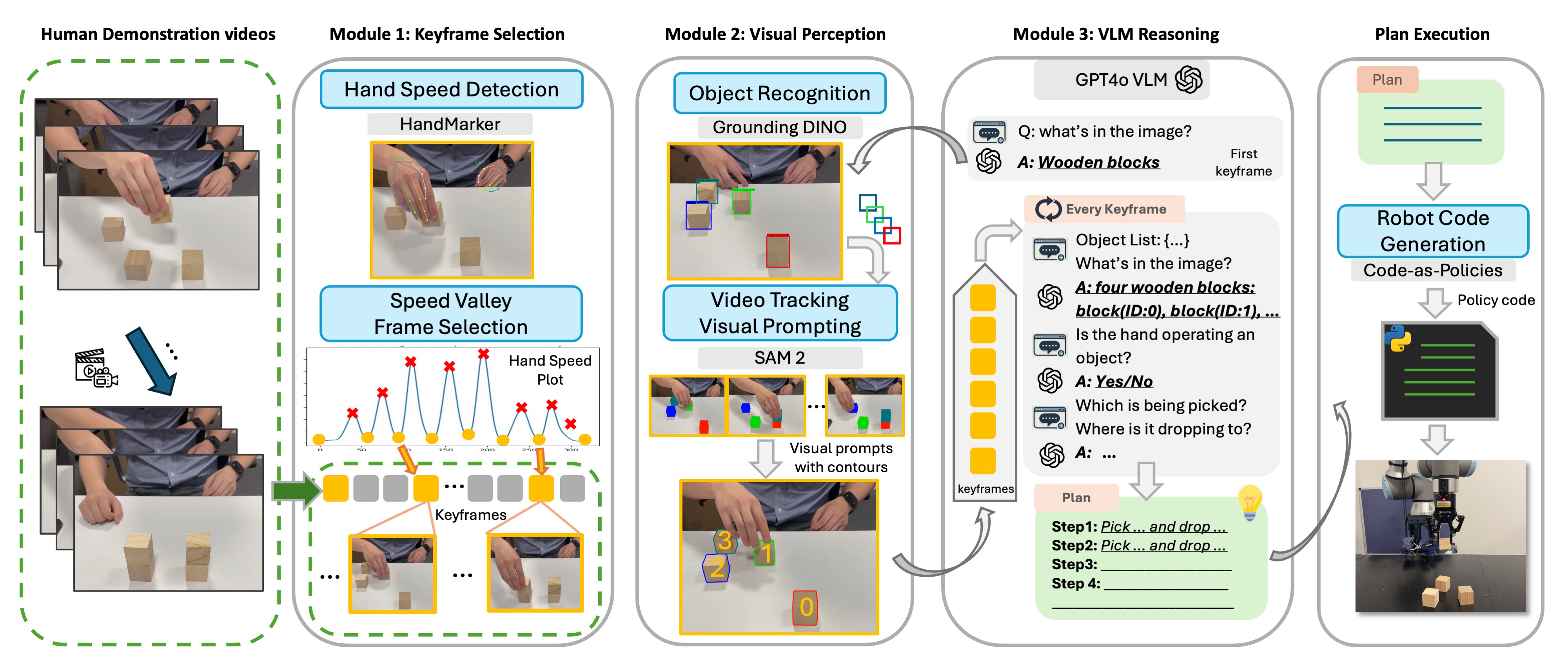
- Introduce a three-module SeeDo pipeline: Keyframe Selection, Visual Perception, and VLM Reasoning.
- Use hand-speed based keyframe extraction to capture critical action frames.
- Apply object tracking and visual prompts (contours, IDs, centers) to enhance VLM perception.
- Employ GPT-4o with chain-of-thought prompting to generate task plans.
- Convert generated plans into Language Model Programs (LMPs) to execute via robotics APIs.
- Evaluate with both simulation (Pybullet) and a UR10e real robot across three tasks.
Experimental results
Research questions
- RQ1Can a vision-language model interpret human demonstration videos to generate executable robot plans?
- RQ2Does adding a keyframe selection and visual perception module improve temporal and spatial reasoning in VLM-based planning?
- RQ3How does SeeDo compare to state-of-the-art video VLMs on long-horizon tasks?
- RQ4Are the generated task plans transferable to both simulation and real hardware?
Key findings
- SeeDo outperforms baselines (closed-source and open-source video VLMs) on TSR, FSR, and SSR across all tasks.
- SSRs stay above 52.48% on wooden blocks and exceed 66.50% on garment organization in SeeDo configurations.
- SeeDo achieves 60.53% TSR and FSR and 80.40% SSR on vegetable organization, outperforming other models.
- Visual prompts markedly improve spatial reasoning, reducing spatial error rates compared to SeeDo without prompts.
- Ablations show that keyframe sampling and hand-detection-based keyframes are crucial for maintaining context and performance.
- The generated task plans can be executed with LMPs on both simulated and real UR10e setups.
Read this paper
Open the full text in the Nubint reader and ask about any passage as you read.
Read this paper on NubintThis review was generated by AI from the original paper. Please check the paper before citing it.