
[Paper Review] W2v-BERT: Combining Contrastive Learning and Masked Language Modeling for Self-Supervised Speech Pre-Training
w2v-BERT proposes an end-to-end self-supervised speech pre-training framework that jointly optimizes contrastive learning for speech unit discretization and masked language modeling (MLM) on the resulting tokens. It achieves state-of-the-art performance on LibriSpeech, reducing WER by 5–10% relative to wav2vec 2.0 and HuBERT, and improves voice search accuracy by over 30% relative to a conformer-based baseline.
Motivated by the success of masked language modeling~(MLM) in pre-training natural language processing models, we propose w2v-BERT that explores MLM for self-supervised speech representation learning. w2v-BERT is a framework that combines contrastive learning and MLM, where the former trains the model to discretize input continuous speech signals into a finite set of discriminative speech tokens, and the latter trains the model to learn contextualized speech representations via solving a masked prediction task consuming the discretized tokens. In contrast to existing MLM-based speech pre-training frameworks such as HuBERT, which relies on an iterative re-clustering and re-training process, or vq-wav2vec, which concatenates two separately trained modules, w2v-BERT can be optimized in an end-to-end fashion by solving the two self-supervised tasks~(the contrastive task and MLM) simultaneously. Our experiments show that w2v-BERT achieves competitive results compared to current state-of-the-art pre-trained models on the LibriSpeech benchmarks when using the Libri-Light~60k corpus as the unsupervised data. In particular, when compared to published models such as conformer-based wav2vec~2.0 and HuBERT, our model shows~5\% to~10\% relative WER reduction on the test-clean and test-other subsets. When applied to the Google's Voice Search traffic dataset, w2v-BERT outperforms our internal conformer-based wav2vec~2.0 by more than~30\% relatively.
Motivation & Objective
- To improve self-supervised speech representation learning by combining contrastive learning and masked language modeling (MLM) in a unified, end-to-end framework.
- To overcome limitations of existing two-stage approaches like vq-wav2vec and DiscreteBERT, which freeze the discretizer during representation learning.
- To enable joint optimization of speech unit discovery and contextual representation learning, avoiding error propagation from pre-trained discretizers.
- To validate the effectiveness of the framework on both standard benchmarks (LibriSpeech) and real-world, challenging speech data (Google Voice Search).
- To analyze the interplay between contrastive learning and MLM, particularly the necessity of contrastive learning for effective masked prediction.
Proposed method
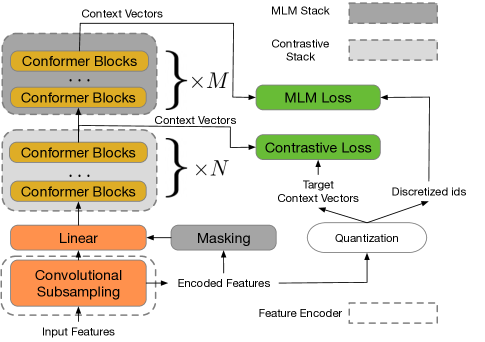
- The model uses a shared feature encoder followed by two parallel stacks of conformer blocks: one for contrastive learning and one for masked language modeling (MLM).
- The contrastive module learns to discretize continuous speech into a finite set of discriminative units by predicting future frames in a contrastive objective.
- The MLM module predicts masked discrete units from the context, similar to BERT’s masked token prediction in NLP.
- Both objectives are optimized jointly in an end-to-end manner, allowing the model to refine both discretization and contextual representations simultaneously.
- The framework uses a codebook to map continuous representations to discrete units, which are then used as targets in the MLM task.
- The model is pre-trained on 60k hours of Libri-Light data and fine-tuned on supervised ASR tasks with standard conformer-based architectures.
Experimental results
Research questions
- RQ1Can joint optimization of contrastive learning and masked language modeling improve self-supervised speech representation learning compared to separate or iterative training?
- RQ2Does end-to-end training of the contrastive and MLM modules lead to better performance than two-stage methods that freeze the discretizer?
- RQ3How does the capacity of the contrastive module affect the performance of the MLM module and overall ASR accuracy?
- RQ4Can w2v-BERT generalize to real-world, noisy, and short utterances such as those in voice search, where standard contrastive learning struggles?
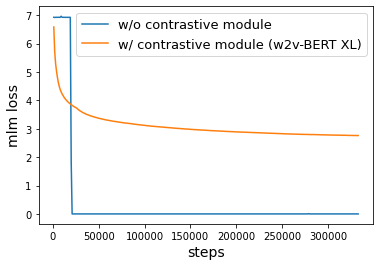
- RQ5What is the role of contrastive learning in enabling effective masked prediction in the framework?
Key findings
- w2v-BERT achieves a 2.3% WER on LibriSpeech test-clean and 4.0% on test-other, outperforming wav2vec 2.0 and HuBERT by 5–10% relative WER reduction.
- On the Google Voice Search dataset, w2v-BERT XL reduces WER from 10.8 (baseline) to 6.2, achieving over 30% relative improvement.
- The performance of w2v-BERT improves with increasing depth of the contrastive module up to a point, with optimal performance at 8–12 layers, after which diminishing returns occur.
- The masked prediction module becomes a bottleneck when the contrastive module is too deep, indicating a need for balanced capacity between modules.
- Empirical analysis confirms that contrastive learning is essential for enabling effective masked prediction, as removing it degrades MLM performance significantly.
- w2v-BERT consistently outperforms wav2vec 2.0 and w2v-Conformer XL across all LibriSpeech subsets, even with identical hyperparameters from prior work.
Read this paper
Open the full text in the Nubint reader and ask about any passage as you read.
Read this paper on NubintThis review was generated by AI from the original paper. Please check the paper before citing it.