
[Paper Review] When Respondents Don't Care Anymore: Identifying the Onset of Careless Responding
This paper proposes a machine learning-based method to detect the onset of careless responding in lengthy questionnaires by identifying structural breaks in three response dimensions—consistency, invariability, and response speed—using changepoint detection with self-normalization. The method reliably identifies when participants shift from attentive to careless responding, enabling researchers to analyze only accurate response segments and preserve sample size.
Questionnaires in the behavioral sciences tend to be lengthy. However, literature suggests that survey length is a contributing factor to careless responding, with longer questionnaires yielding higher probability that participants start responding carelessly. Consequently, in long surveys a large number of participants may engage in careless responding, posing a major threat to internal validity. We propose a novel method for identifying the onset of careless responding (or an absence thereof) that searches for a changepoint in combined measurements of multiple dimensions in which carelessness may manifest, such as inconsistency and invariability. It is highly flexible, based on machine learning, and provides statistical guarantees for controlling the false positive rate. In simulation experiments, the proposed method achieves high accuracy in identifying carelessness onset and discriminates well between attentive and various types of careless responding, even when a large number of careless respondents are present. An empirical application highlights how identifying partial carelessness uncovers novel insights on careless responding behavior. Furthermore, we provide the freely available open source software package "carelessonset" to facilitate adoption by empirical researchers.
Motivation & Objective
- To address the growing threat of careless responding in lengthy behavioral and organizational science surveys, where fatigue or boredom leads participants to abandon accurate responding.
- To develop a method that identifies the precise item at which careless responding begins for each participant, rather than treating all responses as uniformly careless or attentive.
- To provide a flexible, model-free approach that does not predefine response styles and offers statistical guarantees through self-normalization.
- To enable researchers to retain valid response segments from partially careless respondents, thus preserving statistical power and reducing sample loss.
- To open new avenues for theory-building by allowing separate analysis of careless response segments to study their psychological correlates.
Proposed method
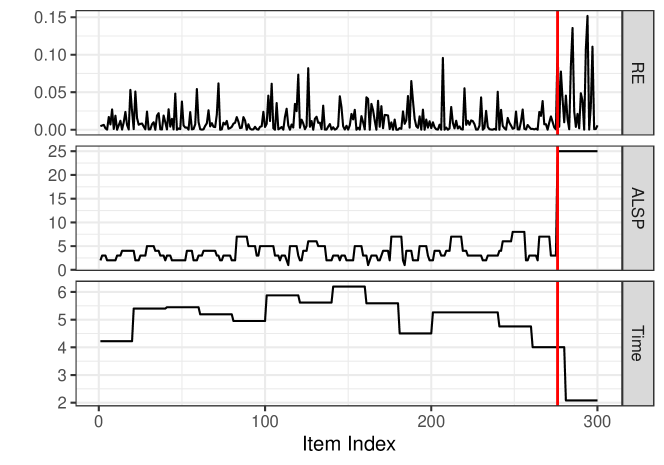
- The method combines three indicators of carelessness: inconsistency in responses (e.g., contradictory answers), invariability (e.g., repeated response patterns like long strings of 'agree' or 'disagree'), and fast response times.
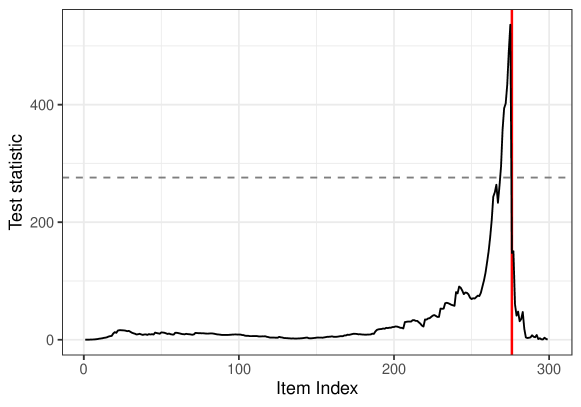
- It uses a self-normalization-based test statistic to detect structural breaks (changepoints) in each of the three dimensions across the response sequence for each participant.
- Changepoint detection is performed using the method of Shao & Zhang (2010), adapted for multidimensional time series to identify when a shift in response behavior occurs.
- The approach is nonparametric and model-free, avoiding assumptions about response distributions or predefined careless response patterns.
- An adaptive long-string pattern algorithm is used to quantify response invariability, detecting repetitive response patterns indicative of carelessness.
- The method is implemented in R and released as open-source software to promote accessibility and adoption in empirical research.
Experimental results
Research questions
- RQ1At which item does careless responding begin for each participant in a lengthy questionnaire?
- RQ2Can multiple indicators of carelessness—consistency, invariability, and response speed—be combined effectively to detect the onset of careless responding?
- RQ3How reliable is the method in identifying changepoints under varying levels of carelessness and response patterns?
- RQ4Can the method distinguish between partially careless respondents and consistently attentive ones with high accuracy?
- RQ5To what extent can the method preserve valid data by isolating accurate response segments, thus reducing sample loss in survey analysis?
Key findings
- The method achieves high reliability in identifying the onset of careless responding in simulation experiments, even under high levels of carelessness.
- It successfully discriminates between attentive and partially careless respondents, with strong performance across diverse response styles.
- The method captures a wide variety of careless response patterns, including those with inconsistent, invariant, or extremely fast responses.
- Empirical validation on a Big Five personality survey confirmed the method’s ability to detect meaningful shifts in response behavior.
- The approach enables researchers to exclude only the careless portion of responses, thereby retaining valid data from partially careless respondents and minimizing sample loss.
- The open-source R implementation facilitates adoption and integration into standard survey data preprocessing pipelines.
Read this paper
Open the full text in the Nubint reader and ask about any passage as you read.
Read this paper on NubintThis review was generated by AI from the original paper. Please check the paper before citing it.