
[Paper Review] Who said that?: Audio-visual speaker diarisation of real-world meetings
This paper proposes an audio-visual speaker diarisation system that uses deep audio-visual synchronisation to self-enroll speaker models from video and audio, transforming unsupervised clustering into supervised classification. By leveraging visual cues to detect speaking segments and enroll speaker embeddings, the method achieves state-of-the-art performance on the AMI meeting corpus, reducing speaker error by 48% (ES) and 26% (IS) relative to audio-only baselines, with further gains from beamforming and multi-modal fusion.
The goal of this work is to determine 'who spoke when' in real-world meetings. The method takes surround-view video and single or multi-channel audio as inputs, and generates robust diarisation outputs. To achieve this, we propose a novel iterative approach that first enrolls speaker models using audio-visual correspondence, then uses the enrolled models together with the visual information to determine the active speaker. We show strong quantitative and qualitative performance on a dataset of real-world meetings. The method is also evaluated on the public AMI meeting corpus, on which we demonstrate results that exceed all comparable methods. We also show that beamforming can be used together with the video to further improve the performance when multi-channel audio is available.
Motivation & Objective
- To address the challenge of determining 'who spoke when' in real-world meetings with high accuracy.
- To overcome limitations of traditional audio-only diarisation, which treats the problem as unsupervised clustering and struggles with overlapping speech and unknown speakers.
- To improve robustness to speaker movement and occlusion by integrating visual information for speaker model enrollment.
- To demonstrate performance gains through multi-modal fusion of audio and video, especially in real-world, unconstrained meeting environments.
- To evaluate the impact of beamforming and spatial audio cues when multi-channel audio is available.
Proposed method
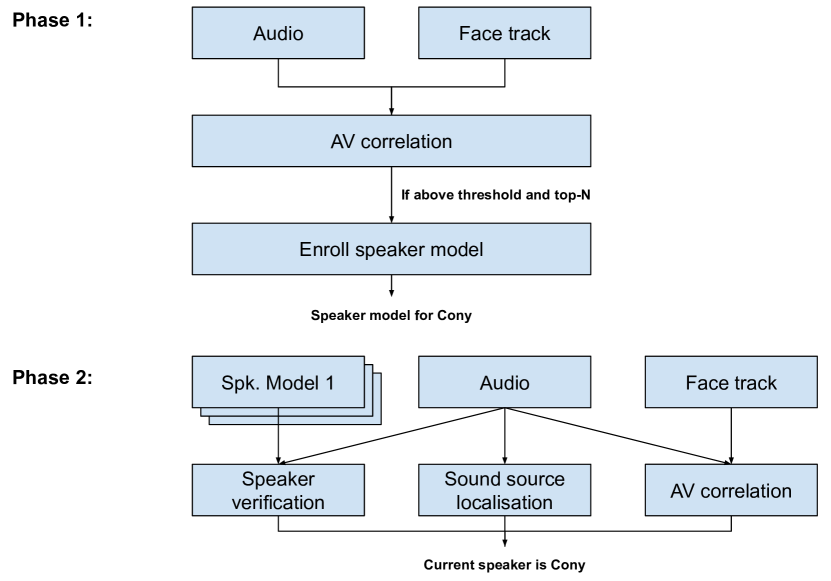
- Uses a deep audio-visual synchronisation network to detect speaking segments when mouth movements are clearly visible in video, enabling self-enrollment of speaker models.
- Applies speaker embeddings (x-vectors) extracted from audio segments, with model enrollment triggered only during visually confirmed speech.
- Reformulates diarisation from unsupervised clustering to supervised classification by using enrolled speaker models to assign probabilities to each segment.
- Employs beamforming on multi-channel audio to estimate sound source locations, which are fused with visual cues to improve active speaker detection.
- Uses a probabilistic fusion framework combining audio, visual, and spatial cues at inference time, with adaptive weighting tuned on validation data.
- Applies VAD and diarisation pipeline based on JHU Sys4, with PLDA scoring and AHC clustering, but replaces clustering with model-based classification.
Experimental results
Research questions
- RQ1Can audio-visual correspondence be used to reliably self-enroll speaker models without prior speaker information?
- RQ2Does transforming diarisation from clustering to classification using self-enrolled models improve performance on real-world meetings?
- RQ3How do visual speech detection and beamforming contribute to robustness against occlusion and background noise?
- RQ4To what extent does multi-modal fusion of audio, video, and spatial cues reduce speaker error compared to unimodal or early-fusion baselines?
- RQ5Can the proposed method generalize to unconstrained, real-world meeting environments where speaker count and movement vary?
Key findings
- The proposed audio-visual speaker diarisation system achieves a 48% relative reduction in speaker error rate (SPKE) on the ES subset of the AMI corpus compared to the audio-only baseline.
- On the IS subset, the system achieves a 26% relative reduction in SPKE, demonstrating strong generalization to diverse meeting conditions.
- The addition of audio-visual correspondence (AVC) and sound source localisation (SSL) contributes 20–40% and 19–39% relative performance gains, respectively, depending on the test set.
- The system outperforms prior state-of-the-art audio-visual methods, including [cabanas2018multimodal], across all test conditions on the AMI corpus.
- The method generalizes well to the internal real-world meeting dataset, where the audio-only baseline fails, indicating robustness to challenging, unconstrained environments.
- Beamforming with multi-channel audio further improves performance by enhancing spatial cues, especially when combined with visual information.
Read this paper
Open the full text in the Nubint reader and ask about any passage as you read.
Read this paper on NubintThis review was generated by AI from the original paper. Please check the paper before citing it.