
[Paper Review] You Truly Understand What I Need: Intellectual and Friendly Dialogue Agents grounding Knowledge and Persona
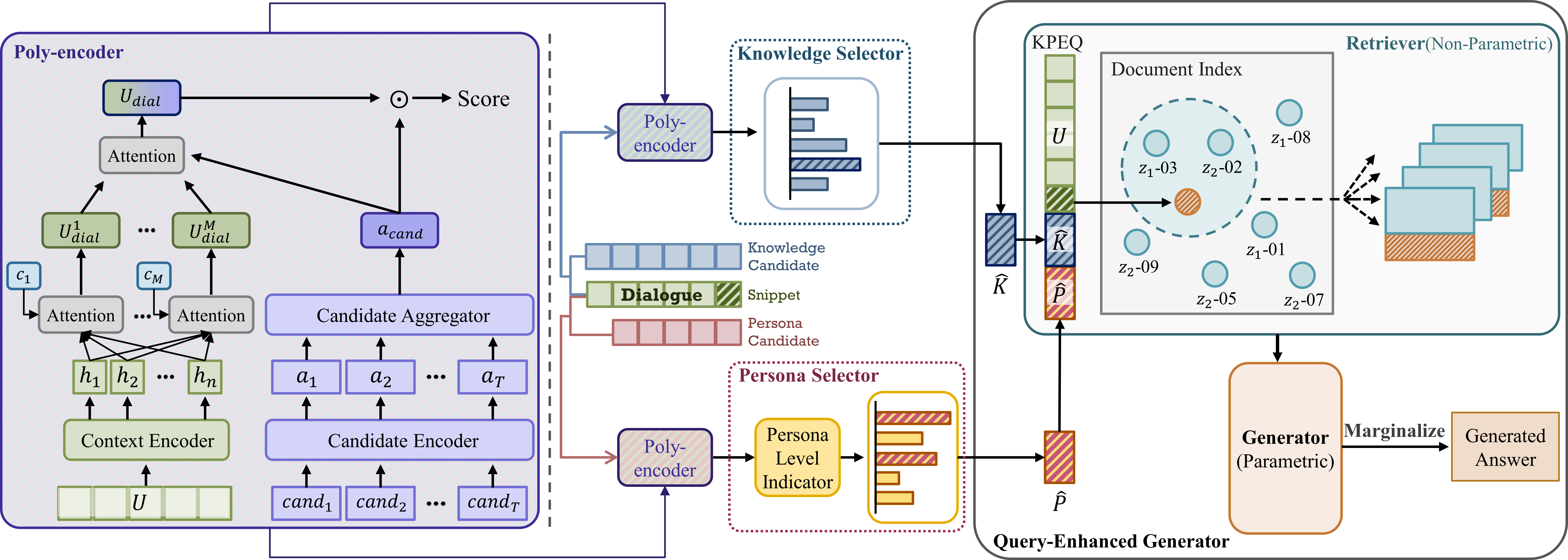
This paper proposes INFO, a dialogue agent that simultaneously grounds external knowledge and user persona using a poly-encoder-based retrieval system and retrieval-augmented generation. By enhancing the input query with retrieved knowledge and persona, the model generates more informative, engaging, and less hallucinated responses, achieving state-of-the-art performance on both grounding and generation tasks in persona-knowledge chat benchmarks.
To build a conversational agent that interacts fluently with humans, previous studies blend knowledge or personal profile into the pre-trained language model. However, the model that considers knowledge and persona at the same time is still limited, leading to hallucination and a passive way of using personas. We propose an effective dialogue agent that grounds external knowledge and persona simultaneously. The agent selects the proper knowledge and persona to use for generating the answers with our candidate scoring implemented with a poly-encoder. Then, our model generates the utterance with lesser hallucination and more engagingness utilizing retrieval augmented generation with knowledge-persona enhanced query. We conduct experiments on the persona-knowledge chat and achieve state-of-the-art performance in grounding and generation tasks on the automatic metrics. Moreover, we validate the answers from the models regarding hallucination and engagingness through human evaluation and qualitative results. We show our retriever's effectiveness in extracting relevant documents compared to the other previous retrievers, along with the comparison of multiple candidate scoring methods. Code is available at https://github.com/dlawjddn803/INFO
Motivation & Objective
- To address the limitations of existing dialogue agents that either hallucinate or use personas passively by grounding both knowledge and persona simultaneously.
- To improve response quality by reducing hallucination and increasing engagingness in open-domain, personalized dialogue systems.
- To develop a retrieval-augmented generation framework that maintains consistency between grounding and generation through token-level marginalization.
- To evaluate the effectiveness of different candidate scoring methods (bi-encoder, cross-encoder, poly-encoder) for joint knowledge and persona retrieval.
- To demonstrate interpretability and provenance of responses via retrieved knowledge and persona sources.
Proposed method
- Employ a poly-encoder architecture to score candidate knowledge and persona passages for relevance to the dialogue context.
- Construct a knowledge-persona enhanced query by injecting retrieved knowledge and persona into the input prompt for the generator.
- Use retrieval-augmented generation (RAG) with non-parametric memory (retrieved documents) and parametric generator (large language model) to improve response consistency.
- Apply token-level marginalization loss during training to align generated responses with both retrieved knowledge and persona.
- Introduce a persona-level indicator to support multiple persona selections, enabling nuanced grounding of personal traits.
- Compare multiple retrieval components (bi-encoder, cross-encoder, poly-encoder) and evaluate their impact on grounding accuracy and response quality.
Experimental results
Research questions
- RQ1Can a dialogue agent effectively balance grounding in both external knowledge and user persona to reduce hallucination?
- RQ2How does the integration of knowledge and persona in the input query affect response engagingness and factual consistency?
- RQ3Which candidate scoring method (bi-encoder, cross-encoder, poly-encoder) yields the best performance in joint knowledge and persona retrieval?
- RQ4To what extent does the proposed retrieval-augmented generation framework improve generation quality compared to standard fine-tuned models?
- RQ5Can the model generate responses that are both factually grounded and socially engaging, as validated by human evaluation?
Key findings
- INFO achieves state-of-the-art performance on both grounding and generation tasks in the persona-knowledge chat benchmark, outperforming existing models on automatic metrics.
- Human evaluation confirms that INFO generates responses with significantly less hallucination and higher engagingness compared to baselines like BART and GPT-2.
- The poly-encoder outperforms bi-encoder and cross-encoder in candidate scoring, demonstrating superior ability to capture relevance between context and candidate knowledge/persona.
- Qualitative analysis shows that INFO correctly retrieves and integrates both ground truth knowledge and persona, while baselines either hallucinate or ignore persona entirely.
- The model’s use of retrieved sources enhances interpretability and provenance, allowing users to trace the origin of factual claims in responses.
- INFO reduces repetitive and generic responses by actively incorporating persona into dialogue, avoiding passive statements like 'I have four children'.
Read this paper
Open the full text in the Nubint reader and ask about any passage as you read.
Read this paper on NubintThis review was generated by AI from the original paper. Please check the paper before citing it.