
[Paper Review] Yuanfudao at SemEval-2018 Task 11: Three-way Attention and Relational Knowledge for Commonsense Machine Comprehension
This paper presents TriAN, a three-way attentive neural network for commonsense machine comprehension that models interactions between passage, question, and answer using word-level attention. By incorporating relation embeddings from ConceptNet and leveraging pretraining on RACE, the system achieves 83.95% accuracy on the SemEval-2018 Task 11 test set, reaching near state-of-the-art performance.
This paper describes our system for SemEval-2018 Task 11: Machine Comprehension using Commonsense Knowledge. We use Three-way Attentive Networks (TriAN) to model interactions between the passage, question and answers. To incorporate commonsense knowledge, we augment the input with relation embedding from the graph of general knowledge ConceptNet (Speer et al., 2017). As a result, our system achieves state-of-the-art performance with 83.95% accuracy on the official test data. Code is publicly available at https://github.com/intfloat/commonsense-rc
Motivation & Objective
- To improve machine comprehension in commonsense reasoning tasks by modeling interactions between passage, question, and answer sequences.
- To integrate external commonsense knowledge from ConceptNet as relation embeddings to enhance model performance.
- To investigate the effectiveness of pretraining and handcrafted features in low-resource reading comprehension settings.
- To evaluate the impact of different attention mechanisms and input representations on model accuracy.
- To explore whether shallow models generalize better than deeper ones on small-scale datasets.
Proposed method
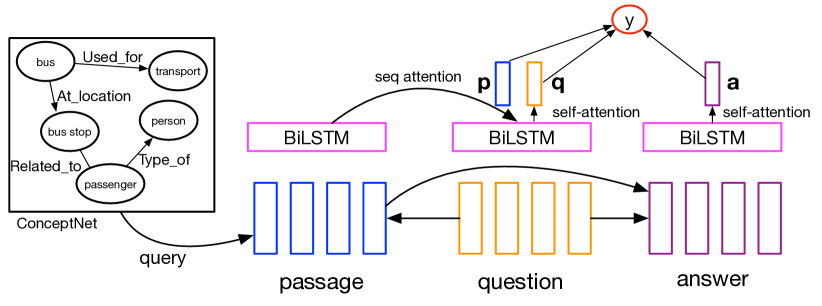
- The model uses a three-way attention mechanism to compute passage-aware question representations and answer-aware passage representations via sequence attention functions.
- Input representations combine GloVe embeddings, part-of-speech and named-entity embeddings, relation embeddings from ConceptNet, and handcrafted features like term frequency and co-occurrence.
- Relation embeddings are derived by querying ConceptNet for edges between words in the passage and words in the question or answer.
- BiLSTM layers are applied to concatenated representations to model sequential dependencies across passage, question, and answer.
- The system employs pretraining on the RACE dataset to improve generalization and reduce overfitting on the smaller SemEval-2018 dataset.
- An ensemble of models is used to improve final performance, achieving 83.95% accuracy on the official test set.
Experimental results
Research questions
- RQ1How effective is three-way attention in modeling interactions between passage, question, and answer in commonsense reading comprehension?
- RQ2To what extent do relation embeddings from ConceptNet improve performance on commonsense comprehension tasks?
- RQ3Does pretraining on external reading comprehension datasets like RACE enhance performance on low-resource benchmarks?
- RQ4How do different input representation components (e.g., POS, NER, handcrafted features) contribute to model accuracy?
- RQ5Why do deeper TriAN models underperform shallower ones on this dataset, despite deeper models typically performing better on larger datasets?
Key findings
- The TriAN model with pretraining achieves 83.95% accuracy on the official SemEval-2018 Task 11 test set, placing it near the state-of-the-art.
- Pretraining on the RACE dataset leads to a 1.13% improvement on the test set compared to training from scratch, indicating strong benefits for data-scarce settings.
- Relation embeddings from ConceptNet contribute approximately 1% accuracy gain, demonstrating their value in commonsense reasoning.
- Removing individual attention mechanisms (passage-question, passage-answer, question-answer) has minimal negative impact, but removing all attention reduces performance by 1.3% on the test set.
- A 1-layer TriAN model outperforms a 2-layer version, suggesting that deeper architectures overfit on the small training set despite their expressiveness.
- Handcrafted features and named-entity embeddings slightly improve performance, while part-of-speech embeddings have a modest positive effect.
Read this paper
Open the full text in the Nubint reader and ask about any passage as you read.
Read this paper on NubintThis review was generated by AI from the original paper. Please check the paper before citing it.